•
•
•
•
•
•
•
•
•
•
•
•
•
•
•
•
•
•
•
•
•
•
•
•
•
•
•
•
•
•
•
•
•



After the holiday, the stock market is expected to enter a sensitive phase as the VN-Index approaches the previous high. Liquidity is weakening and profit-taking pressure is rising, which may lead to diverging price moves depending on the strength of cash flow and macro factors.
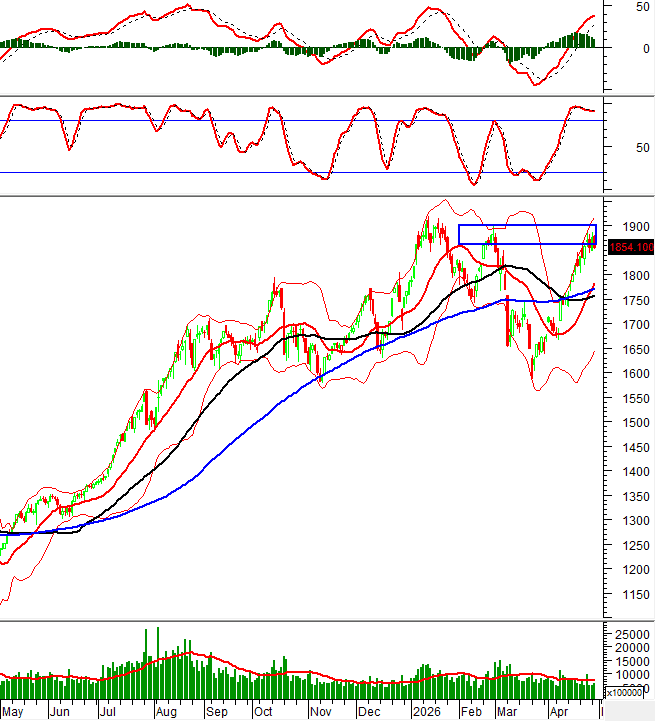
April’s market performance reflected investors’ expectations that Vietnam would strengthen its position on the international financial map. In the first week of the month, the VN-Index hovered around 1,670 points before surging after FTSE Russell’s upgrade on April 8. By April 29, the VN-Index traded around 1,854 points, edging closer to the old high while profit-taking emerged ahead of the long holiday.
Despite strong gains, liquidity deteriorated. The average daily trading value in April was about 24.3 trillion dong per session, down 20% from March. The article attributes part of this decline to higher deposit rates, which rose to 8–9%, and up to 10% for some longer tenors, encouraging some funds to return to savings.
Foreign investors continued to net-sell in April, though the pace slowed versus March. Net selling in April was around 14 trillion dong, compared with nearly 18 trillion dong in March.
In terms of sectors, banks and blue chips—particularly the Vingroup-related group such as VIC and VHM, along with stocks including STB and TCB—led the gains and contributed more than half of the index rise. VIC and VHM alone contributed up to 150 points.
The real estate segment showed clearer divergence. Large-cap names faced profit-taking, while midcaps such as NVL, DXG, and DIG attracted funds, supported by shareholder meeting-related narratives. Meanwhile, money flowed out of the energy group after its earlier rally, and the public-investment sector remained flat as disbursement progress did not deliver a breakthrough.
SHS analysts said the VN-Index’s short-term trend remains up, with key support around 1,820 points. However, as the index nears the 1,890–1,900 resistance area, selling pressure may increase—especially from the Vingroup stock group after the rally.
After five weeks of gains from around 1,600 points, the market faces a risk of forming a short-term peak and could retreat toward the support area.
April also coincided with the shareholder meeting season and the release of Q1 2026 results, prompting investors to reassess corporate valuations and growth prospects. Looking ahead to May, macro factors such as inflation, exchange rates, and oil price movements are expected to have greater influence amid Middle East tensions.
Nhất Việt (VFS) analysts suggested using technical pullbacks to deploy into leading stocks, especially those likely to be added to the FTSE Russell index basket or domestic leaders with attractive valuations. VFS recommended maintaining stock exposure at 60–70% and staying cautious about stocks that have risen due to “Sell in May” pressures following Q1 results.
The article also presented two scenarios for the market after the holiday:
Overall, after a strong rally, the market appears to be in a phase of “reassessing expectations.” Cash flow has not fully exited, but it is becoming more selective—creating opportunities for long-term investors while also increasing the risk of short-term correction that requires strict risk management.
Premium gym chains are entering a “golden era” that is ending or already in decline, as rising operating costs collide with shifting consumer preferences toward more flexible, community-based ways to exercise. Long-term memberships are shrinking, margins are pressured by higher rents and facility expenses, and competition from smaller, more personalized…