•
•
•
•
•
•
•
•
•
•
•
•
•
•
•
•
•
•
•
•
•
•
•
•
•
•
•
•
•
•
•
•
•


VN-Index regained upward momentum and moved toward the upper Bollinger Band. However, trading volume continued to fall sharply below the 20-session average, pointing to cautious investor sentiment. In addition, the Stochastic Oscillator issued a negative signal in the overbought area, suggesting that a pullback could emerge in the next sessions.
The major indices closed mixed on 20/04/2026. The VN-Index rose 1.1% to 1,837.11 points, while the HNX-Index fell 1.03% to 257.33 points.
Trading activity remained subdued. On HOSE, total volume declined 8.1% to just over 581 million shares. On the HNX floor, nearly 41 million shares were traded, down 35.3% versus the previous session.
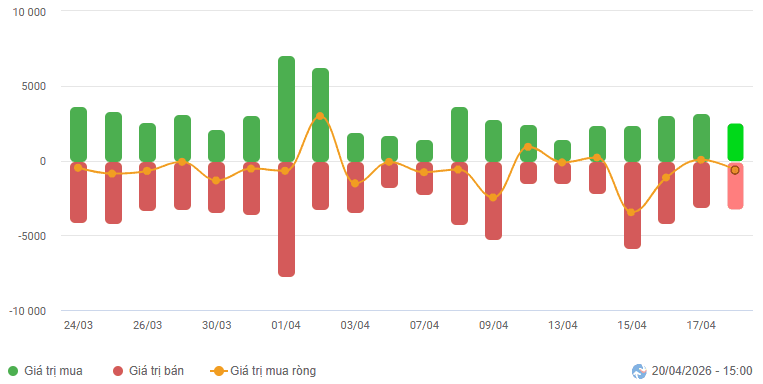
Foreign investors net sold on both exchanges, with net selling of around VND 615 billion on HOSE and VND 27 billion on HNX.
VN-Index saw notable fluctuations early in the session, driven largely by volatility in heavyweight stocks. Pressure from an early correction in the Vingroup group pushed the index toward the 1,800 level, but buying demand returned later, allowing VN-Index to rebound from mid-morning. The market remained polarized but leaned more positively as gains widened in the afternoon, and the index closed near the day’s high at 1,837.11.
In terms of market capitalization, VS-LargeCap led the index’s gains. VS-MidCap rose more positively (+0.7%), while VS-SmallCap increased slightly (+0.12%).
Impact on VN-Index: The top 10 stocks with the most positive contribution added nearly 20 points to the VN-Index, with VHM and VIC accounting for almost 14 points. On the downside, BSR, GAS, and GVR exerted the largest downward pressure, but together they trimmed about 1.43 points from the index.
The VN30-Index rose 20.93 points (+1.05%) to 2,009.04 points. Market breadth favored buyers with 19 gainers, 7 losers, and 4 unchanged. VHM led with a strong surge, followed by VPL, VRE, and HDB, each rising by more than 2.5%. On the downside, DGC faced the heaviest pressure, down 2.6%.
Sector-wise: Real estate led the market with a 2.6% gain, supported by contributions from VHM (limit up), VIC (+1.65%), VRE (+2.97%), and BCM (+2.87%).
Industrials and financials also contributed positively. Several stocks attracted strong demand, including GEE hitting a daily limit, GEX (+5%), CTD (+5.33%), BMP (+3.85%), TOS (+4.16%), HCM (+3.52%), HDB (+2.67%), SSI (+1.4%), TCB (+1.09%), and VCB (+1.01%).
Meanwhile, some stocks declined, including VJC (-1.41%), HVN (-0.44%), GMD (-0.54%), VEF (-1.65%), SGP (-3.16%), VPB (-0.71%), MBB (-0.38%), MSB (-1.58%), VBB (-3.57%), BVB (-2.33%), and BSI (-1.36%).
In the energy group, performance was weaker as a broad-based retreat occurred. Notable declines included BSR (-2.06%), PLX (-1.25%), PVS (-1.03%), PVD (-1.35%), OIL (-0.68%), and PVT (-0.92%).
VN-Index moved higher toward the upper Bollinger Band again, but volume remained well below the 20-day average, indicating ongoing caution among investors. The Stochastic Oscillator turned negative in the overbought region, implying potential pullbacks in the near term.
On the HNX side, the HNX-Index reversed after testing the 200-day SMA. Trading volume dropped sharply and stayed below the 20-day average for six consecutive sessions. The Stochastic Oscillator also turned negative in the overbought region; if it continues to weaken and exits this area in upcoming sessions, short-term risk is expected to rise.
Smart money movement: The Negative Volume Index for the VN-Index crossed above the 20-day EMA. If this condition persists into the next session, the risk of a downside thrust is expected to be limited.
Foreign money flow: Foreign selling continued on 20/04/2026. If this trend continues, downside pressure could intensify in subsequent sessions.

Premium gym chains are entering a “golden era” that is ending or already in decline, as rising operating costs collide with shifting consumer preferences toward more flexible, community-based ways to exercise. Long-term memberships are shrinking, margins are pressured by higher rents and facility expenses, and competition from smaller, more personalized…