•
•
•
•
•
•
•
•
•
•
•
•
•
•
•
•
•
•
•
•
•
•
•
•
•
•
•
•
•
•
•
•
•


On 21/04/2026, the VN-Index reversed intraday late in the session when testing the February 2026 high area (around 1,860–1,900 points). The Stochastic Oscillator continued to weaken after issuing a negative signal in the overbought zone, suggesting that if the indicator falls out of this zone in the coming sessions, short-term risk could increase.
Major indices declined across the session. The VN-Index fell 0.2% to close at 1,833.48 points, while the HNX-Index slipped 1.58% to 253.27 points.
On HOSE, the matched trading volume rose 29.2% to 751 million shares. On the Hanoi Stock Exchange (HNX), trading volume also increased sharply, reaching more than 65 million shares, up 60.4% from the previous session’s low.
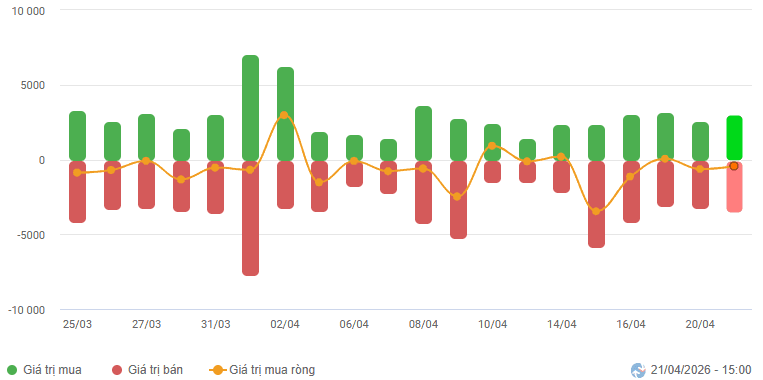
Foreign investors remained net sellers, with net selling value of more than VND 384 billion on HOSE and nearly VND 47 billion on HNX.
VN-Index moved above 1,850 points early in the session on 21/04/2026, but the market followed a “green on the outside, red on the inside” pattern. The index’s upside was mainly supported by the Vingroup group, while selling pressure dominated the rest of the market. As this support weakened, VN-Index lost momentum and closed at 1,833.48, after giving up gains of about 29 points at the morning peak.
By market capitalization, downside pressure became more evident: VS-LargeCap declined 0.22% and VS-MidCap fell 0.63%. VS-SmallCap, however, rose moderately by 0.27%.
In terms of contribution, VIC remained the main support, contributing 4.5 points to VN-Index. STB, LPB and VHM added nearly 3 more points. Toward the close, selling pressure broadened and prevented a green finish. VCB, VPB, FPT and VPL were among the biggest laggards.
VN-Index reversed toward the end of the session while testing the old February 2026 peak area (around 1,860–1,900 points). The Stochastic Oscillator remained weak after a negative signal in the overbought region. If the indicator drops out of this area in the next sessions, short-term risk is expected to rise.
HNX-Index continued to correct with a long red candle and returned to test the 50-day and 100-day simple moving averages (SMAs). Near-term risk increased as the Stochastic Oscillator had already issued a negative signal in the overbought region, while MACD narrowed its distance from the Signal line.
By the close, the market recorded 105 gainers, 131 decliners, and 30 unchanged. The provided content also indicated that foreigners returned to net buying with total net purchases reaching “...”, but the figure was not fully available in the source text.





Premium gym chains are entering a “golden era” that is ending or already in decline, as rising operating costs collide with shifting consumer preferences toward more flexible, community-based ways to exercise. Long-term memberships are shrinking, margins are pressured by higher rents and facility expenses, and competition from smaller, more personalized…




