•
•
•
•
•
•
•
•
•
•
•
•
•
•
•
•
•
•
•
•
•
•
•
•
•
•
•
•
•
•
•
•
•


VN-Index ended 23/04/2026 higher, closing at 1,870.36 points, up 0.7%, while the HNX-Index fell 0.83% to 253.23 points. Trading activity rose sharply on both exchanges, but foreign investors remained net sellers, with the largest outflows concentrated on HOSE.
Major indices finished mixed. VN-Index gained 0.7% to 1,870.36 points, whereas HNX-Index declined 0.83% to 253.23 points.
Liquidity also increased. On HOSE, total matched volume surged 69.5% to over 953 million shares. On HNX, more than 62 million shares were traded, up 47.5% versus the previous session.
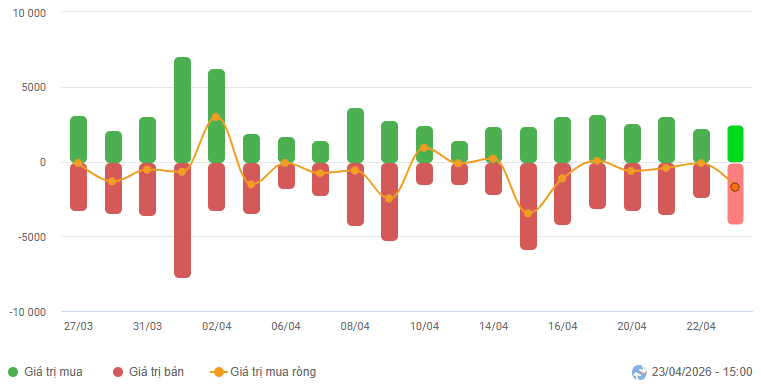
Foreign investors sold net more than 1.6 trillion VND on HOSE and 43 billion VND on HNX.
VN-Index opened the session in positive territory as buying pressure focused on VIC and banking stocks, pushing the index toward the 1,890 level. However, the index later retreated toward the old peak as red stocks dominated the broader market. Selling pressure increased in the afternoon and spread across many sectors, but heavyweight support helped keep VN-Index in the green at the close.
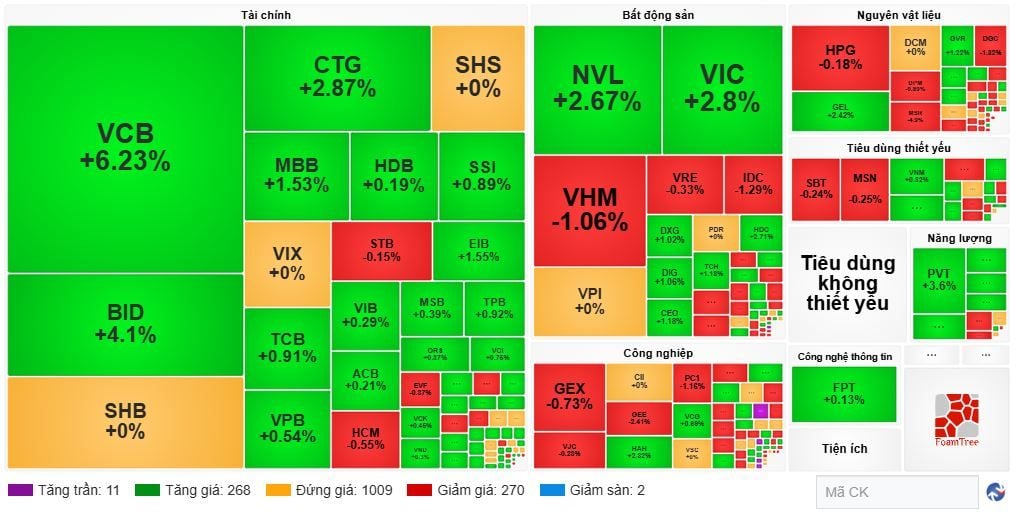
VIC was the key contributor, adding more than 12 points to the index. Leading banks also supported performance, with VCB, BID, and CTG contributing about 9.4 points in total.
On the downside, VHM, BSR, and HPG were the largest negative contributors, collectively taking almost 3 points off the index.
Sector results showed a split between leading groups and broader declines. Real estate and financials were the main supporters of gains, rising 1.46% and 1%, respectively. Within real estate, VIC (+3.52%), NVL (+2.4%), TCH (+1.18%), and HDC (+1.36%) led. In financials, VCB (+5.72%), BID (+3.35%), and CTG (+1.72%) helped lift the group.
Despite the support from leading names, several stocks in these sectors still fell, including VRE (-3.01%), IDC (-1.08%), DXG (-1.36%), and NLG (-1.76%) in real estate, and SHB (-2.63%), VIX (-1.17%), STB (-1.65%), HCM (-1.65%), EIB (-1.1%), and EVF (-4.8%) in financials.
Energy was the weakest sector, with declines driven by BSR (-3.66%), PVS (-1.58%), OIL (-2.67%), and PVD (-0.78%). Materials and consumer discretionary also lagged, with many names down more than 1%, including HPG, MSR, KSV, DCM, DGC, DPM, NTP, DDV, MWG, FRT, PNJ, DGW, and VVS.
Still, there were some positive exceptions, including CTD in industrials, SAB in consumer staples, and PVT in energy.
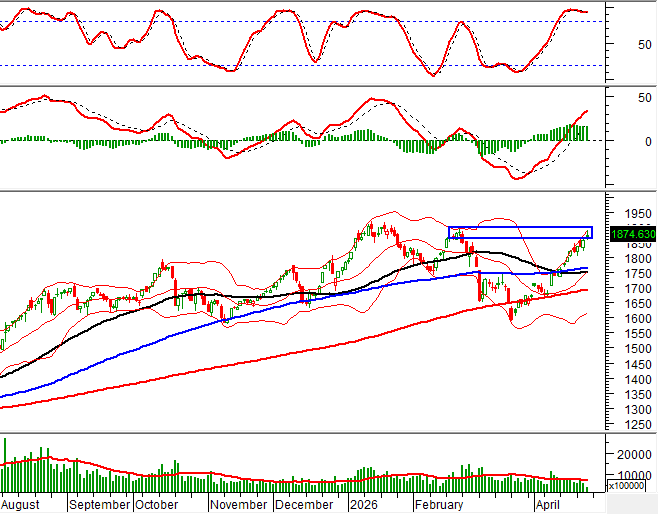
VN-Index formed a High Wave Candle pattern, suggesting the index is in a strong consolidation phase as it tests the old February 2026 peak (around 1,860–1,900 points). Short-term volatility is expected to continue as the Stochastic Oscillator weakens after issuing a negative signal.


Money flow analysis indicated that the Negative Volume Index for VN-Index is above the 20-day EMA. If this condition persists into the next session, the risk of a sudden downward thrust is expected to be limited.

Foreign selling continued on 23/04/2026. If foreign investors maintain this behavior in upcoming sessions, downside pressure may increase.


The Economic & Market Strategy Analysis Department, Vietstock Advisory, provided the market overview. Additional market commentary and linked analyses are available on the Vietstock site.
Note: This section provides a concise encapsulation of the daily market dynamics and does not substitute for full market data or official disclosures.
Premium gym chains are entering a “golden era” that is ending or already in decline, as rising operating costs collide with shifting consumer preferences toward more flexible, community-based ways to exercise. Long-term memberships are shrinking, margins are pressured by higher rents and facility expenses, and competition from smaller, more personalized…