•
•
•
•
•
•
•
•
•
•
•
•
•
•
•
•
•
•
•
•
•
•
•
•
•
•
•
•
•
•
•
•
•


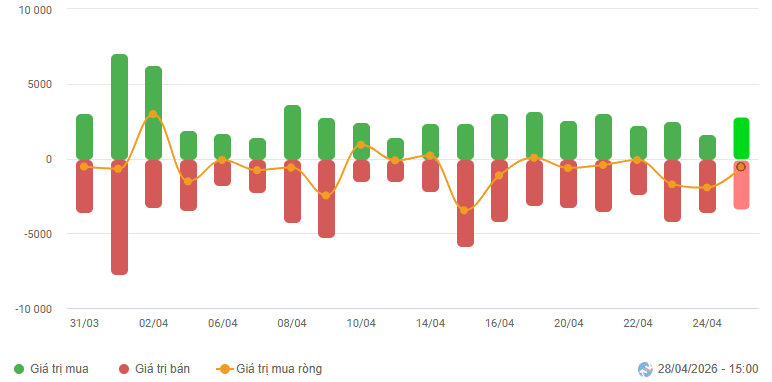
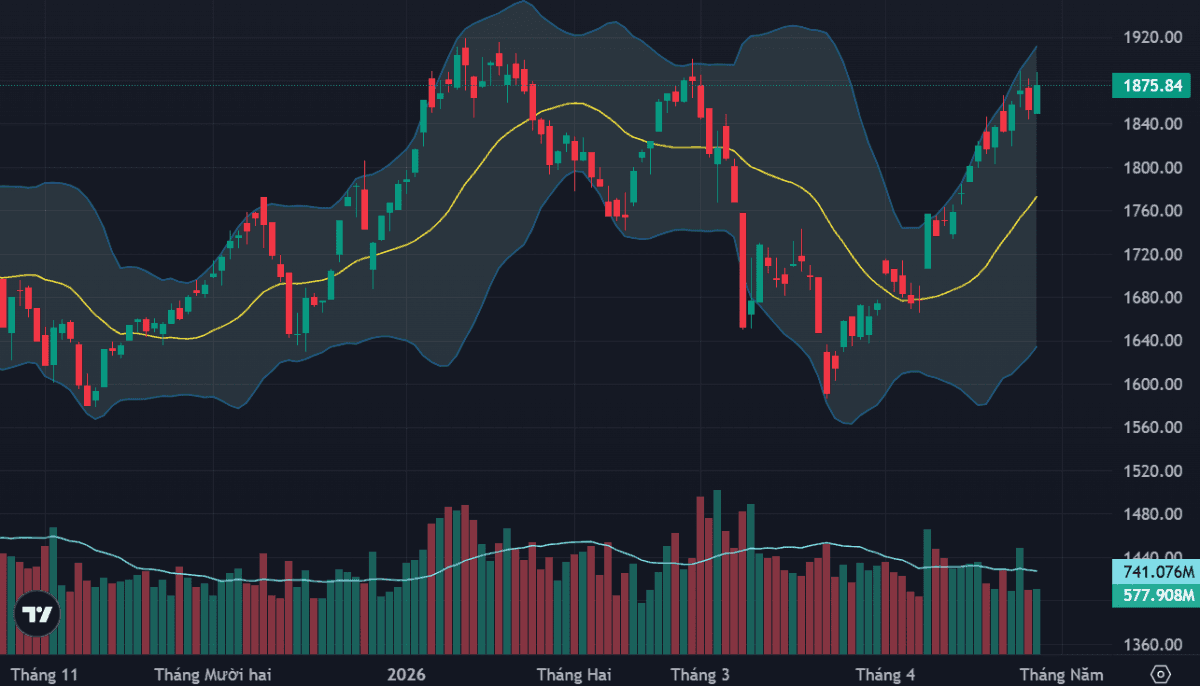
On 28 April 2026, the VN-Index regained its uptrend and continued testing the high from February 2026 (around 1,860–1,900 points). Trading volume stayed below the 20-day average, suggesting investors remained cautious in the near term.
The major indices closed mixed. The VN-Index rose 1.22% to 1,875.84 points, while the HNX-Index fell 1% to 249.44 points.
The VN-Index resumed its uptrend on 28/04, supported mainly by heavyweight stocks and staying above the 1,870 level for most of the session. However, market breadth remained uneven, as many stocks did not participate in the index’s rise. Liquidity was weak amid a holiday mood, leaving rallies vulnerable to pullbacks as profit-taking pressure increased at higher price levels.
By market-cap, VS-LargeCap rose 1.26%, leading the index, while VS-MidCap and VS-SmallCap fell 0.2% and 0.39%, respectively, reflecting continued downside pressure on many mid- and small-cap stocks.
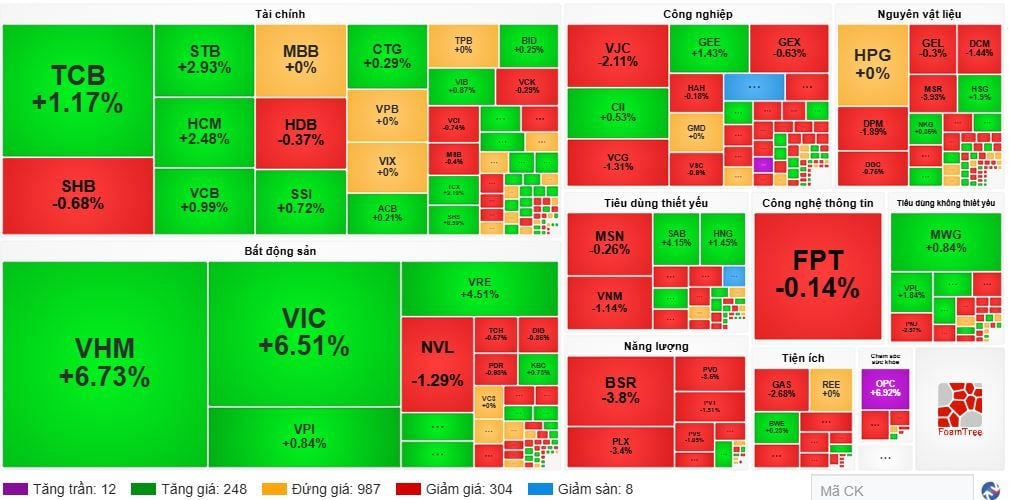
In terms of impact, the 10 most positively contributing stocks added over 38 points to the VN-Index, with VIC and VHM alone contributing 32.27 points. On the downside, GAS, BSR and VCB were the most negative contributors, collectively subtracting 5.26 points from the index.
The VN30-Index rose by 29.98 points (+1.49%) to 2,041.4 points, but breadth skewed toward sellers with 17 declines, 12 gains, and 1 unchanged. PLX hit the daily limit down, followed by GAS which fell 6.1%. Meanwhile, VHM and VRE surged, and VIC and STB also gained 6.3% and 4.9%, respectively.
By sector, real estate remained a bright spot, with several stocks rising sharply: VHM and VRE reached the ceiling, VIC up 6.32%, NVL up 5.4%, SSH up 4.73%, VPI up 2.01%, and TCH up 2.29%. The consumer discretionary group also showed strength in some names, including VPL up 3.44%, MWG up 2.51%, and FPT up 2.08%. However, many other stocks in these groups were under pressure, such as KSF down 2.47%, BCM down 1.11%, SJS down 4.24%, PNJ down 4.29%, HUT down 3.37%, TNG down 1.87%, and VVS down 6.98%.
On the downside, energy traded broadly weaker, with multiple stocks sharply lower: PLX hit the daily limit down and PVT also reached the daily limit down; BSR down 6.4%, PVS down 4.99%, OIL down 4.73%, PVD down 2.87%, PVC down 8.23%, and ALC down 2.09%. Utilities and telecom-related stocks also weakened, with several declines over 1%, including GAS, POW, REE, HDG, NT2, GEG, and DNW; VGI and VNZ were also among the laggards.
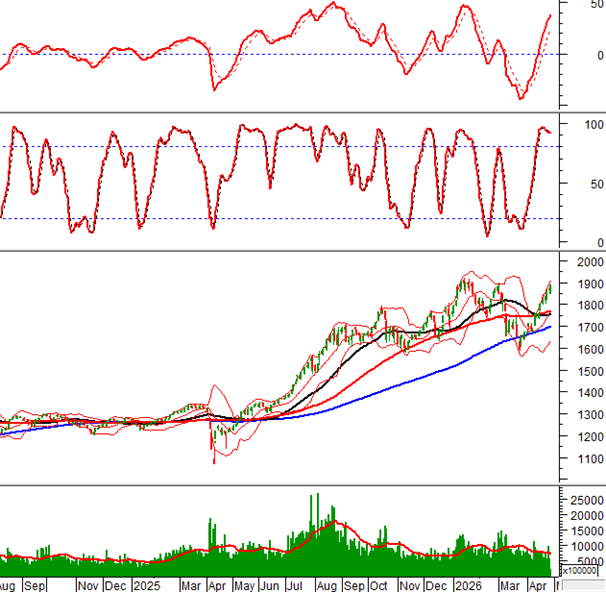
The VN-Index retraced and tested the old high from February 2026 (around 1,860–1,900 points). If the index breaks this resistance, the uptrend would be further reinforced. Trading volume below the 20-day average indicates investors remained cautious in the near term.
The HNX-Index fell for the third consecutive session and slipped below the Middle Band of Bollinger. Near-term risk was assessed as elevated as the Stochastic Oscillator continued to weaken and the MACD cut below the Signal line.
At the close of the session on 28/04/2026, the market had 116 advancing stocks, 112 declining stocks, and 38 stocks unchanged (reference). The foreign side returned to net buying, with total net buying reported as “…” in the source text.
Source note: Economic & Market Strategy Analysis Department, Vietstock Advisory (FILI), 17:21 28/04/2026.
Premium gym chains are entering a “golden era” that is ending or already in decline, as rising operating costs collide with shifting consumer preferences toward more flexible, community-based ways to exercise. Long-term memberships are shrinking, margins are pressured by higher rents and facility expenses, and competition from smaller, more personalized…