•
•
•
•
•
•
•
•
•
•
•
•
•
•
•
•
•
•
•
•
•
•
•
•
•
•
•
•
•
•
•
•
•


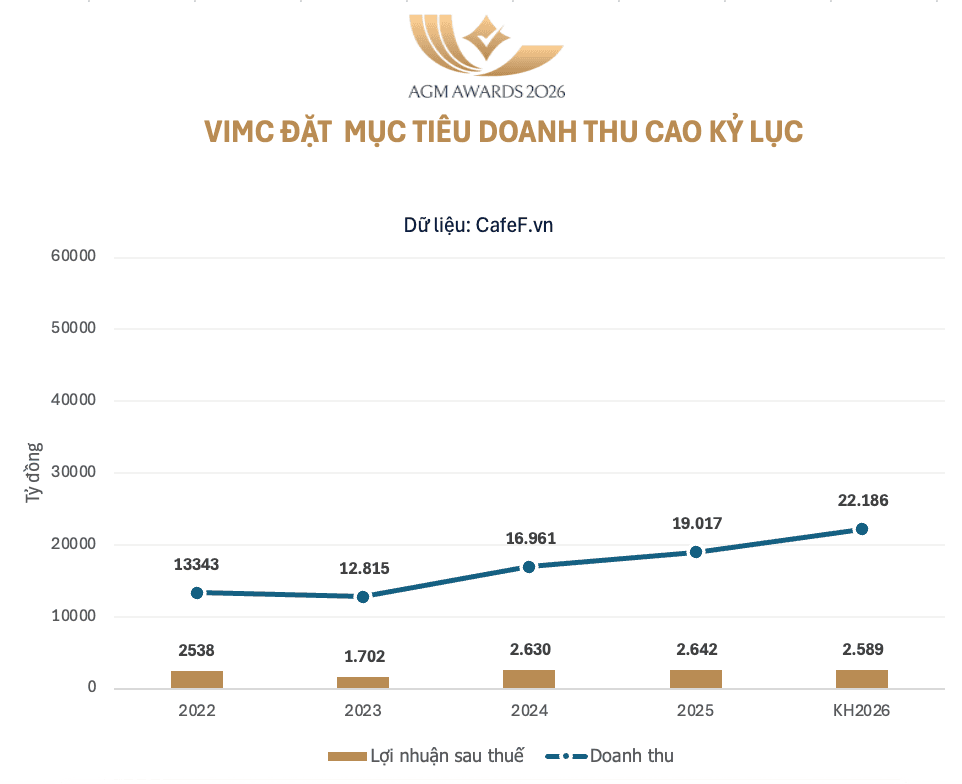
On the morning of April 15, 2026, Vietnam Maritime Corporation (VIMC – MVN) held its 2026 annual general meeting of shareholders and approved the 2026 business plan, targeting revenue of 22,186 billion dong and after-tax profit of 2,589 billion dong, up 8% and down 2% respectively from 2025.
In 2026, VIMC expects global conditions to remain volatile, with conflicts in the Middle East directly affecting the company’s operations. The company said fuel prices have surged to three times pre-war levels while freight rates have not improved meaningfully, pressuring fleet utilization.
VIMC also noted that the logistics and port services segments are affected. Management said it would maximize cost control as directed by the government. The company added that the Middle East conflict is altering energy and raw material trade flows, forcing many shipping lines to adjust routes.
In 2025, VIMC recorded revenue of nearly 19,017 billion dong, up 12% from 2024. Consolidated after-tax profit reached 2,642 billion dong, modestly higher than the previous year.
According to VIMC, the results were mainly influenced by rising geopolitical tensions and intensifying competition among major economies, while the global economy and trade recovered slowly, with demand and investment weakening.
VIMC also reported its plan to contribute capital to form a joint venture to invest in the Can Gio International Transshipment Port project in Can Gio district, Ho Chi Minh City. The company will establish the joint venture with Saigon Port Joint Stock Company and Terminal Investment Limited Holding S.A (TIL), with ownership stakes of 36%, 15% and 49% respectively.
Total capital VIMC is expected to contribute is 13,839 billion dong, divided into two phases. In the 2026–2030 phase, VIMC will contribute 4,156 billion dong. The remaining 9,683 billion dong will be deployed in the 2031–2045 phase. VIMC said the payback period from project operation is about 24 years.
Regarding container fleet oversupply, VIMC’s CEO said oversupply depends on the region. He noted that while fuel prices have risen to three times, freight rates cannot increase by as much as 30%, which he described as dangerous. He said if cost control cannot be achieved, it would become a long-term burden on the fleet.
As a response, VIMC said it will reshape routes, seek better contracts, and remain flexible in operations.
VIMC also said rising fuel costs are causing many fleets to incur losses, and management expects costs to stay high through the end of Q2. The company stated that shipping revenue typically accounts for about 30% of its total revenue, and that vessel charter rates are very high while transport costs do not rise accordingly.
“The issue we worry about is not Hormuz, but the Red Sea. If this sea route returns to normal, oversupply would rise by 20%, and freight rates would fall into a danger zone for large investors who have invested considerable capital in the sector. Therefore, we choose the timing of vessel investments very carefully,” the VIMC CEO said.
On shipping performance, the CEO said shipping revenue remains in check, but profits are difficult to forecast. He said cost control and operational flexibility are key, adding that this year will still be profitable but not as high as 2025.
Regarding the operation of Lạch port 3 and 4, the Chairman of the Board, Nguyen Canh Tinh, said that after one year of partial operation, business performance and exploitation have been in line with the plan.
On plans to reduce government ownership to ensure VIMC remains public, Nguyen Canh Tinh said the issue is not limited to VIMC and its subsidiaries, as many other groups after equitization face similar requirements. He said the law requires compliance and that regulations allow a one-year window to propose a plan.
He added that VIMC is preparing a plan to submit to the Ministry of Finance to reduce the ownership ratio. For subsidiaries, VIMC will review units in strategic development to consider reducing capital accordingly, while units not in the strategy may be fully divested. The list will be submitted to the Ministry of Finance as soon as possible.
On concerns about port oversupply and VIMC’s port advantages, the Chairman said each project is carefully calculated and that investing in ports in key areas remains aligned with broader trends. He said the trend of moving inland ports away from inland areas will be limited, and that ports will be expanded and relocated to larger, deeper-water facilities to accommodate large ships.
He said Can Gio Port, as a venture with the world’s largest shipping line, provides an advantage.
CEO Le Anh Son added that when ship oversupply occurs, the trend is to increase ship size, which increases demand for deep-water ports. He said ports that ensure productivity—supported by international-standard information systems and management—will benefit, and that VIMC’s ports have been upgraded to international standards. He said shipping lines will choose VIMC’s ports.
Regarding Can Gio specifically, VIMC said it aims to compete internationally in port operations, not only to accommodate ordinary ships. The company said it will compete with Singapore ports rather than domestic ones, with safety, efficiency, and environmental friendliness as key factors. VIMC said it will strive to develop Can Gio Port to an international standard while gradually reducing the share of river ports.




Premium gym chains are entering a “golden era” that is ending or already in decline, as rising operating costs collide with shifting consumer preferences toward more flexible, community-based ways to exercise. Long-term memberships are shrinking, margins are pressured by higher rents and facility expenses, and competition from smaller, more personalized…




