•
•
•
•
•
•
•
•
•
•
•
•
•
•
•
•
•
•
•
•
•
•
•
•
•
•
•
•
•
•
•
•
•


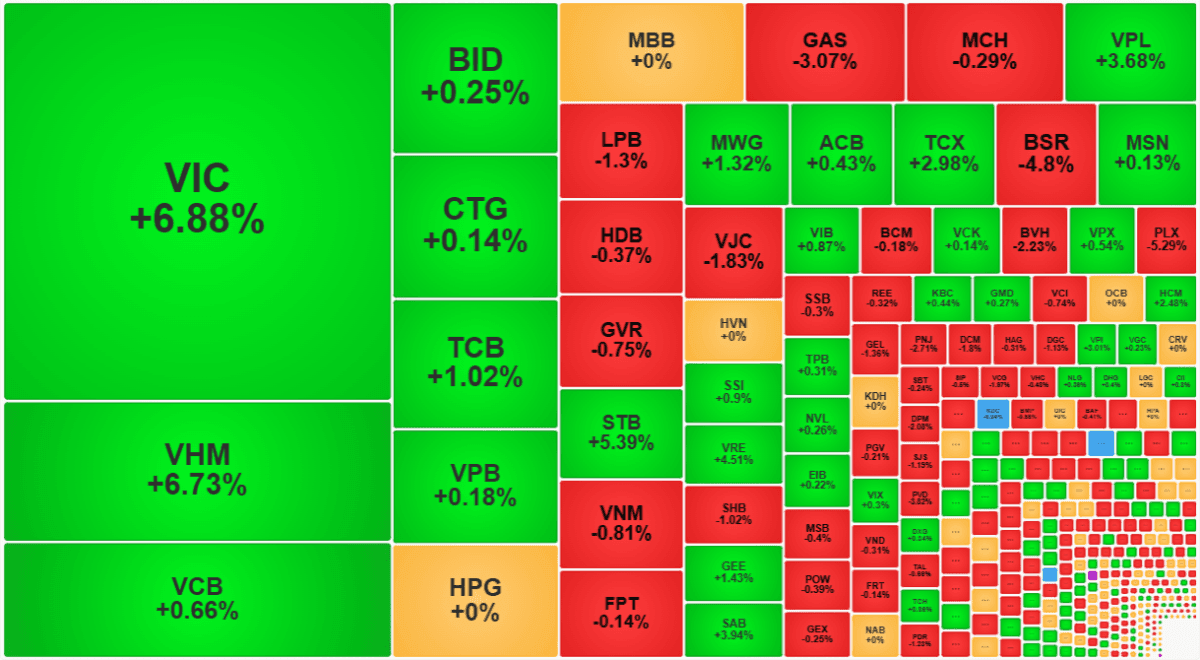
The VN-Index, supported by VIC and VHM, continued to push toward the 1,900-point mark, with the morning session closing up 1.77% (about 32.76 points). Market breadth was positive, but real strength remained concentrated in a limited set of stocks, led by the two “pillar” names.
VIC rose 6.88% and VHM gained 6.73%, together contributing nearly 34 points to the VN-Index. VIC continued to set new all-time highs, while VHM attempted to break through resistance at its historical peak.
Cash flow also concentrated heavily in the two pillars: VHM led the market with net buying of 761.9 billion, followed by VIC with 652.7 billion. Combined, the two pillars accounted for about 19.1% of total matched value on HoSE.
Outside VIC and VHM, several VN30 blue chips posted gains but were not strong enough to act as additional “pillars.” They included STB (+5.39%), VRE (+4.51%), SAB (+3.94%), VPL (+3.68%), MWG (+1.32%), and TCB (+1.02%).
The VN-Index temporarily closed above the February peak at 1,886.05 points. The report noted that if other blue chips remain stable and VIC and VHM continue to be pulled higher, the likelihood of the index reaching the 1,900-point region before the holiday was considered feasible.
However, the market’s broader response was limited. HoSE breadth showed 120 gainers and 170 decliners. Among the 120 rising stocks, only 48 gained more than 1%; among the 170 falling stocks, only 73 fell more than 1%. Most stocks continued to trade in a narrow range.
Downside pressure was described as contained, with GAS the only pillar down 3.07%. Other decliners with limited impact included PLX (-5.29%), VJC (-1.83%), and DGC (-1.13%).
Liquidity showed little enthusiasm. Only 15 stocks rose by 1% or more and traded above 10 billion dong, with VIC, VHM, and a few other blue chips accounting for most turnover.
Notable turnover names included VPI (263.8 billion), HCM (110.8 billion), GEE (68.8 billion), TCX (44.8 billion), HSG (30 billion), PVP (12.5 billion), and PET (11.6 billion).
On the downside, around 20 stocks fell more than 1% with turnover above 10 billion. PC1 stood out as it lost liquidity for the second consecutive session, trading only 25.8 billion (1.23 million shares) at the floor price, while sell-side volume still had 20.3 million shares. PC1 has fallen back to the December low, with no sign of demand appearing.
Turnover on the two HoSE exchanges declined by about 4% from the prior session to 7,656 billion excluding matched trades, consistent with a cautious market ahead of the long holiday. The report also noted that the market trades only two sessions this week.
Foreign investors unexpectedly increased net buying on HoSE by about 59% versus the prior session, totaling 1,109 billion. As a result, the net position narrowed to minus 118 billion.
Most net selling was concentrated in FPT at minus 156.9 billion. Other notable net sellers included SHB (minus 46.9 billion), ACB (minus 38.8 billion), and BSR (minus 36.8 billion).
On the buy side, foreign investors bought VIC (+146.3 billion), VHM (+74.7 billion), VRE (+66 billion), SSI (+44.6 billion), and MWG (+40 billion).
The report cited a need to pause and reallocate funds from the Vingroup group to other sectors. It also referenced the PYN Elite fund: its five largest holdings (accounting for 47% of portfolio weight) posted average profit growth of 54%, but the fund’s overall performance remained heavily negative.
On global markets, U.S. stocks continued to hit records even as oil rose to a three-week high. Gold prices fell below 4,700 USD per ounce, while SPDR Gold Trust continued selling. The report added that foreign investors sold 4.69 trillion dong last week ahead of the holiday break, with outflows of 3,419.9 billion on spot trading.





Premium gym chains are entering a “golden era” that is ending or already in decline, as rising operating costs collide with shifting consumer preferences toward more flexible, community-based ways to exercise. Long-term memberships are shrinking, margins are pressured by higher rents and facility expenses, and competition from smaller, more personalized…