•
•
•
•
•
•
•
•
•
•
•
•
•
•
•
•
•
•
•
•
•
•
•
•
•
•
•
•
•
•
•
•
•
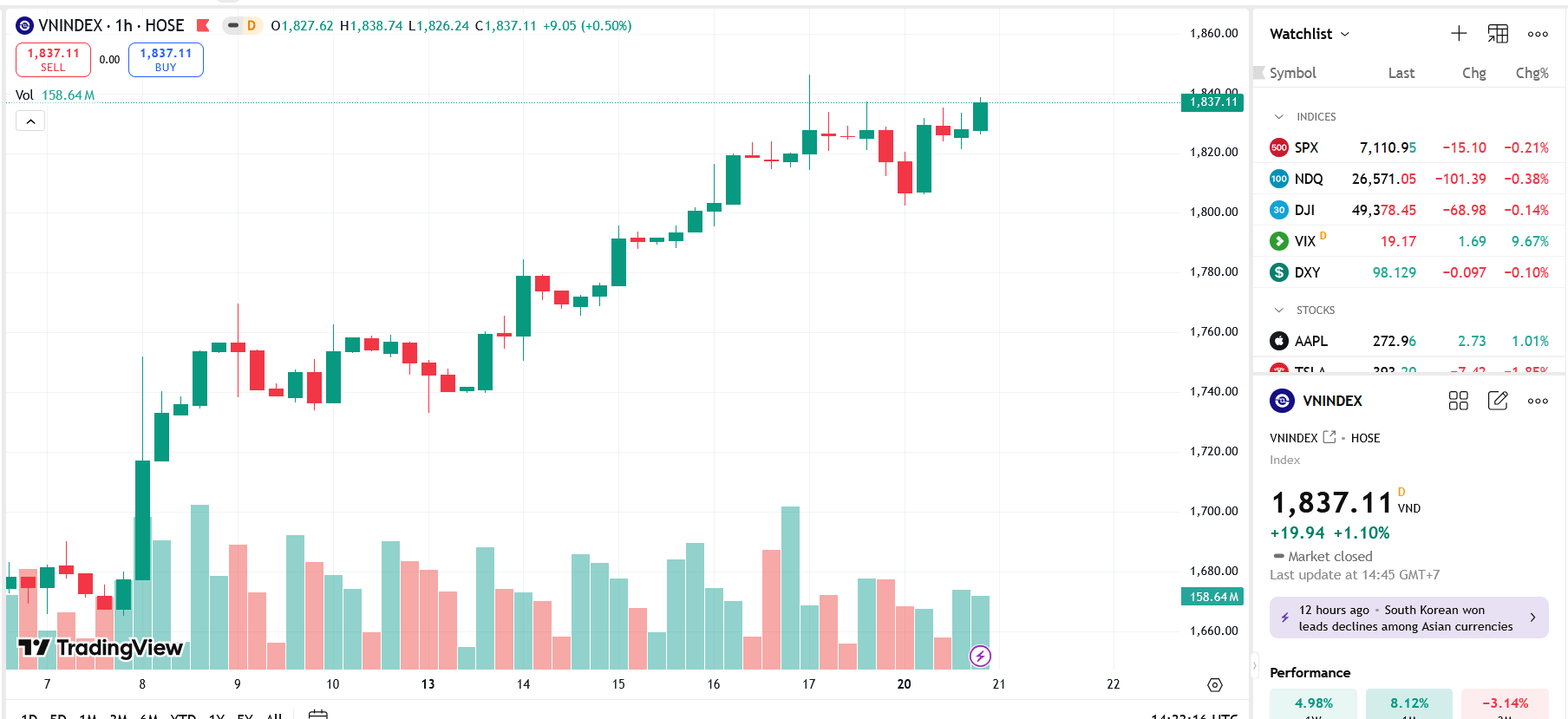
The Vietnamese stock market traded in wide ranges amid a lack of consensus, with cash flow differentiating as investors pursued short-term profits. The VN-Index closed up 19.94 points, or 1.1%, at 1,837.11, while the HNX-Index fell 2.67 points, or 1.03%, to 257.33. After the VN-Index rose for four consecutive weeks, pressure for volatility and a potential correction began to emerge.
Brokerage commentary highlighted that the market’s trading range was broad, with capital flows tending to split as investors focused on short-term gains. BVSC said it expects pullback pressure to be limited, with large-cap stocks continuing to support the index. It also noted that performance across other stock groups is likely to remain highly differentiated based on Q1 results and information from annual shareholder meetings.
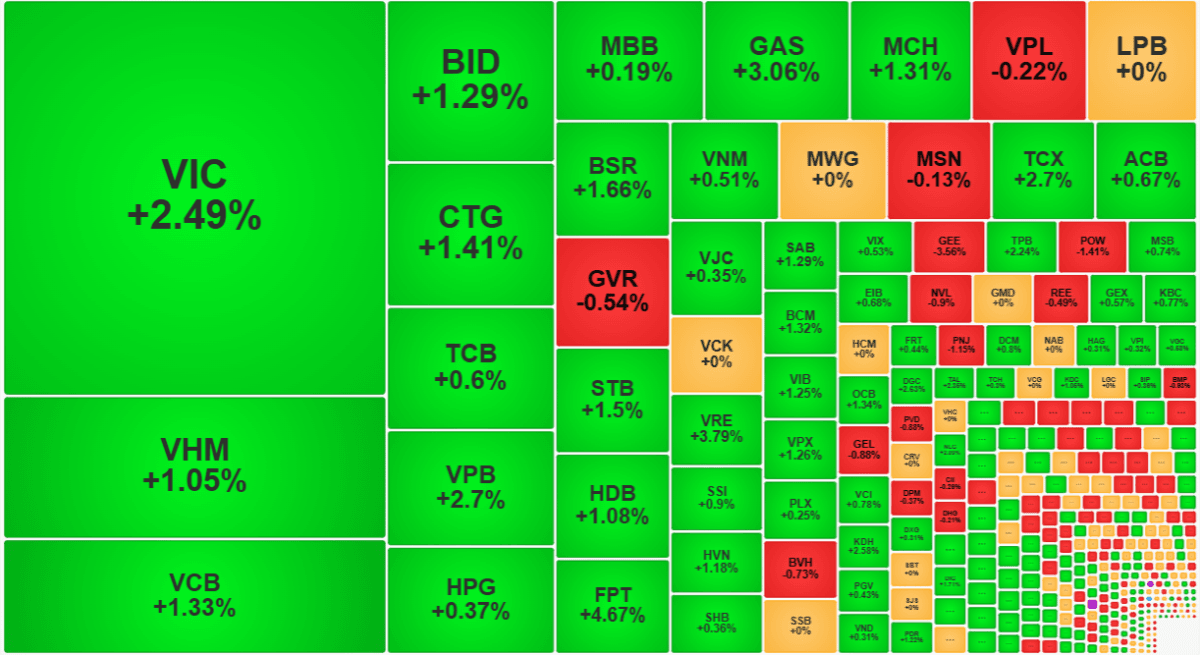
Another view emphasized that the market needs time to stabilize. VinGroup-related stocks continued to lead the session, helping the VN-Index close nearly 20 points higher than the previous session. Market breadth was fairly balanced, with 13 out of 18 sectors advancing. Industrials and Real Estate rose by more than 2.5%, while Oil & Gas and Chemicals declined the most.
Foreign investors were net sellers on both HSX and HNX, and net buyers on UPCOM. Despite the advance, liquidity was described as cautious, with trading characterized by wide ranges and money flow not yet broadly spreading beyond leading names.
Several brokerages pointed to VinGroup as the main driver. TVS said buying demand concentrated mainly in VinGroup stocks (VHM and VIC), lifting the index back after an earlier morning decline and sustaining the advance into the close. SHS also linked the market’s rise to leading market stocks, while noting that liquidity declined over the last two sessions.
One factor cited for cautious sentiment was geopolitical uncertainty: the US–Iran ceasefire is expected to expire on April 22, while tensions in the Hormuz Strait persist. Investors were also advised to watch for upcoming information, including the release of Q1 2026 margin debt data from brokerages.
SHS said the VN-Index’s short-term trend has recovered from the psychological 1,800-point support and is moving toward around 1,850. It described the 1,850 area as a resistance zone tied to a trendline connecting the highest prices in January 2026 and February 2026, adding that there is currently no forecast of a breakout. In a positive scenario, a return to around 1,900 is possible. It also noted that the VN30 index has a similar resistance near 2,000, potentially extending toward the high of October 2025 around 2,050.
YSVN said the VN-Index is consolidating above the MA5 as liquidity eases, suggesting a consolidation phase. It expects the index to hold above 1,790–1,800 before continuing higher, supported by large-cap stocks maintaining positive momentum as the Q1 earnings season approaches. Its short-term strategy (less than one month) was to consider buying stocks in uptrends that pull back during sessions, prioritizing sectors leading the market such as Finance, Real Estate, and Retail.
VCBS described the session as ending with a pinbar candle, with most gains coming from several large-cap stocks such as VinGroup and banks. It said the VN-Index remains above MA20 on the daily chart, with the Tenkan line flattening and gradually recovering, and MACD still sloping upward. VCBS expected the index to trade with support at 1,820 and resistance at 1,880 in the near term, while warning of intraday volatility as RSI has entered overbought territory.
VCSC said the VN-Index continues to show a bullish signal as it moves above MA20 and MA50, keeping the potential to rise toward 1,900–1,920 points. It set a near-term target around 1,880, with short-term support near 1,810–1,815.
BVSC advised investors to maintain a balanced stock/cash ratio and take profits on short-term positions when the VN-Index approaches the resistance zone of 1,865–1,885 points or raise trailing stops to protect gains. Another brokerage view recommended trading cautiously and maintaining prudent allocation, focusing on stocks with solid fundamentals, leaders in strategic sectors, and sectors with strong growth in the economy.
SHS added that there is still potential for the VN-Index to return to around 1,900 points, while TVS maintained a cautious near-term view due to declining liquidity and advised investors to keep safe allocation and monitor upcoming sessions. VCBS suggested that money could rotate into more sectors in the coming sessions and recommended deploying gradually in sectors such as Banking, Infrastructure Spending, and Retail, while selecting stocks that hold above support.
Note: The market commentary from brokerage houses is provided for reference and may reflect conflicts of interest.

Bitcoin (BTC) investors who use steady dollar-cost averaging (DCA) may be underperforming versus strategies that adjust exposure to the market’s cycle, according to new research arguing that Bitcoin’s behavior differs from traditional long-duration assets.
In a report cited by Markus Thielen of 10x Research, Bitcoin’s market…