•
•
•
•
•
•
•
•
•
•
•
•
•
•
•
•
•
•
•
•
•
•
•
•
•
•
•
•
•
•
•
•
•


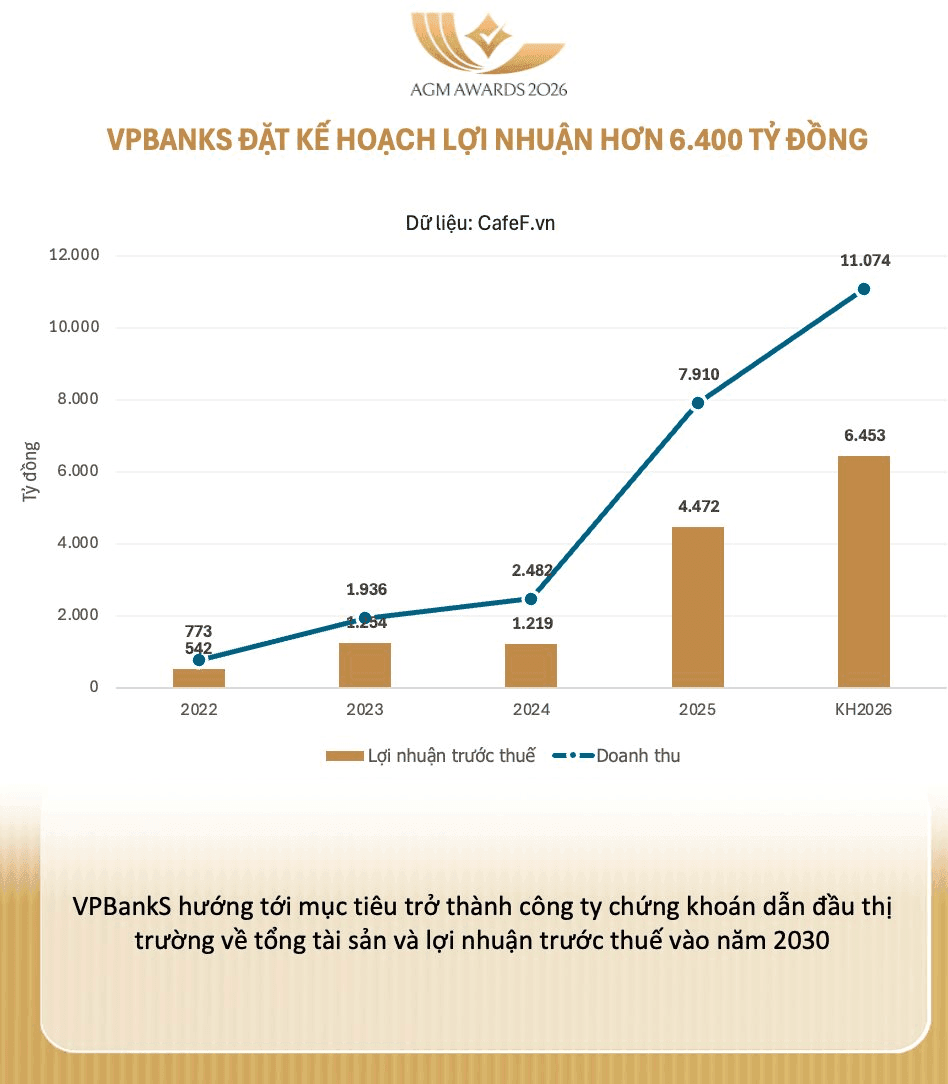
On the afternoon of April 20, VPBankS Securities Joint Stock Company (VPBankS) held its 2026 annual General Meeting of Shareholders (AGM), the first AGM since VPX was officially listed on the stock market.
At the meeting, the board proposed the 2026 business plan with total revenue of 11,074 billion dong, up 59% from 2025. Pre-tax profit is expected to reach a record 6,453 billion dong, up 44% year-on-year.
The plan is part of the company’s 2025–2030 growth strategy, which targets average annual growth of 32% and aims to position VPBankS among leading securities firms in the market.
VPBankS said its 2025 performance supports the 2026 targets. In 2025, revenue reached 7,910 billion dong, more than three times the 2024 figure. Pre-tax profit in 2025 was 4,476 billion dong, nearly four times the prior period and above the target.
Brokerage and margin lending remain the main growth drivers. The company targets an HOSE brokerage market share of 5% after entering the top 10 by the end of 2025.
For margin lending, the company projects 2026 average margin debt of about 49,485 billion dong, roughly double the prior year’s level.
In parallel, investment banking (IB) is identified as a strategic pillar, leveraging the parent bank’s ecosystem to expand debt issuance advisory and equity capital markets activities.
For the long-term strategy through 2030, VPBankS aims to lead the market in total assets and pre-tax profit, and to rank in the top 2 for market share in brokerage and investment banking. The company also set a compound annual growth rate of 32% and a CIR of 23–25%.
The AGM consolidated the Board of Directors for the 2022–2027 term with three members: Chair Hồ Thúy Ngà, Board member Nguyễn Lương Tân, and independent member Trần Ngọc Lan.
Shareholders asked about the feasibility of targeting margin debt of around 50,000 billion dong in 2026, noting that lending rates remain high and raising questions about funding availability and potential impacts on margin growth.
Management said the company ended 2025 with margin debt around 34,000 billion dong and targeted raising it to 50,000 billion by end-2026. As of the discussion, margin debt had exceeded 38,000 billion.
Management added that in Q1, interest rates rose, but the company continued to grow margin debt. It cited an advantage from raising nearly 13,000 billion dong of equity capital by end-2025, helping maintain competitive lending rates for margin borrowers.
On market liquidity, management said liquidity in Q1 remained high at around 35,000 billion dong per session, compared with about 29,000 billion dong per session in 2025. Despite a small net foreign outflow of around US$1 billion in Q1, market absorption remained solid, indicating improved market strength.
Looking ahead, management said it expects macro improvements to support liquidity and margin demand. Margin-rate volatility is viewed as temporary and not expected to hinder achieving the 2026 margin growth target. Management also said there is room for margin lending of roughly 30,000–33,000 billion dong, and that some peers may face tighter headroom, which could help VPBankS attract larger clients.
Management stated that the 50,000 billion dong margin target for 2026 is fully feasible.
Shareholders asked how the parent-bank ecosystem and partners would support VPBankS’s growth and leadership.
Management said the AGM is the first since the IPO and that the company has more than 9,000 shareholders. It described VPBankS as a relatively new securities firm with rapid growth, which it said is linked to its role within the VPBank ecosystem.
Management said the VPBank ecosystem has over 33 years of development, nearly 10 subsidiary companies, and serves nearly 4 million customers. It also said the strategic partner SMBC of Japan has supported the group over the past five years.
Management added that over the past two years, VPBankS mobilized hundreds of millions of USD from international markets, which it said would be difficult for a new firm without ecosystem credibility.
Going forward, management said VPBankS will continue shaping itself into an investment banking institution, expanding into capital markets activities, M&A, IPOs, asset management, and preparing to participate in new areas such as digital assets when conditions allow.
Shareholders asked whether equity investments would focus on proprietary trading or align with ECM advisory.
Management said equity investments are a strategic pillar. In 2025, VPBankS advised on ECM issuances worth about 20,000 billion dong, and in 2026 it aims to increase this to 28,000 billion dong for ECM.
Management said that in ECM/DCM activities, the core is capital scale and financial capacity because advisory typically includes guarantees and distribution, which helps grow market share. It also said the company plans to invest strategically in advisory firms based on understanding of financials, operations, and governance to structure deals safely and efficiently.
Management added that it maintains a flexible equity portfolio managed professionally, similar to mutual funds, using stock selection, capital allocation, and risk management to optimize returns and adapt to market conditions.
On digital assets, management said the government is clear about embracing new technologies, while noting that millions of Vietnamese trade digital assets on international exchanges but that activities are not yet fully regulated. Management said it supports building a safe and effective legal framework for the market.
Management said that over the past year, VPBankS prepared resources, systems, and infrastructure to participate when permitted. It said the company contributed to forming a crypto-asset exchange operating company with both domestic and international shareholders, including a major global blockchain technology group and a leading digital-asset exchange in Hong Kong.
Management said it will collaborate with these partners for technology and operating strengths while contributing domestic financial ecosystem advantages. It said the securities firm will participate not only as an investor but also as part of a platform enabling investors to access a broad range of assets.
Management also said it is finalizing the establishment of a fund management company to begin operations soon, and that together with securities, insurance, banking, and private banking services, VPBankS is building a comprehensive investment ecosystem with asset management as a key component.
Management affirmed that all activities prioritize safety, regulatory compliance, and alignment with government policy, and that once licensed, the company will move quickly on the prepared platform.
Shareholders asked for an assessment of current stock valuation.
Management said since listing in December, the stock price has risen to around 34,500 dong, above the IPO price of 33,900 dong, before correcting in subsequent months, a pattern management said is common in markets.
On valuation metrics, management said the stock trades at about P/B of 1.62x and P/E of 12.69x. It described this as relatively reasonable valuation with room for upside. Management also said sector peers average P/B of about 2.1x and P/E of about 14.74x, meaning VPBankS’s multiples are lower.
Based on this, and on the market’s positive outlook and long-term growth policies, management said it expects the stock price to better reflect the company’s value and growth potential in the near term.







Premium gym chains are entering a “golden era” that is ending or already in decline, as rising operating costs collide with shifting consumer preferences toward more flexible, community-based ways to exercise. Long-term memberships are shrinking, margins are pressured by higher rents and facility expenses, and competition from smaller, more personalized…




