•
•
•
•
•
•
•
•
•
•
•
•
•
•
•
•
•
•
•
•
•
•
•
•
•
•
•
•
•
•
•
•
•


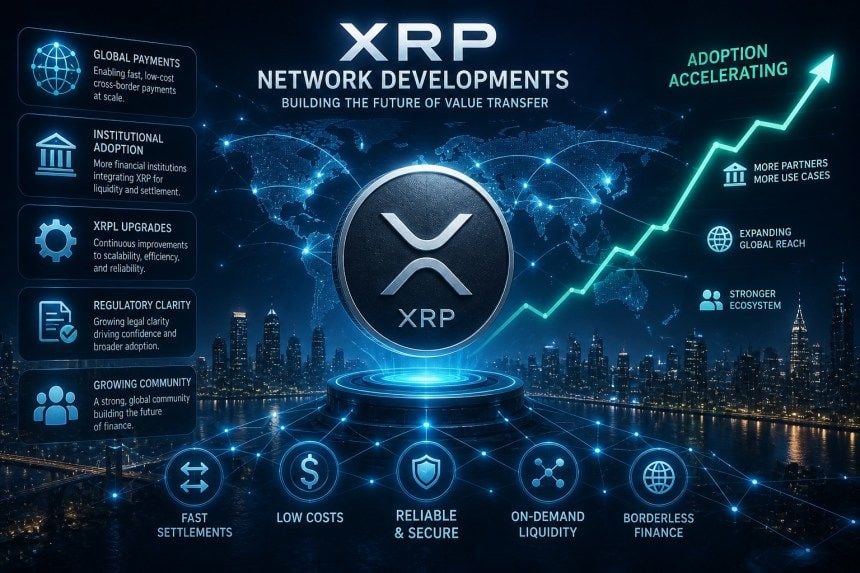
XRP holders are seeing measurable developments on the XRP Ledger that signal growing network activity and expanding real-world use cases. Recent data posted by crypto enthusiast @mrcauliman on X highlights several indicators that suggest the infrastructure supporting XRP is evolving in ways investors should monitor.
One of the clearest developments XRP holders should watch is the increasing activity on the XRP Ledger. Metrics highlighted by @mrcauliman show the network processed around 2.4 million transactions within 24 hours, while new ledgers closed at an average interval of about 3.9 seconds.
Beyond transaction numbers, the value of tokenized real-world assets (RWAs) on the ledger has been expanding. A key contributor is Ondo Finance, which has deployed around $323 million worth of tokenized assets onto the network. Additional projects, including Doppler Finance and OpenEden, have further increased the amount of traditional financial instruments represented on-chain.
Stablecoin adoption is also strengthening the ledger’s financial ecosystem. The total value of stablecoins circulating on the network has climbed to roughly $446 million, led by RLUSD, a stablecoin introduced by Ripple. Stable assets are important in blockchain finance because they provide liquidity and settlement stability for trading, payments, and decentralized finance applications.
Alongside increasing activity, new functionality is also being introduced to the XRP Ledger. Network participants are currently voting on amendments designed to enable native lending capabilities within the protocol. If approved, these changes would allow the ledger to support lending mechanisms directly on-chain, adding another financial layer to its existing payment and settlement features.
The amendment process reflects how upgrades are implemented on the network. Validators vote on proposed changes, and once a supermajority supports an amendment for a sustained period, the feature becomes active. According to the discussion highlighted by @mrcauliman, the current proposals are progressing through this governance process without disruption.
Another frequently highlighted advantage of the XRP Ledger is its energy efficiency. Unlike proof-of-work networks that require extensive computational resources, XRPL’s consensus model consumes very small amounts of electricity per transaction. Industry estimates often suggest that a single transaction on the network can use less energy than a typical online search, making it one of the more energy-efficient blockchain infrastructures currently operating.
Taken together—rising transaction volumes, increasing tokenized asset value, growing stablecoin liquidity, potential lending capabilities, and low energy consumption—the indicators point to infrastructure growth on the XRP Ledger. For XRP holders, these developments suggest the network is expanding beyond its original payment-focused use case, potentially influencing long-term demand for XRP as the ecosystem evolves.






Premium gym chains are entering a “golden era” that is ending or already in decline, as rising operating costs collide with shifting consumer preferences toward more flexible, community-based ways to exercise. Long-term memberships are shrinking, margins are pressured by higher rents and facility expenses, and competition from smaller, more personalized…