•
•
•
•
•
•
•
•
•
•
•
•
•
•
•
•
•
•
•
•
•
•
•
•
•
•
•
•
•
•
•
•
•


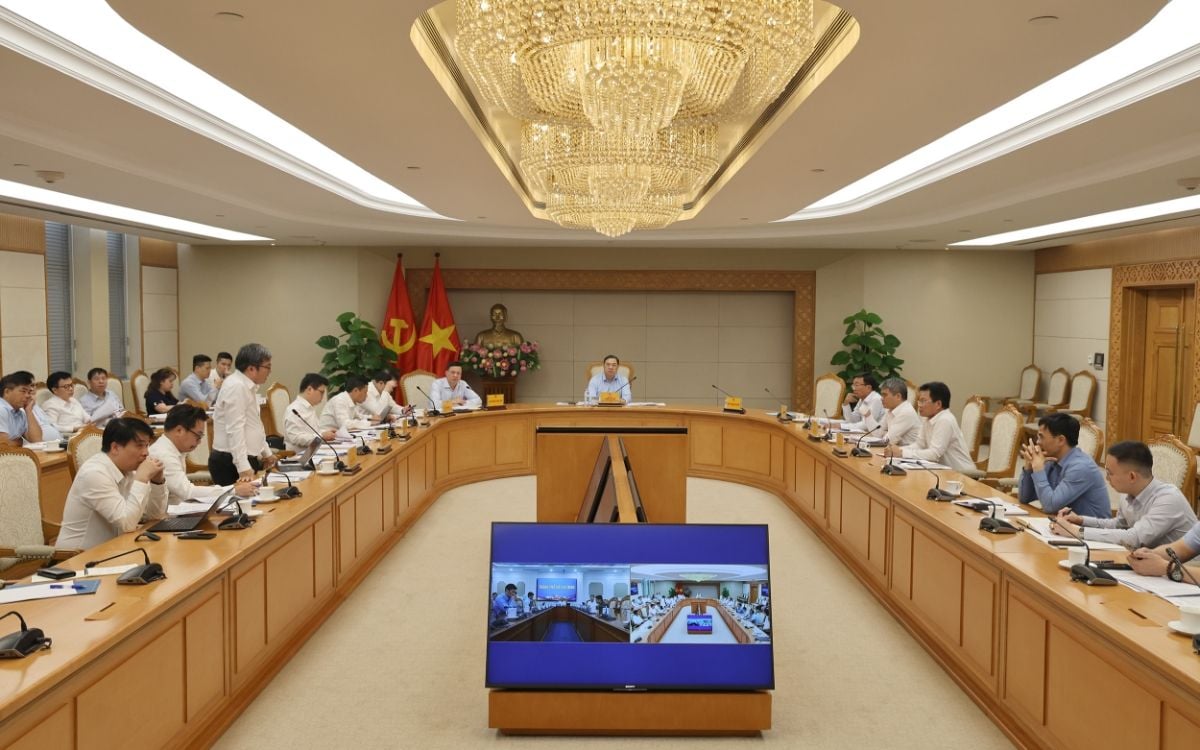
On the afternoon of April 22, 2026, Deputy Prime Minister and Permanent Deputy Prime Minister Pham Gia Tuc presided over a meeting with the Ministry of Construction and other ministries, agencies, and localities to discuss the progress of the North–South high-speed rail project, other rail projects under the Ministry of Construction’s management, and the urban rail system in Hanoi and Ho Chi Minh City. According to a report from the Ministry of Construction, the North–South high-speed rail project has completed its pre-feasibility study and is simultaneously developing the task outline, cost estimates, and bidding documents for the feasibility study. Localities and the Vietnam Power Corporation are reviewing and counting the land clearance volume, relocating electrical works, and planning resettlement areas. Additionally, work on the Lao Cai–Ha Noi–Hai Phong and Ha Noi–Dong Dang lines continues, focusing on planning, feasibility studies, land clearance, and cost determination. The Ministry of Construction and the Ministry of Science and Technology have translated, appraised, and issued 606 standards and technical norms for the North–South high-speed rail project; 106 standards for the Lao Cai–Ha Noi–Hai Phong line; and 636 technical standards for urban rail projects. Moreover, the Ministry of Construction is reviewing 16,105 general construction norms, focusing on amendments to align with new requirements… At the meeting, the ministries discussed capital allocation, the development of science and technology and the rail industry, the implementation of the restructuring plan for the Vietnam Railways Corporation, and the plan to train human resources to operate high-speed rail. Hanoi’s Vice Chairman Tran Viet Dung reported on resettlement site preparations to support land clearance for the North–South high-speed rail project; progress on Hanoi urban rail lines Hanoi Station–Yen So, Ha Dong–Xuan Mai, Nhon–Ga Ha Noi, Nam Thang Long–Tran Hung Dao, Van Cao–Lang–Hoa Lac. In Ho Chi Minh City, Vice Chairman Bui Xuan Cuong said after consolidation, the city is reviewing and integrating 28 previously planned urban rail lines; continuing with those that are clear such as Ben Thanh–Tham Luong, Ben Thanh–Can Gio, Ben Thanh–Thu Thiem… Mr. Cuong urged the Ministry of Construction to promptly hand over the boundary markers and the rail line corridor for the North–South high-speed rail to identify overlaps with other major transport projects in the city; to quickly have design and architectural options for the terminal station of the North–South high-speed rail to support TOD (Transit-Oriented Development). Leaders of Hanoi and Ho Chi Minh City also expect the ministries to complete the national standards for urban rail to ensure consistent nationwide application. The Ministry of Finance should review and report to the Government on the task of investing in the Railway Industrial Complex; this would serve as a basis for localities to encourage domestic investors and enterprises to participate in urban rail projects. In concluding, Deputy Prime Minister Pham Gia Tuc praised the proactive stance of the Ministry of Construction, the ministries, and localities in implementing the projects. These are important works with long-term growth implications, expanding international cooperation and creating new development momentum. Given that this is a new field with many unprecedented contents, the Deputy Prime Minister asked the ministries and localities to closely follow the resolutions and conclusions of the Party Central Committee, the National Assembly, and the Government; to assess the economy, finance, technology, and governance models to select the optimal option. Notably, he called for a rapid completion of a synchronized system of standards and technical norms in line with international standards, forming the basis for technology transfer, consultant selection, and contracting, while linking to real technology transfer and gradually developing the rail industry and mastering rail technology. He emphasized accelerating land clearance, TOD development, and diversifying funding sources. On human resources, the Deputy Prime Minister stressed that “we must stay ahead from the very beginning,” actively cooperating with partners, from basic training to hands-on coaching, linked to the projects in operation; training funding from the state budget, enterprises, public–private partnerships, and international support, with governance, exploitation, operation requirements, and sufficient capacity to absorb technology transfer to progressively master rail technology. For localities, accelerate land clearance in identified route corridors and be ready to act as soon as the project is approved. The TOD-oriented urban development along the North–South high-speed rail line should be pursued, with each station viewed as a new economic-urban development center to maximize land value along the route. For connecting lines such as Lao Cai–Ha Noi–Hai Phong and Ha Noi–Dong Dang, the objective is to ensure quality and schedule, linked to technology transfer while promoting trade, tourism, and regional integration. The Deputy Prime Minister also asked Hanoi and Ho Chi Minh City to harmonize the technical standards across urban rail lines to ensure integrated connectivity, and to study metro lines suitable for large urban areas. He affirmed that the Government is ready to remove obstacles and urged ministries and localities to continue close coordination to accelerate the projects and to form a modern, synchronized rail system in line with the country’s development orientation.

Premium gym chains are entering a “golden era” that is ending or already in decline, as rising operating costs collide with shifting consumer preferences toward more flexible, community-based ways to exercise. Long-term memberships are shrinking, margins are pressured by higher rents and facility expenses, and competition from smaller, more personalized…