•
•
•
•
•
•
•
•
•
•
•
•
•
•
•
•
•
•
•
•
•
•
•
•
•
•
•
•
•
•
•
•
•


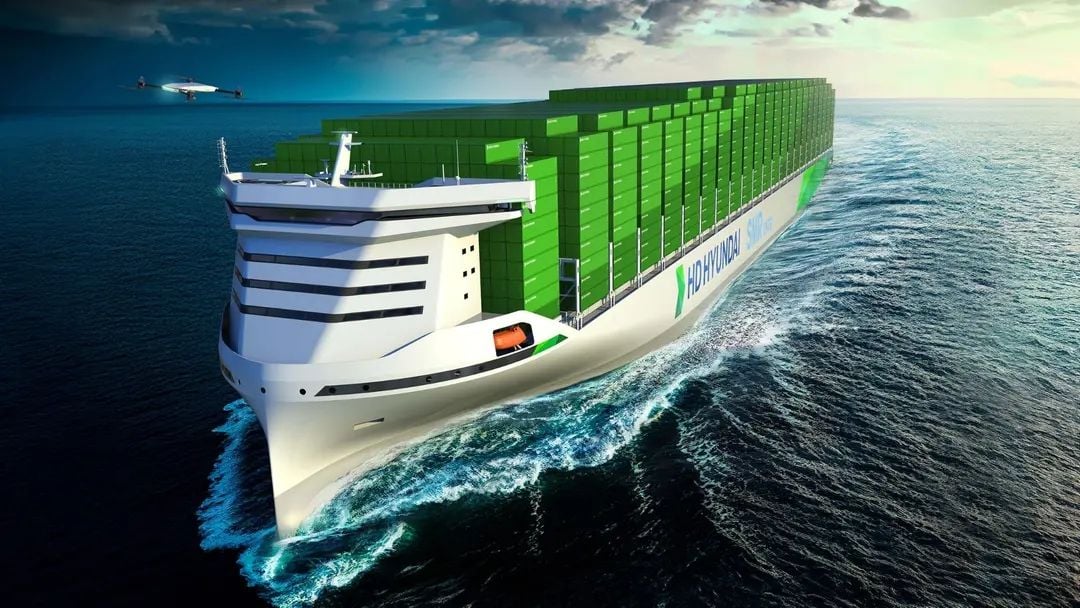
On March 9, 2026, Hyundai Heavy Industries (HD Hyundai) of South Korea announced it has signed a cooperation agreement with the American Bureau of Shipping (ABS) to jointly develop what the companies describe as the world’s first nuclear-powered container ship for commercial transport.
A conceptual design presented for the project depicts a 15,000 TEU-class container ship powered by a small modular reactor (SMR).
The proposed vessel would have a capacity of 16,000 TEU (roughly 16,000 twenty-foot equivalent units). It would use an SMR with up to 100 MW (about 134,000 horsepower) to generate electricity for electric propulsion, replacing traditional fossil-fuel engines.
The companies say a smaller, modular SMR and its architecture are intended to make integration into large new container ships easier than conventional nuclear reactor systems.
Engineers from both organizations will study whether such reactors can meet the high energy demands of high-speed container ships operating on long sea routes.
The project also focuses on designing a dedicated energy-management system, the layout of electrical equipment, and integrating safe nuclear operations. It includes the use of twin-screw propulsion and direct-drive electric motors to reduce energy losses.
The project’s main objective is to achieve Net Zero in commercial shipping by dramatically cutting emissions. The initiative also aims to improve efficiency for long-haul operations at high speeds and to support more refrigerated containers by providing a stable power source for operators.
ABS said the collaboration is intended to validate the feasibility of nuclear-powered electric propulsion for large container ships. Matthew Muller, ABS Asia-Pacific Commercial Director, said: “By combining HD Hyundai's shipbuilding expertise with ABS's safety and certification capabilities, we will comprehensively validate the safety, efficiency, and environmental friendliness of next-generation propulsion solutions.”
HD Hyundai and ABS also referenced international standards for safety and certification, including the IMO and IAEA frameworks.
Shim Hak-moo, Head of Design at HD Hyundai Samho, said: “Nuclear-powered electric propulsion is a breakthrough technology to achieve net zero. In the fiercely competitive green ship market, this could become a powerful asset for HD Hyundai.”
The cooperation agreement was announced on March 9, 2026.
Premium gym chains are entering a “golden era” that is ending or already in decline, as rising operating costs collide with shifting consumer preferences toward more flexible, community-based ways to exercise. Long-term memberships are shrinking, margins are pressured by higher rents and facility expenses, and competition from smaller, more personalized…