•
•
•
•
•
•
•
•
•
•
•
•
•
•
•
•
•
•
•
•
•
•
•
•
•
•
•
•
•
•
•
•
•


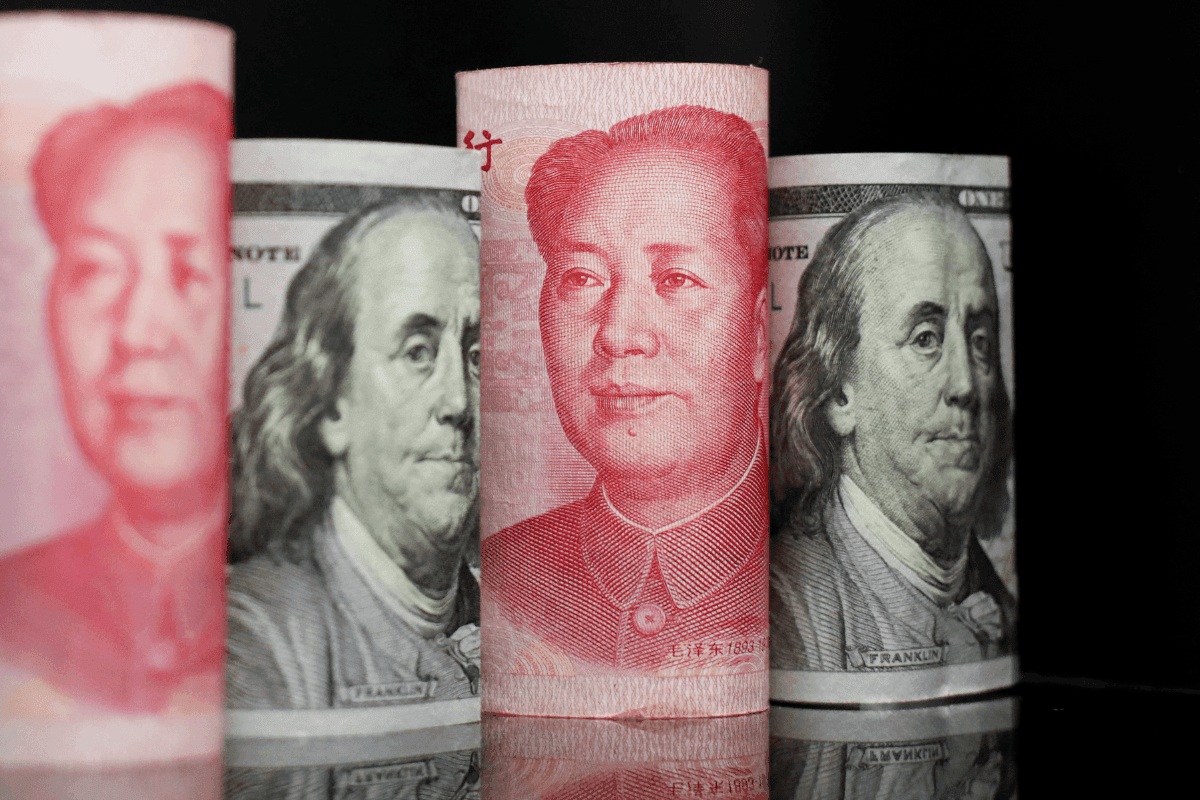
There is an active, heated debate among analysts about the “petrodollar” and the “petroyuan,” focusing on whether the U.S. dollar’s role in oil payments could weaken as other currencies gain traction.
In 2025, the USD sold off heavily as the “sell America trade” gained traction, the U.S. Federal Reserve cut rates, and the greenback faced a confidence shock tied to U.S. policy and fiscal stance. A brief U.S.-Iran conflict also boosted the USD earlier in the year, but the broader question of the dollar’s reserve-currency role has remained central to analyst discussions.
CNBC reported that Deutsche Bank recently sparked the debate after one of its strategists suggested that USD dominance could weaken if countries increasingly use other currencies for oil payments.
In a report dated March 24, Mallika Sachdeva, Chief Executive of Deutsche Bank’s FX division, said the U.S.-Iran confrontation could be remembered as a key catalyst for “erosion of the USD’s dominant role in oil-trading payments (petrodollar)” and the “start of the yuan’s involvement in this space (petroyuan).”
In a report dated April 14, Franklin Templeton argued that Sachdeva’s assessment was “quite simplistic.” The firm contended that the Deutsche Bank strategist did not accurately capture the relationship between pricing crude in USD and security considerations involving the U.S. and Saudi Arabia.
Sonal Desai, Franklin Templeton’s CIO of fixed income, wrote that oil is priced in USD not only because the U.S. has long acted as a global security provider, but also because oil-exporting countries have a strong incentive to be paid in USD. The incentive, Desai said, is tied to what the USD provides: access to the deepest and most liquid capital markets, supported by an institutional and legal framework that respects property rights and enforces contracts, alongside a strong, dynamic and innovative economy.
In the first half of 2025, the USD recorded its steepest decline in more than five decades after President Donald Trump announced aggressive tariffs and then rolled them back, undermining investor confidence in American assets. For the year, the Dollar Index—measuring the greenback against a basket of six major currencies—fell by about 10%.
After a Gulf conflict erupted on February 28, 2026, the USD recovered, rising versus most major currencies and moving in tandem with oil prices. More recently, the USD weakened again as oil cooled amid hopes for a peaceful resolution to end the conflict.
CNBC said Deutsche Bank and Franklin Templeton represent two extremes within the spectrum of views on de-dollarization: Deutsche Bank argues the USD is in structural decline, while Franklin Templeton contends that no currency can replace the USD.
The article also cited long-term data showing that the share of the USD in international reserves has fallen over the decades—from just above 70% in 1999 to just over 50% today. It noted that other currencies, including the yuan and euro, have gained share, though the USD remains dominant.
Elias Haddad, head of strategy at Brown Brothers Harriman, told CNBC that analysts generally struggle to imagine a world in which the dollar does not retain a leading role in global trade. “Nothing can replace the USD. All other currencies have not yet reached the threshold to substitute the USD,” he said.
The yuan currently accounts for about 3% of official foreign exchange reserves held by central banks worldwide, and it is increasingly influential as part of Beijing’s long-term strategy to internationalize the currency. However, Haddad said the yuan cannot realistically reach a 50% share in global foreign exchange reserves soon, especially given China’s still-closed capital markets.
Desai added that building a framework for the yuan to replace the USD—covering factors such as highly liquid markets, the rule of law, full convertibility, and long-term macro stability—would take decades rather than years.
Haddad also noted that the security role of the United States in the Gulf has weakened since the conflict began, which he said could further erode confidence in U.S. trade and security policies. He cited U.S. fiscal credibility and pressure from the Trump administration on the Federal Reserve as additional factors that could sustain the USD’s structural weakness.
Taken together, the article suggested a scenario in which the USD’s reserve status is gradually eroded but not erased—meaning the dollar could weaken without being replaced.
Desai further said some of the recent USD weakness reflects intrinsic characteristics of the currency. “Part of USD weakness aligns with its role as a global reserve currency. Unlike the yuan, USD is freely convertible, with ups and downs,” he emphasized.

Premium gym chains are entering a “golden era” that is ending or already in decline, as rising operating costs collide with shifting consumer preferences toward more flexible, community-based ways to exercise. Long-term memberships are shrinking, margins are pressured by higher rents and facility expenses, and competition from smaller, more personalized…