•
•
•
•
•
•
•
•
•
•
•
•
•
•
•
•
•
•
•
•
•
•
•
•
•
•
•
•
•
•
•
•
•


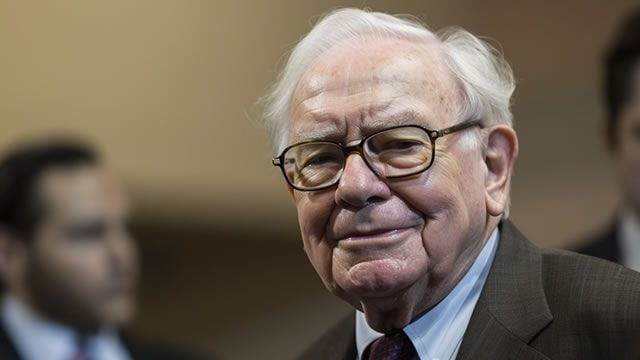
This year marks a new era in Berkshire Hathaway’s storied history. After leading Berkshire for well over half a century and seeing the company he built reach a $1 trillion market cap, billionaire Warren Buffett retired as CEO on Dec. 31.
Greg Abel, Berkshire’s longtime understudy and a value-focused executive with more than a quarter-century at the company, is now responsible for day-to-day operations, including management and oversight of Berkshire’s $320 billion investment portfolio. As of the closing bell on April 16, Abel has final say over 48 positions.
Buffett and Abel’s investment approach is similar, emphasizing value, strong management teams, sustainable competitive advantages, and capital-return programs. A key feature of Berkshire’s strategy under both leaders is concentration: just 10 positions account for nearly 79% of Berkshire Hathaway’s invested assets.
Several of these holdings share common traits. All 10 pay dividends, and some also actively repurchase shares. Apple has the largest share repurchase program on Wall Street, with Berkshire’s article citing that Apple has spent roughly $841 billion since 2013 to retire over 44% of its outstanding shares.
Buffett and Abel also view seven of these 10 core positions as indefinite holdings. With the exception of Bank of America, Chevron, and Chubb, the remaining seven companies are expected to remain in Berkshire’s portfolio for decades. The article highlights that Coca-Cola, American Express, and Moody’s are among the longest-tenured holdings and are currently generating annual yields on cost of 63%, 45%, and 41%, respectively.
Abel’s influence is also visible in Berkshire’s exposure to Japan’s “sogo shosha” trading houses. The article says Abel is a major fan of the five trading houses and was instrumental in building stakes in Mitsubishi and Mitsui.
Beyond the 10 core holdings, Abel oversees 20 additional billion-dollar wagers within Berkshire’s $320 billion investment portfolio.
The article notes that three of the sogo shosha—Itochu, Marubeni, and Sumitomo—appear in this group and collectively make up five of Berkshire’s 16 largest holdings by market value.
What stands out in these billion-dollar wagers, according to the article, is an emphasis on sustainable competitive advantages. It cites Sirius XM and VeriSign as examples of legal monopolies: Sirius XM is described as the only licensed satellite radio operator, while VeriSign is described as the registrar of “.com” and “.net” domains.
The article also says Abel is overseeing close to $4.7 billion in combined investments in payment facilitators Visa and Mastercard. It contrasts their model with lenders by stating that Visa and Mastercard focus on collecting merchant fees for facilitating payments, rather than setting aside capital for credit delinquencies or loan losses during economic turbulence.
Domino’s Pizza is highlighted as another example, with the article stating that Buffett added to the position for six consecutive quarters leading up to his retirement. It attributes that decision to Domino’s ability to build consumer trust and its track record of meeting or exceeding five-year growth initiatives.
Rounding out Abel’s responsibilities are 18 relatively smaller holdings, ranging from $5 million to approximately $692 million:
The article says many of these smaller positions fall into two categories: companies that have been reduced or are being removed from Berkshire’s portfolio, and investments made by Ted Weschler or Todd Combs. It also notes that Todd Combs left Berkshire to join JPMorgan Chase in December 2025.
As an example, the article states that Berkshire’s stake in Amazon was slashed by 77% during the December-ended quarter. It describes a 77% reduction in a mid-tier position as historically a strong signal that a company would soon be removed, while also arguing that Amazon is not a value stock in the traditional sense—adding that this could be a challenge for Greg Abel.




Premium gym chains are entering a “golden era” that is ending or already in decline, as rising operating costs collide with shifting consumer preferences toward more flexible, community-based ways to exercise. Long-term memberships are shrinking, margins are pressured by higher rents and facility expenses, and competition from smaller, more personalized…