•
•
•
•
•
•
•
•
•
•
•
•
•
•
•
•
•
•
•
•
•
•
•
•
•
•
•
•
•
•
•
•
•


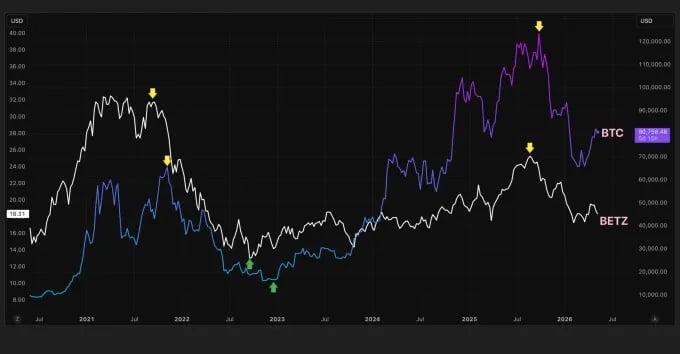
The price movements of Bitcoin and the world’s largest sports-betting ETF show a statistically significant relationship, with correlation levels above 80% based on an analysis of historical data. The link comes as exchange-traded funds (ETFs), including BlackRock’s IBIT, have increasingly influenced Bitcoin’s market behavior over the past two years.
CoinDesk’s analysis team identified the Roundhill Sports Betting & iGaming ETF (BETZ) as another ETF with a notable correlation to Bitcoin’s cycle since 2020. BETZ is listed on the NYSE and invests in companies tied to online sports betting, online casinos, and iGaming, including DraftKings, Flutter, and Entain.
The fund launched in June 2020. To date, it has drawn about $98 million in net inflows, making it the world’s largest sports betting ETF. As of yesterday, BETZ managed about $50 million in assets.
TradingView data cited in the analysis shows:
The correlation coefficient ranges from -1 to 1. Values closer to 1 indicate the assets more often move in the same direction, while values closer to -1 indicate opposite movement. Values near 0 suggest limited linkage.
The analysis also references an R² of about 0.83, indicating that over 80% of the price movements of the two assets are statistically linked.
Beyond correlation, the analysis highlights a recurring timing pattern when overlaying BETZ’s price chart with Bitcoin’s. The ETF tends to peak or trough ahead of Bitcoin by a few weeks:
While correlation does not imply causation, the recurrence of the pattern across cycles has led observers to be cautious. It aligns with the view expressed by some experts, including Ray Dalio, founder of Bridgewater Associates, that Bitcoin behaves more like an asset sensitive to market psychology and liquidity than a safe haven.
CoinDesk also cautioned that short-term traders should treat BETZ as a supplementary indicator of sentiment and capital flows rather than an independent predictive tool for Bitcoin’s trend.
In recent days, BETZ has begun to diverge from Bitcoin’s uptrend. The analysts said: “This could be an early signal worth monitoring, though it could also be noise in a relationship that has never been guaranteed to persist.”

Premium gym chains are entering a “golden era” that is ending or already in decline, as rising operating costs collide with shifting consumer preferences toward more flexible, community-based ways to exercise. Long-term memberships are shrinking, margins are pressured by higher rents and facility expenses, and competition from smaller, more personalized…






![Humanity [H] falls 17% as volume collapses; potential rebound or deeper breakdown ahead](/_next/image?url=https%3A%2F%2Fimages.indexcdn.com%2Fhumanity_h_crashes_17_rebound_or_deeper_breakdown_whats_20260513_bc5328420e.jpg&w=2560&q=85)


