•
•
•
•
•
•
•
•
•
•
•
•
•
•
•
•
•
•
•
•
•
•
•
•
•
•
•
•
•
•
•
•
•


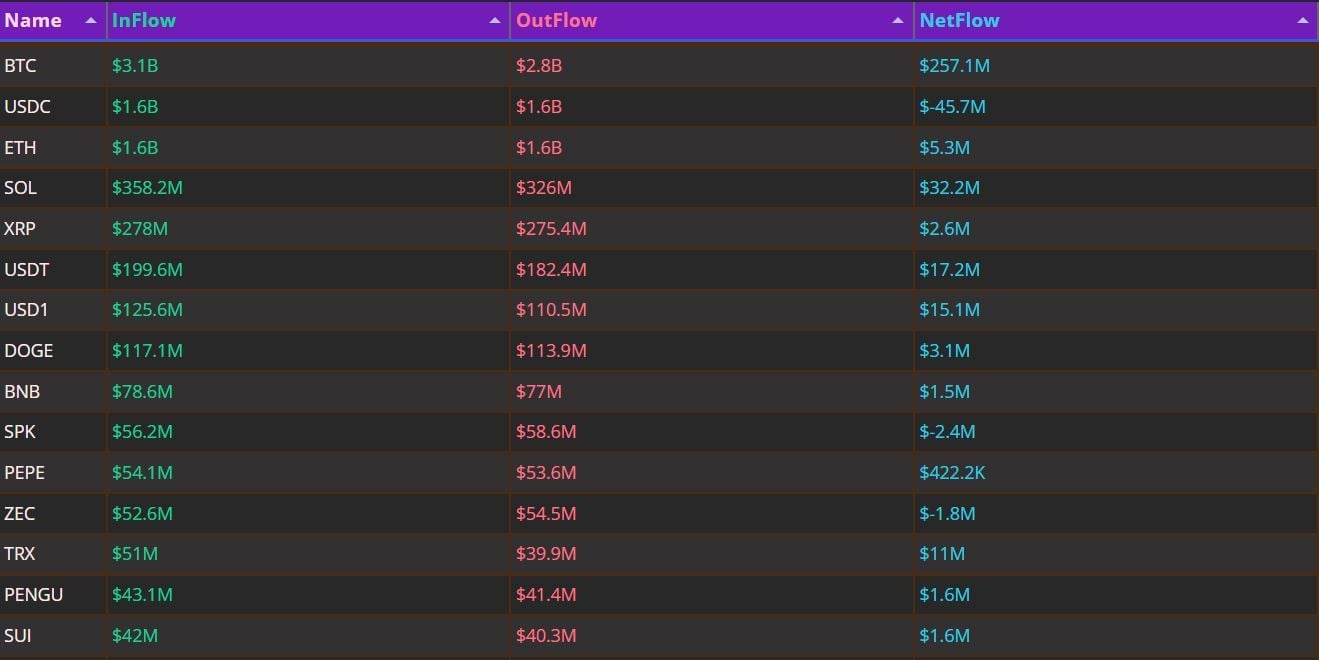
Bitcoin (BTC) saw a sharp wave of ‘net inflows’ over the past 24 hours, while USD Coin (USDC) posted the largest ‘net outflow’ among major crypto assets—an inversion that can signal rotation in where traders are parking liquidity and taking risk. According to Cryptometer data cited at 1:35 a.m. ET on April 23 (based on flows recorded over the prior 24 hours), Bitcoin registered approximately $257.1 million in net inflows. Tether (USDT) also attracted capital, posting $17.2 million in net inflows, while Solana (SOL) added $32.2 million. Ethereum (ETH) recorded a modest $5.3 million net inflow. USDC, however, moved in the opposite direction, logging about $45.5 million in net outflows—the biggest capital exit in the dataset. Smaller outflows were also recorded in a handful of assets, including RAVE with $5.7 million and WBETH with $2.4 million in net outflows. By ranking, Bitcoin led inflows by a wide margin, followed by SOL, USDT, USD1 with $15.1 million, and TRON (TRX) with $11.0 million. On the outflow side, USDC topped the list, followed by RAVE and WBETH. While flow data does not identify the underlying source of capital movements, the split between strong BTC inflows and USDC outflows may point to short-term repositioning—either from stablecoin balances into higher-beta exposure, or a shift in venue and settlement preferences among traders. In the near term, sustained inflows into BTC and major liquid assets are often watched as a proxy for broader ‘risk-on’ engagement, while stablecoin outflows can reflect redemptions, transfers between platforms, or temporary changes in liquidity demand. Article Summary by TokenPost.ai 🔎 Market Interpretation - Notable rotation signal: The dataset shows a sharp divergence—Bitcoin (BTC) posted the strongest net inflow (~$257.1M) while USD Coin (USDC) saw the largest net outflow (~$45.5M), suggesting liquidity may be shifting from stablecoin parking to higher-risk exposure. - Risk-on bias (near term): When top liquid assets (especially BTC) attract sustained inflows, it is commonly interpreted as increased speculative participation or renewed directional conviction. - Stablecoin outflows are ambiguous: USDC outflows can reflect redemptions, transfers between exchanges/venues, or reduced demand for idle liquidity—not necessarily bearish on their own. - Broad participation beyond BTC: Additional inflows into Solana (SOL), Tether (USDT), Ethereum (ETH), plus USD1 (~$15.1M) and TRON (TRX) (~$11.0M) indicate the move is not isolated to a single asset. - Outflows concentrated: Beyond USDC, only smaller outflows are highlighted (RAVE ~$5.7M, WBETH ~$2.4M), implying the pressure is primarily on USDC rather than broad-based deleveraging. 💡 Strategic Points - Track persistence, not one print: A single 24-hour flow spike can be noise; multiple consecutive days of BTC inflows paired with stablecoin outflows strengthens the “risk-on rotation” thesis. - Watch stablecoin mix (USDC vs USDT): USDC outflows alongside USDT inflows may indicate settlement preference shifts (venue, region, fee/rail choice) rather than simple risk appetite. - Use flows as a confirmation tool: Combine net flows with price trend, funding rates, and spot/perp basis. Inflows with improving market structure can validate upside momentum; inflows while price stalls may hint at distribution or hedged accumulation. - Liquidity planning: If USDC is moving off one venue, spreads and depth can change locally; traders may want to monitor order-book liquidity and stablecoin availability where they execute. - Risk management lens: A “risk-on” turn can lift majors first (BTC/ETH) and then spill into higher beta (e.g., SOL). Consider position sizing and invalidation levels, since flow-driven rallies can reverse quickly if stablecoin demand snaps back. 📘 Glossary - Net inflow / net outflow: The net amount of capital moving into or out of an asset (or related vehicles/venues) over a set period; typically calculated as inflows minus outflows. - Stablecoin: A crypto asset designed to track a fiat value (usually USD). USDC and USDT are the most widely used for trading and settlements. - Risk-on: A market regime where participants increase exposure to volatile assets in pursuit of higher returns (e.g., rotating from stablecoins to BTC/SOL). - Higher beta: Assets that typically move more than the market (more volatile), often outperforming in rallies and underperforming in sell-offs. - Redemption: The process of exchanging stablecoins for underlying fiat, which can appear as outflows in flow metrics. - Settlement/venue preference: Choosing certain coins (e.g., USDT) or platforms for trades, collateral, and transfers due to liquidity, rails, fees, or regional accessibility.

Premium gym chains are entering a “golden era” that is ending or already in decline, as rising operating costs collide with shifting consumer preferences toward more flexible, community-based ways to exercise. Long-term memberships are shrinking, margins are pressured by higher rents and facility expenses, and competition from smaller, more personalized…