•
•
•
•
•
•
•
•
•
•
•
•
•
•
•
•
•
•
•
•
•
•
•
•
•
•
•
•
•
•
•
•
•



Blue-chip stocks led declines today, creating broad negative spillover as investors have continued to see a “green on the outside, red on the inside” pattern across recent sessions.
The breadth of advancers/decliners on the VN Index was 0.49/1, with 130 stocks falling by more than 1%. Investors were frustrated by the persistence of declines across multiple sessions, alongside very narrow breadth for almost the entire week prior, and also in sessions before the holiday.
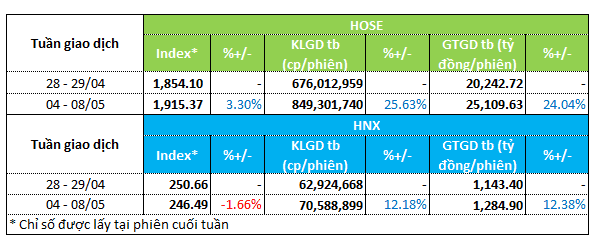
VIC fell 1.33% and VHM dropped 1.83%, alongside declines across nearly the entire banking group. As a result, the VN-Index fell 1.04% (down 19.87 points) to 1,895.5, slipping below 1,900.
Market commentary noted that whether the VN-Index is above or below 1,900 is becoming less meaningful because the index no longer fully represents the broader market. The pattern described is that when the index rises, most stocks do not rise; when it falls, most stocks fall with it, sometimes more than the index.
Analysts characterized the move as a repeat of the early-year phase rather than a new development. They pointed to breadth divergence versus the index and “hot money” concentrating in a few stocks as negative signals for the overall trend.
Over the past roughly three weeks, short-term opportunities have become scarcer despite positive Q1 results that have supported speculative sentiment. As market conditions become more challenging, the tendency to protect profits is expected to strengthen. Weak signals—such as exhausted leaders, shrinking liquidity, or sudden broad selling—were cited as components of “sell signals” from hot money.
Today, only a few stocks were cited as bucking the trend with solid fundamentals, including VIX, Gelex group, and LPB. The rest of the gains were described as mostly abrupt moves, such as in some oil & gas or fertilizer stocks.
There was said to be no clear money rotation. If leaders stabilize in coming sessions, they could support hot money for longer; otherwise, the market could shift into a broad pullback.
Even if a pullback occurs, it was described as not inherently negative because the main driver is short-term supply and demand. The fundamental backdrop was characterized as not worse. Typically, a sharp index drop can affect psychology for a few sessions, while the actual outflow of funds requires longer observation. In a correction trend, selling pressure is expected to determine the magnitude of the decline.
The view presented was that investors should not participate heavily in the cash market at this time, as speculative opportunities are very limited. A long-term strategy of selective buying was still considered viable because many stocks are attractively valued; holding long was described as not a problem, though it ties up capital. Derivatives were highlighted as a better speculative channel.
The derivatives market showed fairly good expectations for the underlying, with a narrow basis spread for almost the entire session. Morning trading was described as challenging: risk was not large, but effectiveness was low. VN30 oscillated in a narrow range from roughly 2064.xx to 2073.xx.
In the early afternoon, the basis reversed with a relatively wide spread—more than 5 points. VN30 weakened due to pressure on VIC and VHM. Attention increased after the spread widened, and shortly afterward a large short order was reported, alongside heavy selling on leaders. VN30 then broke below 2064.xx.
A “short scenario” was described as becoming natural below 2064.xx, with a stoploss placed on VN30 if it recovers back above 2064.xx.
VN30 closed today at 2040.51. Nearest resistance levels for tomorrow were listed as 2050; 2064; 2073; 2090; 2100; and 2111. Support levels were listed as 2030; 2015; 2004; 1983; 1971; and 1960.
“Blog chứng khoán” is a personal property and does not represent the views of VnEconomy. The opinions and assessments are those of the individual investor, and VnEconomy respects the author’s writing style. VnEconomy and the author are not responsible for issues arising from the assessments and investment opinions posted.

Premium gym chains are entering a “golden era” that is ending or already in decline, as rising operating costs collide with shifting consumer preferences toward more flexible, community-based ways to exercise. Long-term memberships are shrinking, margins are pressured by higher rents and facility expenses, and competition from smaller, more personalized…