•
•
•
•
•
•
•
•
•
•
•
•
•
•
•
•
•
•
•
•
•
•
•
•
•
•
•
•
•
•
•
•
•


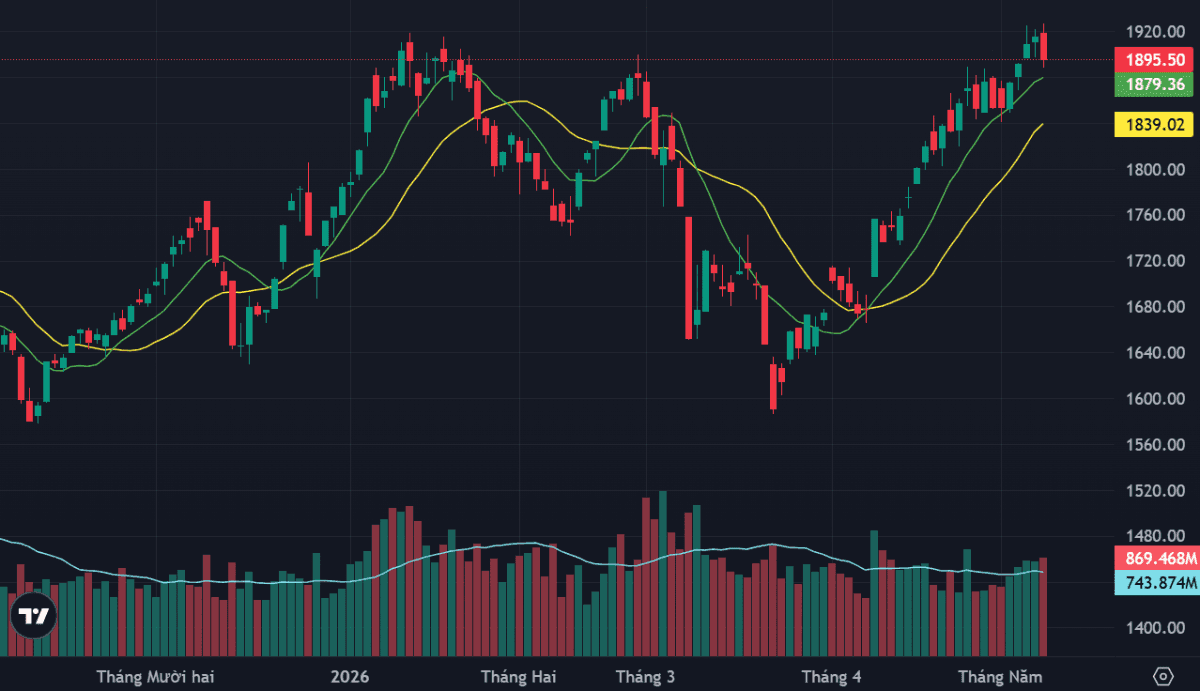
The VN-Index faced broad selling pressure as almost all VN30 blue-chips declined, including VIC and VHM. The pressure quickly spread to the broader market, pushing the index to reverse and fall 1.04%, breaking the 1,900-point level.
The VN-Index closed at 1,895.5 points, down 18.87 points from the reference. The morning session had recorded a 0.31% gain, with 117 gainers and 162 decliners.
VHM was hit by heavy selling, lifting liquidity by 33% versus the morning session to about 800 billion dong. However, the price fell rapidly and extended losses through the afternoon. VHM closed down 1.83% from the reference, meaning it fell 4.22% from the morning close. VIC recovered slightly in the final minutes, but the overall session remained weak: VIC closed down 2.19% versus the morning and finished 1.33% below the reference.
The weakness was not limited to VIC and VHM. Data cited from the VN30 basket showed 26 stocks down and only 2 up. With many declines concentrated among top-cap names, downward pressure on the VN-Index intensified. Other notable declines included VCB down about 0.82% and closing 0.66% below the reference, BID down 0.84% to finish down 2.12%, and CTG down 1.66%. HPG fell 1.28%, GAS fell 1.47%, and VPL fell 2.73%.
The VN30-Index closed down 1.62%, with 2 gainers and 27 losers. The article noted that 18 VN30 stocks fell more than 1%. SAB rose 2.92% and LPB rose 1.93%, but SAB was described as the only one that advanced strongly in the afternoon. SAB peaked around 2 PM before pulling back slightly; compared with the morning session, it was up 2.92%. LPB closed above the reference but slipped 1.12% in the afternoon. The only other stock rising in the afternoon was SHB, up 0.35% but still ending down 0.7%.
Market breadth deteriorated by the close. At the end of trading, there were 104 advancers and 213 decliners, worse than in the morning. Among the 104 advancing stocks, only 2 were VN30 constituents. Forty-nine stocks closed up more than 1%, all from the mid- and small-cap group.
Active trading was reported in several stocks, including VIX up 4.03%, GEX up 1.79%, CII up 6.78%, BSR up 6.94%, EIB up 2.71%, GEE up 3.91%, DXG up 1.62%, GEL up 6.92%, DCM up 6.72%, VSC up 2.26%, and PC1 up 3.04%. Each of these names had liquidity above 100 billion dong per stock.
Beyond these highly liquid names, the article said that among the top 49 strongest stocks there were around ten additional stocks with liquidity above 10 billion dong. Although the count was small, this group accounted for roughly 30% of the total matched value on the HoSE market, indicating that speculative capital remained concentrated.
The article described widespread psychological pressure, with red dominating broadly. The number of stocks down more than 1% reached 130 (morning: 84). Nearly 30 stocks traded above 100 billion dong, including VHM (-1.83%), FPT (-2.64%), and VIC (-1.33%), each with turnover exceeding a trillion dong.
Midcap and small-cap stocks also saw many deep declines, with only 18 of 130 VN30 components green. Examples included VPI down 2.44%, NVL down 2.33%, TCH down 2.06%, KBC down 3.27%, KDH down 2.06%, and DGW down 4.16%, all with very large liquidity.
Foreign investors turned net buyers, but the article also noted that net selling increased. Net position was -299.3 billion, with on-exchange -0.6 billion. Foreign investors sold heavily VHM (-368.1 billion), FPT (-217.7 billion), DGC (-189.2 billion), ACB (-130.7 billion), TCH (-118.6 billion), HPG (-88.2 billion), and PLX (-84.7 billion). On the buy side, they bought BSR (+133.3 billion), GEE (+101 billion), DCM (+96.9 billion), and GEX (+64 billion).
By the close, the VN-Index slipped back below 1,900 points. The article added that the level has limited significance because the index previously did not have broad consensus from the majority of stocks.

Premium gym chains are entering a “golden era” that is ending or already in decline, as rising operating costs collide with shifting consumer preferences toward more flexible, community-based ways to exercise. Long-term memberships are shrinking, margins are pressured by higher rents and facility expenses, and competition from smaller, more personalized…