•
•
•
•
•
•
•
•
•
•
•
•
•
•
•
•
•
•
•
•
•
•
•
•
•
•
•
•
•
•
•
•
•


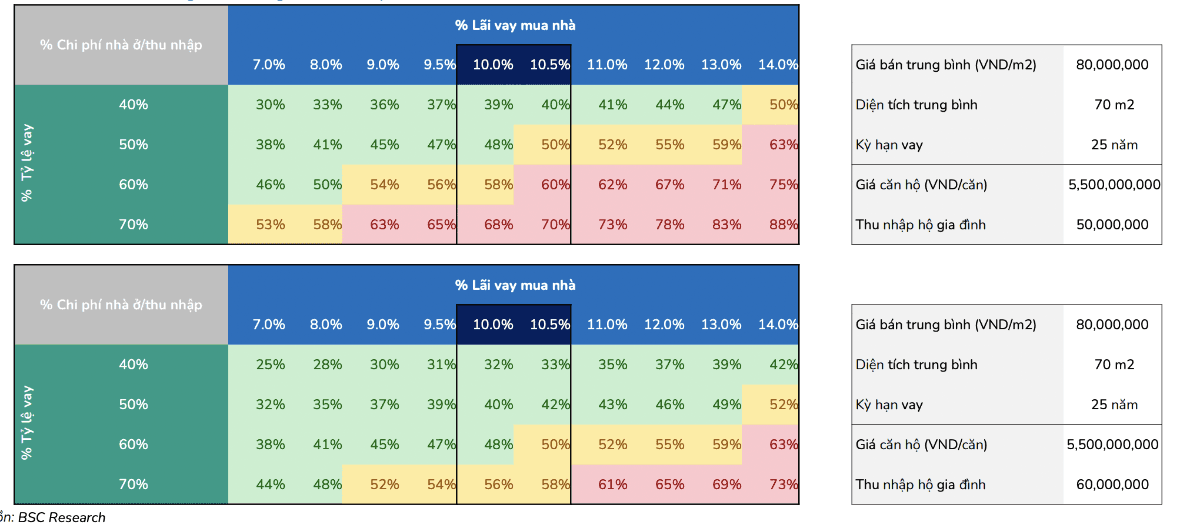
BSC Securities’ latest real estate market outlook assesses current housing price levels and mortgage rates, using assumptions based on developers’ planned launches and a 25-year loan term. The model also incorporates affordability variables, including a minimum household income threshold of 50 million VND per month (the benchmark for social housing inaccessibility), the loan value as a share of the house value, and the interest rate.
BSC argues that monthly housing costs of about 30-40% of income are a “safe” level, while 50% is the maximum acceptable. Under these affordability parameters, BSC assesses that standard households with real demand can still afford homes in the context of mortgage rates of 10-10.5% and an average price of around 80 million VND per square meter.
Separately, Ho Chi Minh City’s 1645 Task Force reported that in 2025 it held 56 meetings to review and resolve issues related to granting pink certificates for 250 projects. As a result, 218 projects with more than 130,000 housing units had issues addressed to enable certificate issuance.
However, 32 projects still have unresolved issues. BSC notes that 14,673 properties require the city People’s Committee to resolve at least 30% of cases each quarter.
BSC adds that legal bottlenecks are no longer the market’s main focus, citing a streamlined legal framework, standardized processes, and centralized data collection through the real estate trading platform, which is expected to support legal completion of projects.
While buyer sentiment was somewhat negative in Q4 2025 to Q1 2026, housing transactions still increased at a solid pace: up 35% year-over-year and 11% quarter-over-quarter. BSC attributes the pace of transactions partly to large inventory, driven by the number of approved launch products and products eligible for sale in Q4 2025.
BSC reports that new selling launches recovered strongly in 2025-2026, supporting cash flow and profit growth in 2027-2028. It also notes that, following restructuring and with a large backlog, real estate developers are more proactive in project deployment and are maintaining a market-cleaning trend through M&A deals.
Looking ahead, BSC expects the momentum from 2025-2026 selling launches to continue supporting sector-wide profit growth. The firm forecasts after-tax profit for the real estate sector at 46,339 billion VND in 2026/2027, up 2.3% year-on-year, and 55,951 billion VND, up 20.7% year-on-year.
Excluding VHM, BSC forecasts after-tax profit of 2,817 billion VND, up 12.8% year-on-year, and 6,590 billion VND, up 133% year-on-year.
BSC notes that real estate stocks experienced a sharp correction in Q4 2025 to Q1 2026, trading at discounts of 30-50% from the peak set in October 2025. Examples cited include DXG (-39.3%), PDR (-38.6%), NLG (-34.6%), TCH (-32.2%), and KDH (-30.5%).
The sector is currently trading at a median P/B of 1.3x, below the 1.5x median P/B in the entire prior cycle (2013-2022). BSC also characterizes the valuation as undervalued in the earnings-growth phase of the previous cycle (2017-2019).
Based on these factors, BSC believes the market’s structural shift in the new cycle is supported by clearer earnings prospects and attractive valuations, which it expects will support positive re-rating in the coming period.
BSC also highlights that profit growth in the Financials group is slowing, while the Non-financial group is rising.








Premium gym chains are entering a “golden era” that is ending or already in decline, as rising operating costs collide with shifting consumer preferences toward more flexible, community-based ways to exercise. Long-term memberships are shrinking, margins are pressured by higher rents and facility expenses, and competition from smaller, more personalized…