•
•
•
•
•
•
•
•
•
•
•
•
•
•
•
•
•
•
•
•
•
•
•
•
•
•
•
•
•
•
•
•
•


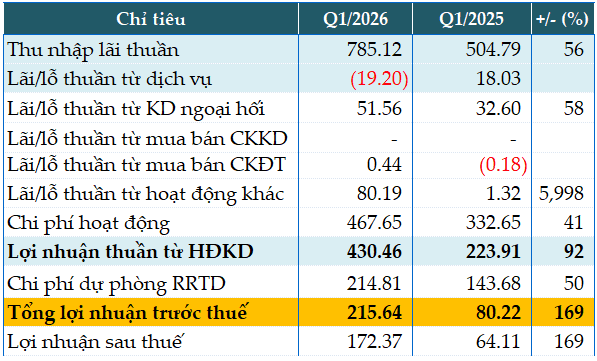
BVBank reported Q1 2026 pre-tax profit of approximately VND 216 billion, up 1.7 times year-on-year, according to its consolidated financial results. The bank said profit growth was supported mainly by strong growth in core income and debt recovery from provisions, helping it maintain earnings momentum despite higher loss provisioning.
In the first quarter, BVBank’s core banking segment recorded net interest income of over VND 785 billion, up 56% year-on-year. Non-interest income was mixed: the services segment recorded a loss, while most other lines performed well.
The jump in other income was attributed mainly to recovering over VND 79 billion from loans written off via risk provisions (Q1 2025 recoveries were about VND 605 million).
Alongside business growth, BVBank’s operating expenses rose 41% to about VND 468 billion. Even so, supported by higher total operating income, net operating profit from core activities exceeded VND 430 billion, up 92% year-on-year.
BVBank increased credit risk provisions by 50%, setting aside nearly VND 215 billion. Despite this, pretax profit still reached approximately VND 216 billion, up 1.7 times versus the same period last year.
By end-Q1, BVBank had achieved nearly 31% of its full-year 2026 pretax profit target of VND 700 billion.
As of 31/03/2026, total assets were VND 136,884 billion, up 3% year-to-date. Customer loans reached VND 79,226 billion, up 2%, with a retail-focused approach: about 95% of the loan book served individuals and SMEs.
On funding, total deposits were VND 126,700 billion. Deposits from financial institutions and households led at over VND 101,300 billion (+21%), while customer deposits were VND 74,032 billion, up 4%.
The funding mix showed a shift toward 6–12 month term deposits, reflecting BVBank’s flexible funding strategy to support lending, improve liquidity, and optimize funding costs.
BVBank’s gross non-performing loans (NPLs) stood at VND 2,466 billion as of end-Q1 2026, up 5% from the start of the year. The NPL ratio increased slightly from 3.01% to 3.11%.



Premium gym chains are entering a “golden era” that is ending or already in decline, as rising operating costs collide with shifting consumer preferences toward more flexible, community-based ways to exercise. Long-term memberships are shrinking, margins are pressured by higher rents and facility expenses, and competition from smaller, more personalized…