•
•
•
•
•
•
•
•
•
•
•
•
•
•
•
•
•
•
•
•
•
•
•
•
•
•
•
•
•
•
•
•
•


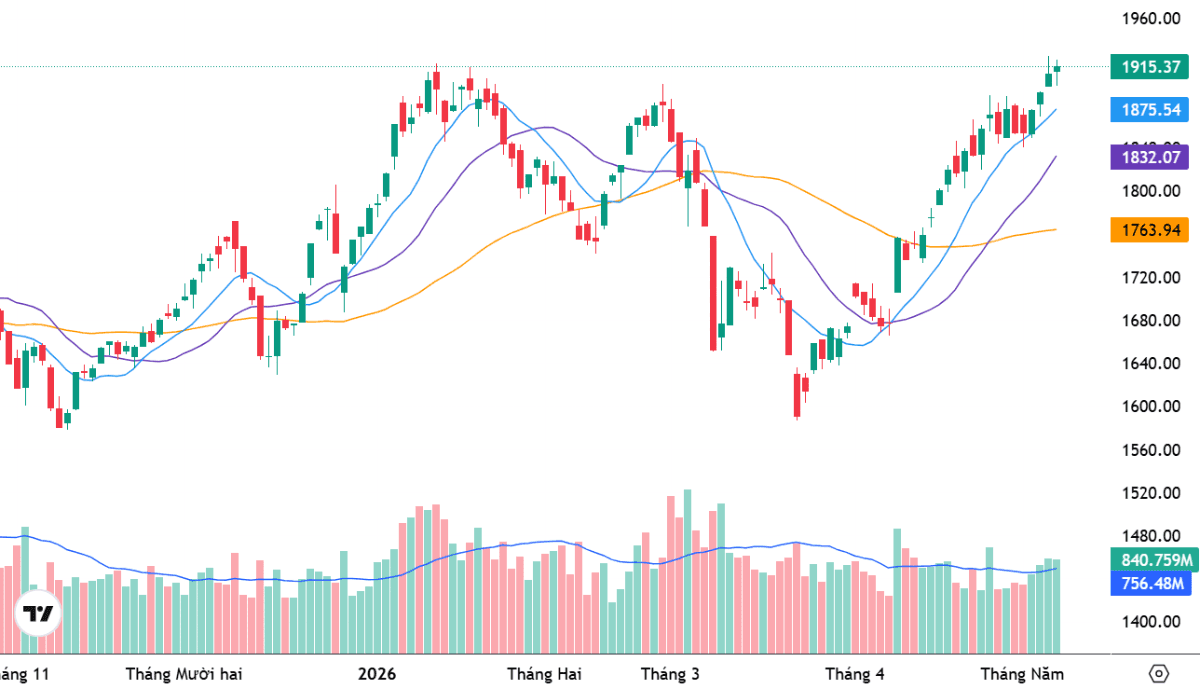
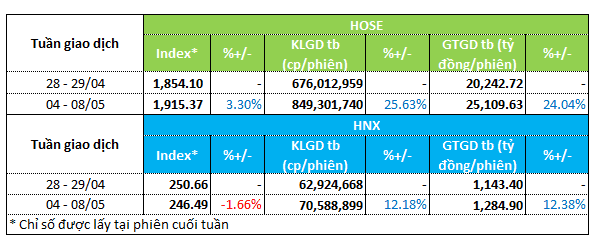
The market in the first week of May set a new all-time high for the VN-Index, closing at 1,915.37 points. The index also posted a seventh consecutive weekly gain. Despite the green on the surface, investors largely did not have a positive trading experience during most of the week.
Analysts noted that the VN-Index is in a historic high zone, with the 10-day, 20-day and 50-day moving averages tracking near the breakout area. The rally has been driven mainly by leadership stocks, particularly VinGroup-related names, and the “leadership effect” has been evident.
However, caution remains because the breakout has not yet translated into broad participation. One indicator highlighted was that the percentage of stocks trading above the MA20 fell below 40%, suggesting the market has not entered a wide “bursting-wide” phase. In this view, the breakout may create psychological momentum and attract short-term funds, but liquidity confirmation and wider stock participation are needed for a more sustainable rally.
After the index’s sharp rise and the breakout beyond the 1900-point threshold, analysts expected meaningful profit-taking pressure around the resistance band of 1920–1925 points in the coming week. This pressure was expected to concentrate on the groups that led the rally, including VinGroup ecosystem stocks such as VIC and VHM, especially as the market moves into a lower-information domestic phase after the earnings season.
Even so, some analysts argued that opportunities remain because many stocks are still trading at relatively low levels while earnings growth stays positive. They also expected any correction to be highly differentiated rather than uniform across the market.
Analysts generally agreed that Q1 earnings results did not create additional price upside, but they may help stabilize the market floor as valuations become more attractive. Short-term catalysts discussed for May included US–Iran negotiations and signs that tensions could cool, which could influence oil prices and domestic inflation expectations.
At end of week 4/2026, the VN-Index was at 1,915.37 points, approaching the historic high. The VN30 stood at 2,074.06 points, still below the historical 2100–2120 range seen in January 2026.
By May 4, 2026, 803 listed companies (49.2% of the total across the three exchanges) had released Q1 financial reports. Total after-tax profit for the market increased 38.2% year-on-year.
In real estate (residential and commercial), Q1 revenue increased 11.3%. Within this segment, VinGroup (VHM, VRE, VEF) accounted for 81.5% of revenue. After-tax profit rose 55.5% year-on-year, with some companies recording unusually large gains such as VHM (+866%) and NVL (+280%). VinGroup (excluding VIC and VPL) accounted for 89.5% of total industry profit.
Overall, by end of April 2026, total market capitalization was about 419 (+/-) billion USD, equivalent to 82% of 2025 GDP. VN30 market cap was 249 billion USD (59% of total). VinGroup market cap was 99 billion USD (39.7% of VN30 and 23.6% of total market).
Other valuation metrics cited included P/E of 15.2, P/B of 2.10, and P/S of 1.66. Excluding VinGroup, the remaining market capitalization was about 320 billion USD (unchanged versus end-March 2026), with P/E of 12.96, P/B of 1.8, and P/S of 1.4—described as a relatively reasonable valuation zone given ongoing earnings growth.
Several analysts emphasized that May is often a period with fewer information catalysts after earnings season, which can make the market more sensitive to external factors such as geopolitics, oil prices, interest rates, and exchange-rate expectations. At the same time, they pointed to improving liquidity and the possibility that money flows could broaden beyond the leading VinGroup names.
One view was that money flow improved clearly, with stronger spread into banks and GEX stocks, supporting the possibility that the VN-Index could continue higher and test the May peak. Another view cautioned that if liquidity remains concentrated in large-cap stocks, the market may still experience pullbacks or pauses to “re-energize.”
On positioning, opinions varied between maintaining moderate exposure and preparing for a more selective rotation. Some analysts recommended focusing on groups with attractive bases and improving trends, including banks and brokerage-related stocks, as well as midcaps with positive fundamentals.
One strategy highlighted was that “Buy in May” may fit better than “Sell in May,” with the rationale that many stocks remain priced below their assets or earnings. Another approach stressed maintaining flexibility and avoiding chasing the index, waiting for clearer confirmation of broader participation before increasing exposure.
Overall, analysts agreed on one key theme: while the VN-Index has entered a historic high zone, the rally’s sustainability depends on liquidity confirmation and broader stock participation rather than leadership alone.








Premium gym chains are entering a “golden era” that is ending or already in decline, as rising operating costs collide with shifting consumer preferences toward more flexible, community-based ways to exercise. Long-term memberships are shrinking, margins are pressured by higher rents and facility expenses, and competition from smaller, more personalized…



