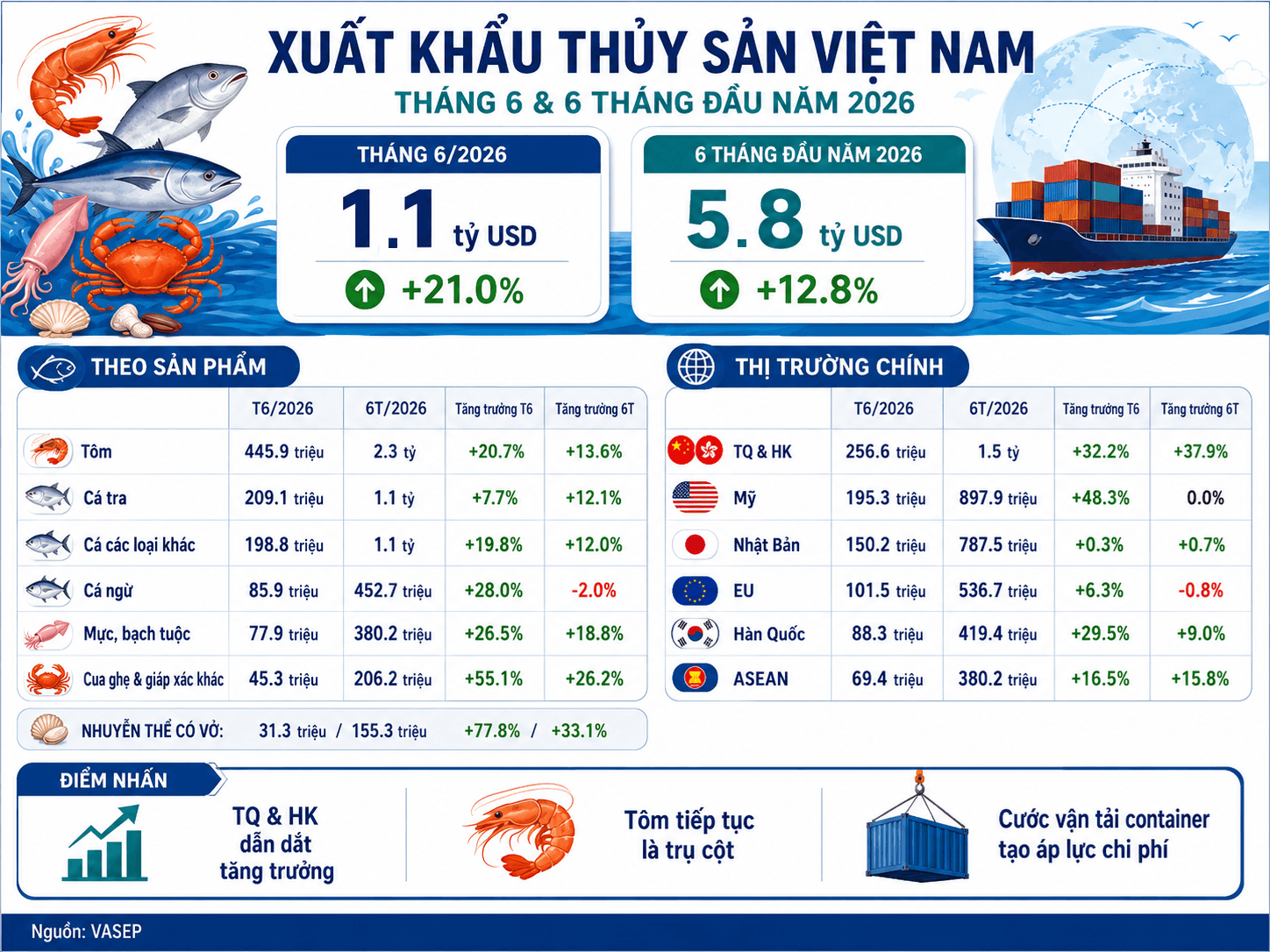
China and Hong Kong are Vietnam’s largest seafood import markets, supporting sector growth of about 13% in the first half of 2026. In June, Vietnam’s seafood export value reached about $1.1 billion, up 21% year over year, while the six-month total was nearly $5.8 billion.
China and Hong Kong together imported $1.5 billion of Vietnamese seafood, up about 38% and representing more than a quarter of the sector’s total. This underscores China’s position as the largest market and a key growth driver, with demand strengthening for shrimp, tra fish, lobsters, cephalopods, and a wide range of frozen seafood products.
By contrast, the US, Japan, and the EU have not shown strong growth. The US only recovered in June, with six-month performance roughly flat. Japan rose modestly, while the EU declined. Overall, the pattern points to slower recoveries across multiple economies and increased competitive pressure on exporters.
Exporters are facing price competition and tighter market requirements, including technical regulations and rising traceability obligations. Logistics costs are also increasing, with international container freight rates near their highest levels in nearly two years.
Freight pressures are being influenced by buyers pushing shipments earlier—particularly to the US—to mitigate tariff impacts. This has shortened delivery windows and increased demand for shipping capacity. In addition, instability in the Red Sea and the Middle East continues to disrupt shipping routes, lengthening transit times and raising operating costs.
For the seafood industry, which depends heavily on cold-chain logistics and on-time delivery to preserve quality, these disruptions can directly affect costs and competitiveness.
Market diversification is helping offset weaker performance in the US, EU, and Japan. ASEAN and Korea remain strong alongside China, supporting overall export momentum.
VASEP expects Vietnam’s seafood exports to reach about $5.8 billion in the first half of 2026, providing a positive base for aiming at double-digit growth in 2026. To sustain momentum, exporters are expected to broaden markets, manage costs, comply with traceability and origin requirements, and increase the share of value-added processed products.