•
•
•
•
•
•
•
•
•
•
•
•
•
•
•
•
•
•
•
•
•
•
•
•
•
•
•
•
•
•
•
•
•


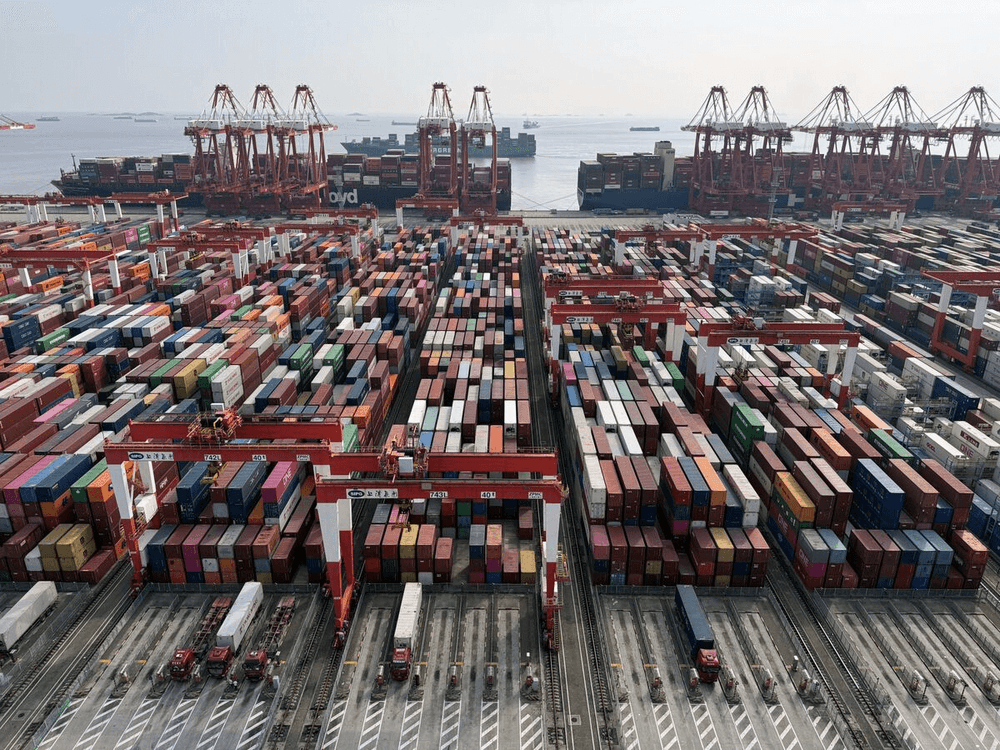
China’s export growth in March slowed to its weakest level in six months as the conflict between the United States and Iran weighed on global demand. At the same time, China’s imports rose at the fastest pace in more than four years, according to data released by China’s Customs on April 14.
Exports rose 2.5% in March from a year earlier, well below the 8.6% forecast in a Reuters poll and far under the 21.8% growth in total exports for January-February.
Imports increased 27.8% year-on-year in March, the strongest rise since November 2021. The figure was well above expectations of 11.2% and faster than the 19.8% increase recorded in the first two months of the year.
Despite ongoing trade tensions between China and the United States, China’s economic growth remains heavily dependent on trade. Analysts said the US-Iran military conflict, which erupted in late February, could leave China more resilient than other major economies due to ample strategic oil reserves, a diversified energy mix, and tight price-control measures.
However, the export-dependent economy remains vulnerable if global growth slows, including potential negative effects from a prolonged closure of the Hormuz Strait. At a press briefing on April 14, Wang Jun, deputy director of the General Administration of Customs, said global oil prices had been volatile recently, creating a complex and challenging trade environment.
Zhiwei Zhang, chief economist at Pinpoint Asset Management, said global macroeconomic prospects are difficult to forecast because the Middle East conflict may have weighed on demand, adding that export growth could slow.
Zhang noted that, compared with other export-dependent economies, China’s export growth trajectory may be better protected from high energy prices and raw material shortages due to the scale and efficiency of its manufacturing sector.
Dan Wang of Eurasia Group said China’s strategic oil reserves and trade, along with the volume of imported oil being shipped into the country, could amount to more than 120 days of net imports. Wang also argued that China could absorb energy shocks by diversifying its energy mix and increasing coal use.
CNBC calculations based on official trade data showed China’s crude oil imports in March fell about 2.8% in volume and about 4.4% in value year-on-year.
Natural gas imports fell 10.6% year-on-year to 8.18 million tonnes, the lowest since October 2022, according to Wind’s compilation.
China’s trade surplus in the first three months of the year reached $264.3 billion, down 3% from a year earlier, after spiking to a record high in the first two months.
Zhang said the main reason for the decline in the trade surplus is exporters’ inability to fully pass higher energy costs to foreign customers.
China’s exports to the United States fell 26.5% in March year-on-year, while imports from the US rose 1%.
Higher base commodity and energy prices linked to the Middle East conflict have begun to feed into producers’ input costs in China, eroding margins that were already thin. China’s factory-gate prices (PPI) rose 0.5% year-on-year in March, reflecting higher input costs and marking the first rise in more than three years.
Meanwhile, domestic consumer demand remained weak, with China’s CPI up 1% year-on-year, below expectations.







Premium gym chains are entering a “golden era” that is ending or already in decline, as rising operating costs collide with shifting consumer preferences toward more flexible, community-based ways to exercise. Long-term memberships are shrinking, margins are pressured by higher rents and facility expenses, and competition from smaller, more personalized…




