•
•
•
•
•
•
•
•
•
•
•
•
•
•
•
•
•
•
•
•
•
•
•
•
•
•
•
•
•
•
•
•
•


In Buon Ma Thuot, green Robusta coffee fields spread across red basalt soil. On the plots, Ê Đê farmers work with quiet concentration, reading the plants through experience—assessing vitality from the leaves, judging quality from the cherries, and sensing how the monsoon–dry season is shifting. Some cherries are recognized as “up to standard” without tasting, reflecting knowledge built over generations and passed from one person to another.
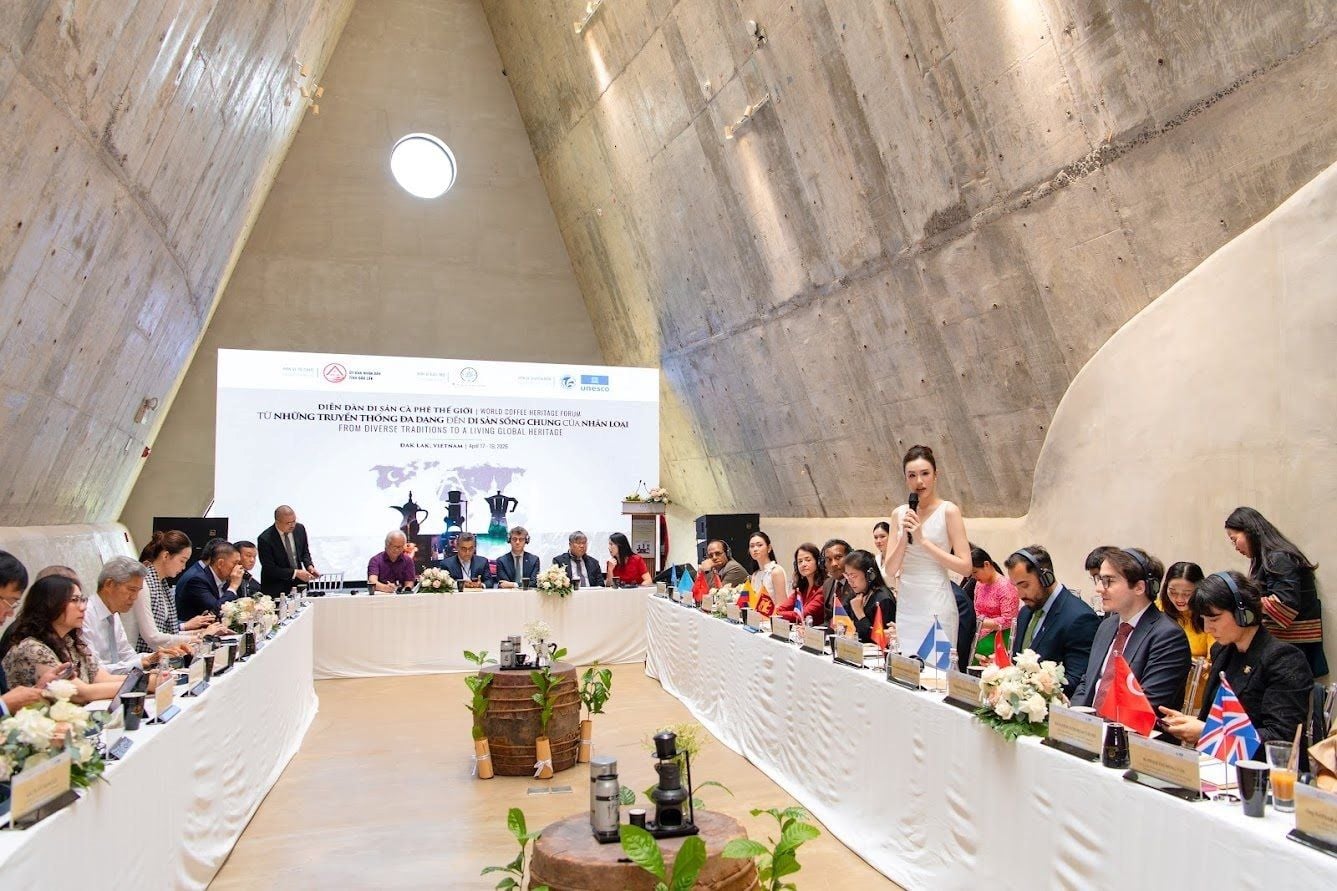
This question—whether Dak Lak coffee can become a living heritage of humanity rather than only a valuable product—was raised at the World Coffee Heritage Forum 2026 (18–19/04). The event is organized by Trung Nguyên Legend together with the Dak Lak Provincial People’s Committee, UNESCO, and Ho Chi Minh City University of Culture.
Vietnamese Robusta coffee, particularly Buon Ma Thuot Robusta, is described as an emblematic crystallization of the land’s “treasure.” The forum frames the region as more than a raw-material production area, presenting it instead as a cultural space where basalt soil, climate, cultivation expertise, and community memory converge.
The shift highlighted by the forum is from high-volume production toward coffee with depth and identity—positioning Vietnam more strongly on the world coffee map. To support a transition from commodity value to heritage value, Dak Lak and Vietnam are expected to build the foundations needed for conservation practices aligned with UNESCO’s 2003 Convention.
In 2025, knowledge related to growing and processing Dak Lak coffee was listed in the National Intangible Cultural Heritage List, recognizing local knowledge and the bond between people, nature, and livelihoods.
The World Coffee Heritage Forum 2026 is expected to clarify a roadmap for making Dak Lak coffee a sound conservation practice under the UNESCO 2003 Convention, while also expanding international collaboration and promoting Vietnamese coffee culture globally.
The forum’s discussion connects coffee value to an ecosystem that includes physical, social, and spiritual layers. Together, these layers are presented as evidence of “living heritage,” where coffee is not only preserved but continues to be practiced, refreshed, and shared within community life.
The approach is also linked to a framework described by Dang Le Nguyen Vu (founder of Trung Nguyên Legend), placing coffee within a progression: product → heritage → living heritage. In this view, coffee must not end at preservation; it should remain active in community practice and dissemination, reflecting the core spirit of the 2003 Convention.
The forum further emphasizes communication of Vietnam’s coffee through a universal language, referencing “three coffee civilisations—Ottoman, Roman, and Zen”—as a way to express connection, creativity, and mindfulness. This is presented as a path that moves beyond landscape-based heritage models toward a living value system connected to modern life, with ongoing development potential.
Within this framing, Buon Ma Thuot is described as a convergence space where nature, culture, and community intersect—positioning it as a potential “coffee city” in the sense of a living heritage space.
The forum positions Dak Lak coffee’s heritage pathway as more than replicating existing models. It is described as establishing a fresh understanding of coffee as an evolving value system—one that, when clearly rooted in community life, can move from possibility to an ongoing process on the global heritage stage.






Premium gym chains are entering a “golden era” that is ending or already in decline, as rising operating costs collide with shifting consumer preferences toward more flexible, community-based ways to exercise. Long-term memberships are shrinking, margins are pressured by higher rents and facility expenses, and competition from smaller, more personalized…