•
•
•
•
•
•
•
•
•
•
•
•
•
•
•
•
•
•
•
•
•
•
•
•
•
•
•
•
•
•
•
•
•


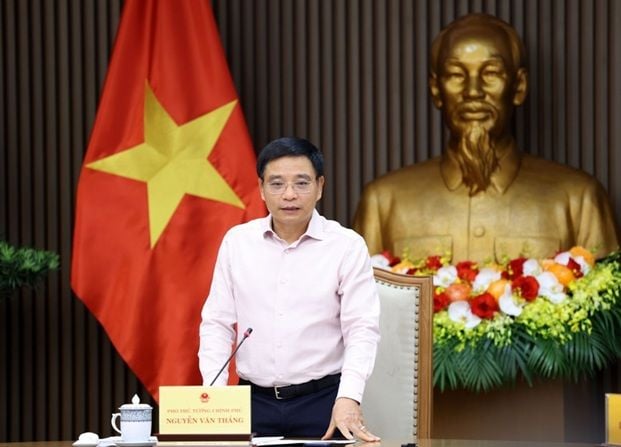
On 24 April, Deputy Prime Minister Nguyen Van Thang chaired a meeting at the Government Headquarters with relevant ministries and sectors, as well as Ho Chi Minh City and Da Nang City, to review the implementation of activities for the International Financial Center (TTTC).
Deputy Prime Minister Thang stressed that the TTTC must have all conditions to ensure smooth operation. He noted that numerous investors have shown interest in the International Financial Center in Vietnam.
Deputy Minister of Finance Nguyen Thi Bich Ngoc said that the foundational legal framework for TTTC has largely been formed, creating an important prerequisite for the transition to the operational phase. She added that the TTTC operating Regulation—covering the organization and operation of TTTC—is in its final stage. Completing this Regulation, she said, is a key step from institutional design to actual operation.
For TTTC in Ho Chi Minh City, 15 investors have been granted membership commitment certificates. The city is coordinating with strategic partners to develop proposals including a centralized commodities exchange, a maritime financial center, an aviation financial center, a venture capital fund, a green finance program, an international settlement switch, a clearing and settlement center, and a digitized asset sandbox model, among others.
For TTTC in Da Nang, the city has signed 20 MOUs with organizations, enterprises, and investors. It is continuing negotiations on four MOUs with international organizations. Da Nang has issued membership registration certificates for 12 investors, issued Letters of Interest to 11 investors, and has an additional nine investors currently completing membership registration.
Participants suggested that TTTC operating regulations should be issued soon and that a supervisory agency should be established. They also emphasized that infrastructure development is a prerequisite for effective operation, including physical infrastructure (especially the core area of the financial center in localities), digital infrastructure, IT systems, data, and interconnection with national systems.
Human resources were also identified as decisive for TTTC’s operational quality. In the near term, the focus should be on building and implementing mechanisms to attract, employ, and remunerate personnel with international competitiveness, and actively attracting experts with experience in global financial centers to participate in TTTC management, governance, and professional activities.
In concluding remarks, Deputy Prime Minister Nguyen Van Thang said the policy to establish the International Financial Center has been clearly defined and basic conditions have been prepared, and that the focus should now shift to rapid and decisive implementation. “There is no reason to delay; move quickly but ensure solid, effective progress. Do it to the extent possible,” he stated.
He also directed that implementation must tightly control risks, ensure security and safety of the national financial system, and build a high-quality environment to attract major financial institutions, adding that investor attraction must be substantive.
The Deputy Prime Minister asked ministries, sectors, and the two localities to promptly complete assigned tasks to ensure the financial centers operate smoothly.
He directed the Ministry of Finance to coordinate with relevant agencies to propose options to streamline the TTTC Steering Committee and the TTTC Governing Council, aiming for lean and efficient operation while leveraging the proactive roles of Ho Chi Minh City and Da Nang in TTTC development. Central agencies, he said, should focus on policy management and supervisory mechanisms as assigned, and report to the Prime Minister in April 2026.
Regarding TTTC operating regulations, the Ho Chi Minh City People’s Committee was tasked with consolidating and fully incorporating opinions of Steering Council members and the Ministry of Finance’s appraisal, then reporting to the Chair for signing.
The Ministry of Finance was assigned to lead, in coordination with the two cities and relevant ministries/agencies and the State Bank, to carefully review TTTC strategy development in Vietnam and the 2026 work plan, and report to the Chair of the Council for issuance.
For establishing the TTTC supervisory agency, the Ho Chi Minh City People’s Committee was instructed to promptly coordinate with the State Bank and relevant ministries to implement the Government’s direction in Notice 111, and report to the Government before 15 May.
Finally, the Deputy Prime Minister assigned the Ministry of Finance, in coordination with Ho Chi Minh City, Da Nang, other ministries and agencies, and the State Bank, to assess progress and results of TTTC tasks under Decision No. 114 dated 1 August 2025—clarifying which tasks have been completed and which will continue to advance TTTC operations—and report to the Prime Minister by 10 May.






Premium gym chains are entering a “golden era” that is ending or already in decline, as rising operating costs collide with shifting consumer preferences toward more flexible, community-based ways to exercise. Long-term memberships are shrinking, margins are pressured by higher rents and facility expenses, and competition from smaller, more personalized…