•
•
•
•
•
•
•
•
•
•
•
•
•
•
•
•
•
•
•
•
•
•
•
•
•
•
•
•
•
•
•
•
•


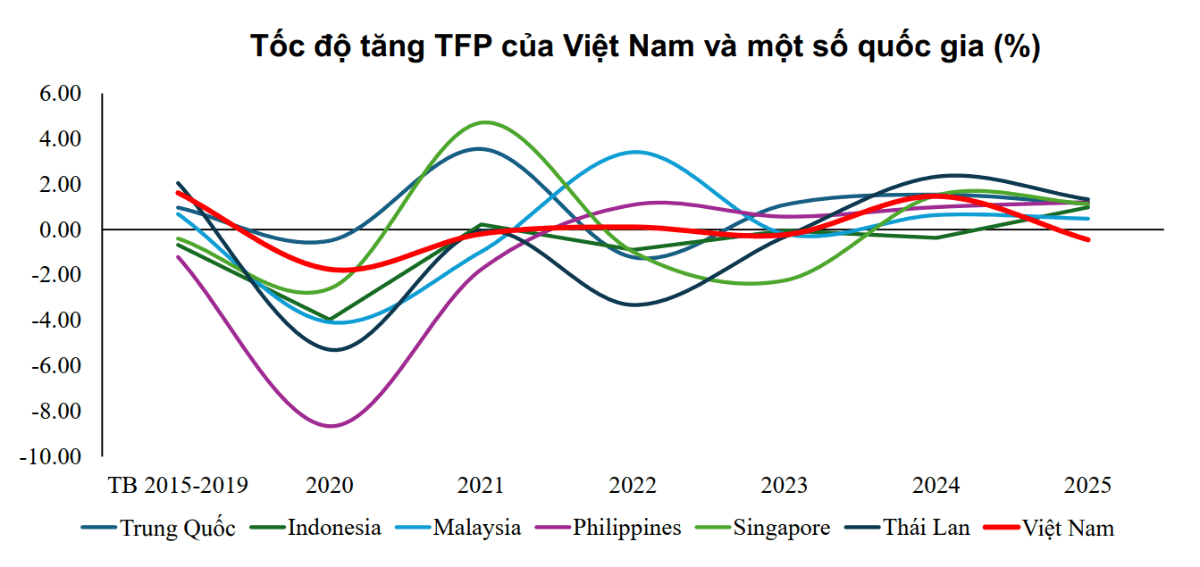
The 2025 Vietnam Annual Economic Review published by the National Economics University notes that the share of investment by the domestic private sector is trending downward, while the contribution of total factor productivity (TFP) to growth has turned negative. This indicates that growth strategies for 2026 should focus on institutional reform and the digital economy. Despite the challenges from the uncertain global economy, in 2025 Vietnam's economy grew by an impressive 8.02% and climbed to the 33rd largest economy in the world. Removing the “bottlenecks” of the institutional framework and building a coordinated ecosystem During the National Conference on Vietnam’s Economy 2025 and 2026 prospects: Promoting the development of the digital economy in the new era, Prof. Dr. To Trung Thanh of the National Economics University argued that 2025 growth still relied mainly on expanding credit (credit growth above 19%, the highest in a decade) and investment from the State sector (nearly 30% of total social investment and up nearly 20%). More concerning is that the share of domestic private sector investment—the essential long-term growth driver—has been trending downward. Along with that, the contribution of total factor productivity (TFP) to growth has turned negative, reflecting narrowing efficiency in governance, technology and resource allocation. In a context where the 2026 economy is forecast to face many risks from complex geopolitical tensions, to achieve growth, according to Prof. Dr. To Trung Thanh, the room is not only in expanding investment or stimulating aggregate demand; the core lies in reforming the institutional framework, improving governance quality, creating a more business-friendly, transparent and stable environment. “The essence is the process of restructuring the economy based on digital transformation,” he emphasized. Nguyen Duc Hien, Deputy Head of Policy and Strategy, Central Economic Committee, stated that 2026 must be a turning point for Vietnam to move from recovery to breakthrough, from growth driven by breadth to growth driven more by science, technology, innovation and the digital economy. In the conference, Prof. Dr. Nguyen Thanh Hieu, Deputy Director of the National Economics University, argued that completing the institutional framework for the digital economy must go hand in hand with building a coordinated policy coordination mechanism to avoid fragmentation. “Digital transformation, to go deep, must be placed in a fully connected ecosystem, from policy to implementation, from the public sector to the private sector,” Hieu emphasized. Specifically, according to Hieu, the digital economy today is not only about digitizing the ordinary economy, but about developing a business model based on data, digital technology and innovation. Although many enterprises have recognized the opportunities from applying this model, they do not know where to start to redesign their business plans. The role of data has been considered, but transforming them into real value remains limited. Therefore, the most urgent issue for the business community is to move from awareness to stronger action. To achieve this, businesses need to change their investment mindset: not only viewing digital transformation as a technology cost, but prioritizing investment in people, in building and exploiting data, in governance systems and in linking with partners within the ecosystem. Keeping growth targets at what price? ADB expert: Focusing reforms in key areas will help Vietnam sustain high growth WB forecasts Vietnam’s GDP growth in 2026 could reach 6.3%.








Premium gym chains are entering a “golden era” that is ending or already in decline, as rising operating costs collide with shifting consumer preferences toward more flexible, community-based ways to exercise. Long-term memberships are shrinking, margins are pressured by higher rents and facility expenses, and competition from smaller, more personalized…




