•
•
•
•
•
•
•
•
•
•
•
•
•
•
•
•
•
•
•
•
•
•
•
•
•
•
•
•
•
•
•
•
•


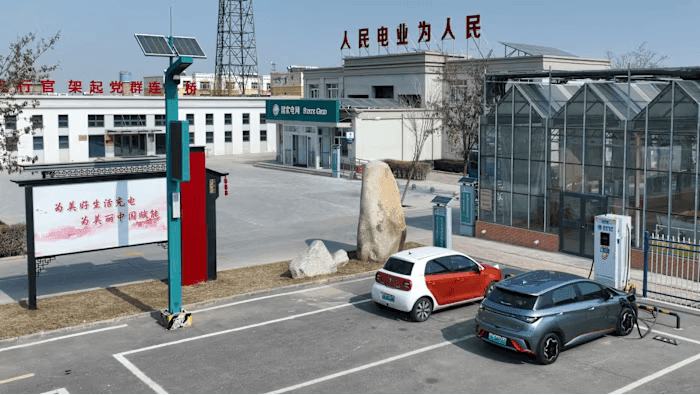
Electric-vehicle makers in China are moving beyond wealthy mega-cities and targeting less-developed inland regions to accelerate the phase-out of internal-combustion engines. The government’s expansion of public charging infrastructure is expected to prioritize underserved areas such as rural communities.
EVs currently account for about half of total car sales in China and have overtaken gasoline cars in most first- and second-tier cities, including Beijing, Guangzhou, Shanghai and Shenzhen. However, in lower-tier cities—representing around 80% of urban areas—the EV share remains below 40%.
“This will be the driver for the next phase of electrification,” said Chris Liu, Electric Vehicle Analyst at Omdia.
Expanding into inland areas poses a major challenge for traditional automakers that still rely on gasoline sales and have not undertaken the restructuring analysts say is necessary for the EV era. Volkswagen, BMW, Toyota, Honda and General Motors remain among the top 15 best-selling brands in China, largely due to internal-combustion engines, while their EV share is nearly negligible.
Omdia forecasts that EV sales in lower-tier cities will reach a “tipping point”—50% of total sales—by the end of 2027. Analysts warn this could create a surplus of gasoline cars and increase exports to international markets.
Some analysts also project that by 2030 only about 20% of cars sold in China will be gasoline-powered. Ying Damin, sales manager for Zeekr (Geely’s premium EV brand), said the gasoline share could be even lower in his cities as EV sales rise rapidly.
He added that Chinese consumers have shifted their identity from foreign car ownership to domestic EV technology. “Chinese people are proud of their brands,” he said.
The difference between big cities and smaller ones has largely been driven by affordability and limited charging infrastructure. That gap is changing as domestic brands such as BYD and Geely roll out more competitively priced models, including plug-in hybrids, supported by government efforts to expand charging access.
Late last year, the Chinese government launched a three-year plan to expand charging infrastructure. The target is 28 million public charging points by the end of next year, up from 21 million this year—enough to serve about 80 million EVs. There are already more than 50 million EVs on the road.
The plan focuses on underserved areas such as rural regions, highway rest stops and public parking lots, with total investment estimated at around $28 billion.
Chinese firms are also investing heavily in battery technology. CATL recently announced a battery that could enable a car to travel up to 1,500 km on a single charge.
As battery technology and charging infrastructure improve, analysts say consumers in inland cities—home to hundreds of millions—will increasingly favor EVs.
According to HSBC, consumers in inland areas may be influenced by trends from large cities, but they are expected to prefer cheaper domestic brands while still receiving a smart-driving experience.
Automomobility data shows that China sold 27.8 million vehicles last year, with EVs (including hybrids) and gasoline cars each at 13.9 million. Five years earlier, gasoline cars accounted for 23.9 million while EVs stood at 1.3 million.
Rising fuel costs after the Iran conflict have also supported EV demand. Ying said: “When oil prices rise sharply, especially in March, gasoline-vehicle sales fall sharply while EVs rise.”
Electric vehicles now account for 50% of China’s car market.
Competition in the EV sector is intensifying. China is rolling out nearly a new model every two days, with more than 1,400 models unveiled at the Beijing auto show this week, while price wars have trimmed industry-wide profits.
Despite the rapid growth, some automakers remain hesitant to fully abandon gasoline, particularly those with heavy investments in domestic production. VW plans to launch more than 30 EV models in China by 2030, but Robert Cisek, VW’s head in China, said the “gasoline era will last longer than we think.”
He argued that big cities will shift quickly to all-electric, while smaller cities will differ because the government still seeks to maximize existing gasoline-production capacity. He also warned that “there could be other events in the future that reverse the trend.”
VW’s strategy, he said, is to maintain a diversified product portfolio—from pure EVs to gasoline-powered vehicles—while integrating smart-driving technology developed in China across all offerings. “No matter which way the market shifts, we will have a product that fits.”
Premium gym chains are entering a “golden era” that is ending or already in decline, as rising operating costs collide with shifting consumer preferences toward more flexible, community-based ways to exercise. Long-term memberships are shrinking, margins are pressured by higher rents and facility expenses, and competition from smaller, more personalized…