•
•
•
•
•
•
•
•
•
•
•
•
•
•
•
•
•
•
•
•
•
•
•
•
•
•
•
•
•
•
•
•
•


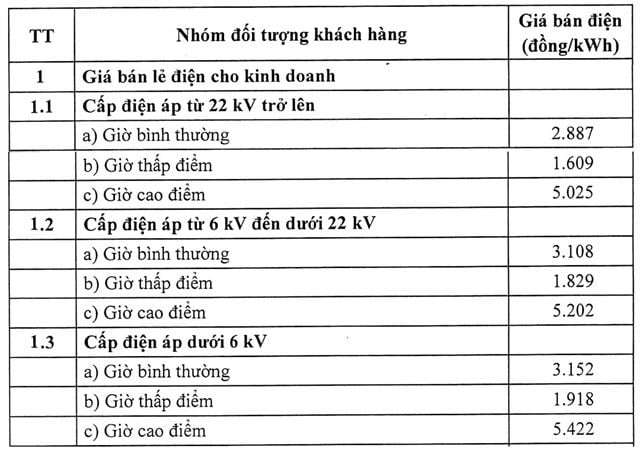
The Ministry of Industry and Trade has issued a new peak-hour regime for Vietnam’s national electricity system, defining peak, off-peak and normal time blocks. The framework applies to customers using electricity for manufacturing and business purposes, with tariffs varying by voltage level.
Peak hours: Monday to Saturday, 17:30 to 22:30 (5 hours per day). Sunday is not subject to peak hours.
Normal hours: Monday to Saturday, two periods—06:00 to 17:30 and 22:30 to 24:00 (13 hours per day). On Sundays, normal hours run continuously from 06:00 to 24:00.
Off-peak hours: 00:00 to 06:00 daily (6 hours per day).
Retail electricity prices for business customers depend on voltage level and time block:
For manufacturing customers, retail prices also vary by voltage level:
Across applicable voltage levels, manufacturing and business customers consuming electricity during peak hours face rates ranging from 3.266 to 5.422 VND/kWh, depending on voltage. Off-peak rates are substantially lower, ranging from 1.146 to 1.609 VND/kWh across the listed categories.
The ministry said shifting load profiles toward off-peak and normal hours can help level the load curve, reduce the gap between peak and average demand, and improve the efficiency of electricity generation and system operation.
It also pointed to Vietnam’s growing renewable energy share, including solar and wind. Adjusting peak-hour timing is intended to better reflect supply-demand characteristics under the new energy mix and may encourage the development of storage solutions.
Electricity Vietnam (EVN) supports the changes, saying aligning consumption with the new time blocks can reduce electricity costs for users who shift demand away from peak periods. EVN also noted that the regulation preserves the total daily hours for each block, aiming to minimize disruption for consumers, and could be more favorable for continuous daytime industrial production. EVN further stated that if customers adjust usage to the new time blocks, electricity bills should not change.
Tâm An, VietNamNet







Premium gym chains are entering a “golden era” that is ending or already in decline, as rising operating costs collide with shifting consumer preferences toward more flexible, community-based ways to exercise. Long-term memberships are shrinking, margins are pressured by higher rents and facility expenses, and competition from smaller, more personalized…