•
•
•
•
•
•
•
•
•
•
•
•
•
•
•
•
•
•
•
•
•
•
•
•
•
•
•
•
•
•
•
•
•


Eximbank’s Ordinary General Meeting (AGM) 2026 was held on the morning of April 28 in Hanoi, with proposals covering the bank’s business plan, profit distribution, and the election of additional members to the Board of Directors and the Supervisory Board for term VIII (2025–2030).
As of 8:30 a.m. on April 28, 2026, 166 shareholders attended in person or by proxy, representing more than 1.05 billion shares with voting rights, equivalent to 56.46% of Eximbank’s charter capital. Under the Law on Enterprises and the bank’s charter, the AGM 2026 met the conditions to proceed.
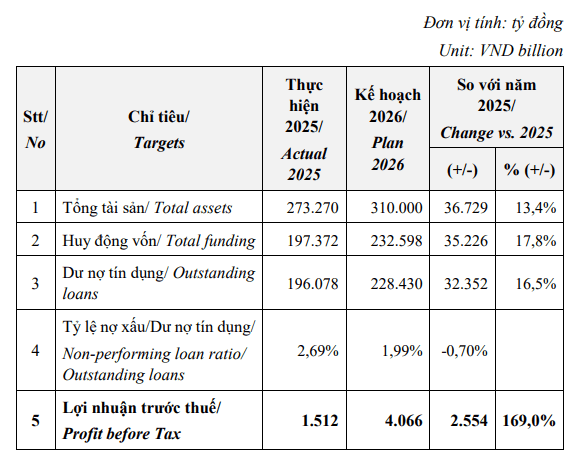
Eximbank aims for pre-tax profit of 1,515 billion VND in 2026, flat with the 2025 result. By 2026, the bank targets total assets of 310,000 billion VND, up 13% from the start of the year. Deposits mobilized and outstanding loans are expected to increase by 17.8% and 16.5% to 232,598 billion VND and 228,430 billion VND, respectively. The bank plans to keep the nonperforming loan (NPL) ratio below 2.5%.
For profit distribution, Eximbank proposes retaining all remaining profits and not paying dividends to strengthen financial capacity for growth and sustainable development. Undistributed profits through 2025 stand at nearly 3,397 billion VND.
On February 13, 2026, Eximbank announced the receipt of resignations from four directors and four Supervisory Board members. On February 6, 2026, it also announced plans to increase the number of Board members from 5 to 7, including at least 2 independent directors. Based on the resignations, the number of Board members for term VIII was expected to be 6, including at least 1 independent director. On April 13, 2026, Eximbank received the resignation of Pham Tuan Anh, a Board member.
The process indicates an increase in independent directors to 3 while keeping the total Board size at 5 per the previous resolution, resulting in three new independent directors to be elected.
The three candidates proposed to join the Board are Nguyen Tri Trung, Nguyen Trong Hien, and Ho Poh Wah, with backgrounds including ABBank, SCB, SCIC, REE, GELEX, Viglacera, Citi Bank, Standard Chartered Bank, KBC Bank Singapore, and OCBC Bank, among others.
The three candidates proposed for the Supervisory Board are Pham Thi Hong Thu, Luu Thuy Lan, and Do Thi Tuy Phuong, all with long experience at Eximbank.
Discussion at the AGM focused on three pillars for 2026–2030: customer centricity, governance and talent, and risk governance. Eximbank outlined a three-phase roadmap:
The bank commits to the approach: “Move confidently, grow sustainably and with controls.”
Eximbank reported that pre-tax profit in 2025 reached 1,512 billion VND, equivalent to 29% of the plan. The shortfall was mainly attributed to customer-support policies that lowered lending margins and increased provisioning to build a financial buffer for future growth.
For Q1 2026, Eximbank reported profit before tax of 338 billion VND.
In Q1 2026, the bank reported deposits of 204,417 billion VND (up 3% year-to-date and 20% of the annual plan) and lending of 200,764 billion VND (up 2.39% year-to-date and 14% of the annual plan). Net interest income was 1,380 billion VND (up about 2% year-on-year). Operating costs were controlled at 871 billion VND, while pre-provision income was 657 billion VND. After provisioning, quarterly pre-tax profit was 338 billion VND, equivalent to 22.3% of the annual plan.
To meet the 2026 targets, Eximbank said it will focus on selective business, concentrating on personal customers and SMEs and selective large, high-performing enterprises, alongside regional customer targeting. The bank also plans balance-sheet optimization through asset-liability management, cost control, and diversified funding, including expanding low-cost CASA deposits and aligning funding maturities with loan maturities. It will continue digital transformation and system safety measures, and maintain provisioning to ensure safety.
In a challenging rate environment, Eximbank’s credit-growth strategy for 2026 centers on prudence and efficiency. For individuals and SMEs, it will carefully select segments with clear cash flows and focus on short-term working capital financing. For large corporations, it will prioritize funding to key groups for cross-selling and product diversification.
The bank’s objective is to grow credit in line with regulatory limits while maintaining asset quality, keeping the NPL ratio under 2.5%.
On funding, Eximbank plans to diversify funding channels to achieve the lowest input costs, emphasize CASA, and use ALM-based funding matching to optimize capital use across the portfolio. Given a cooling real estate market, the bank plans to preemptively implement multiple debt-recovery scenarios, focusing on asset recovery to protect bank assets and maintain the target NPL ratio below 2.5%.
A new dividend policy is being considered: not to distribute dividends and to retain profits for reinvestment. The bank said it will avoid stock-dividend proposals in the near term to prevent equity dilution, and that a balanced dividend policy will be presented to the AGM to align shareholder interests with sustainable growth.
Management emphasized a strict separation of rights among shareholders, the Board of Directors, and executive management, with independent directors playing a pivotal role to monitor conflicts of interest and ensure governance quality.
At the end of the AGM, all resolutions were approved.
Premium gym chains are entering a “golden era” that is ending or already in decline, as rising operating costs collide with shifting consumer preferences toward more flexible, community-based ways to exercise. Long-term memberships are shrinking, margins are pressured by higher rents and facility expenses, and competition from smaller, more personalized…