•
•
•
•
•
•
•
•
•
•
•
•
•
•
•
•
•
•
•
•
•
•
•
•
•
•
•
•
•
•
•
•
•


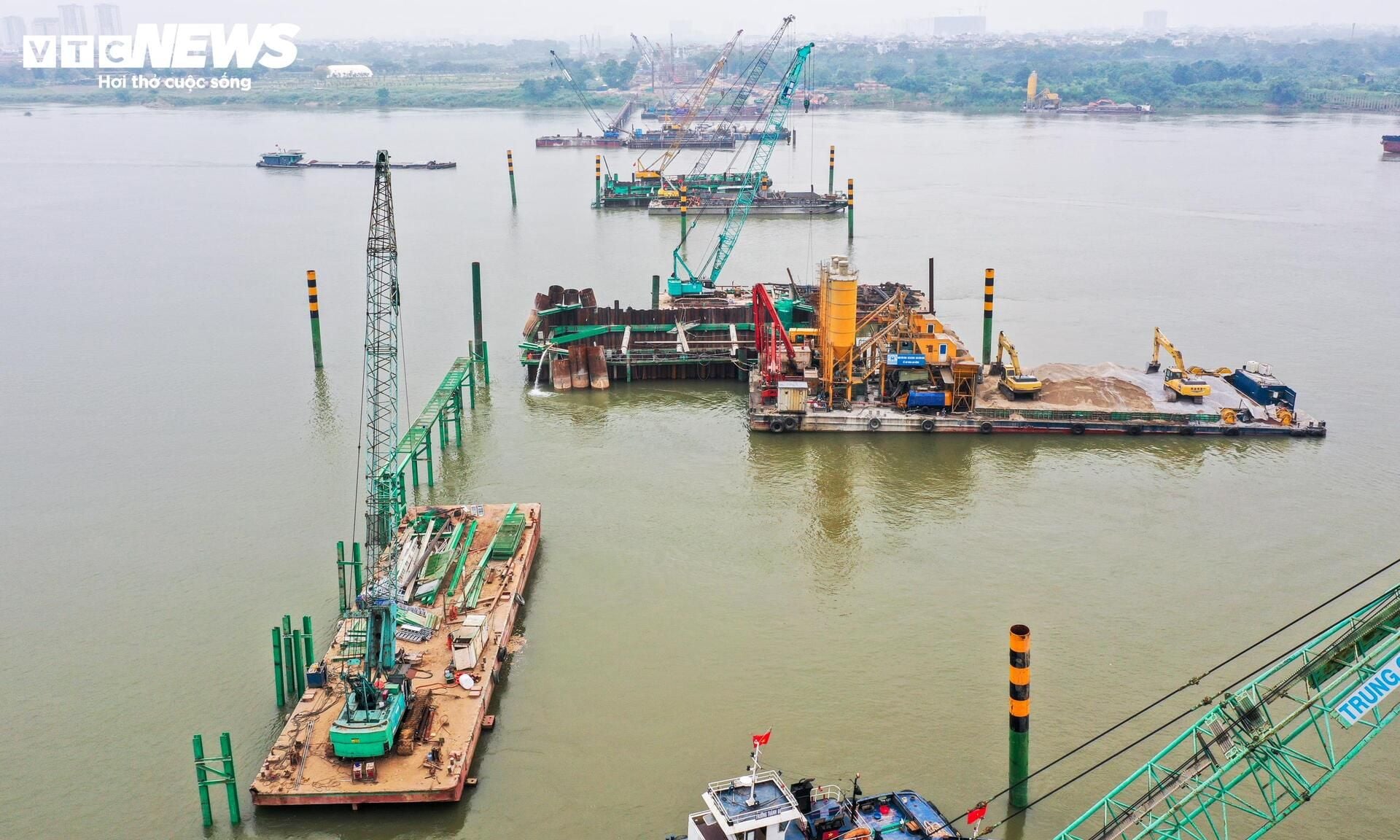
The Tran Hung Dao Bridge project is one of Hanoi’s key infrastructure works, launched to mark the 71st anniversary of Hanoi’s Liberation Day (October 10, 1954 – October 10, 2025). The project is expected to help complete the city’s cross-river traffic network and add a new connection corridor between the city center and the eastern part of Hanoi.
Under the approved plan, the project includes two component projects with total investment of about 15,967 billion VND. The route starts at the five-way intersection of Tran Hung Dao, Tran Thanh Tong, and Le Thanh Tong (Cu Nam Ward and Hai Ba Trung Ward) and ends at Nguyen Son Street (Long Bien Ward and Bo De Ward). The total route length is approximately 4.18 km.
In recent days, construction has been carried out intensively across multiple areas. The main contractors are Trung Chính Trading & Construction Co., Ltd. and Dat Phuong Group JSC, working simultaneously on several fronts.
Benefiting from favorable weather at the start of the year, contractors have mobilized maximum manpower and machinery to accelerate progress ahead of the rainy season from May 2026. Construction is not limited to daytime; work also continues at night.
On site, lighting systems are maintained continuously, and workers operate under a 3-shift, 4-team schedule to support overall project progress.
In the area of the main bridge piers from TC1 to TC4, work is proceeding as planned. Some piers have completed the first concrete pedestal and are continuing to install reinforcing steel in preparation for subsequent concrete pours. Other locations have completed pile-head processing, cleaned pits, and moved to the next stage of rebar assembly for pier pedestals.
On the Long Bien side, construction is progressing in parallel. Some piers have completed foundation treatment and are ready to pour concrete footings. Several locations have completed the first batch of concrete footings, which are curing while teams prepare for subsequent steps. Other piers have basically completed the pedestal and are moving to waterproofing and backfilling.
According to the project investor, the bored piles of the main bridge have reached about 89% of the total volume. Meanwhile, the pedestal and stem of the piers have reached over 37%. These components are critical for building a river-crossing bridge, particularly under the Red River’s complex hydrological conditions.
Alongside the main bridge, the approaches and the Long Bien interchange are also under development. To date, the contractor has driven hundreds of piles with various diameters. However, progress in some areas cannot proceed at full pace due to incomplete site handover.
The Tran Hung Dao Bridge project began on October 9, 2025 and is scheduled for completion in 2027. Once operational, the project is expected to ease traffic congestion in Hanoi’s central area and strengthen connectivity between the two riverbanks, supporting development momentum for the city’s urban space.






Premium gym chains are entering a “golden era” that is ending or already in decline, as rising operating costs collide with shifting consumer preferences toward more flexible, community-based ways to exercise. Long-term memberships are shrinking, margins are pressured by higher rents and facility expenses, and competition from smaller, more personalized…