•
•
•
•
•
•
•
•
•
•
•
•
•
•
•
•
•
•
•
•
•
•
•
•
•
•
•
•
•
•
•
•
•


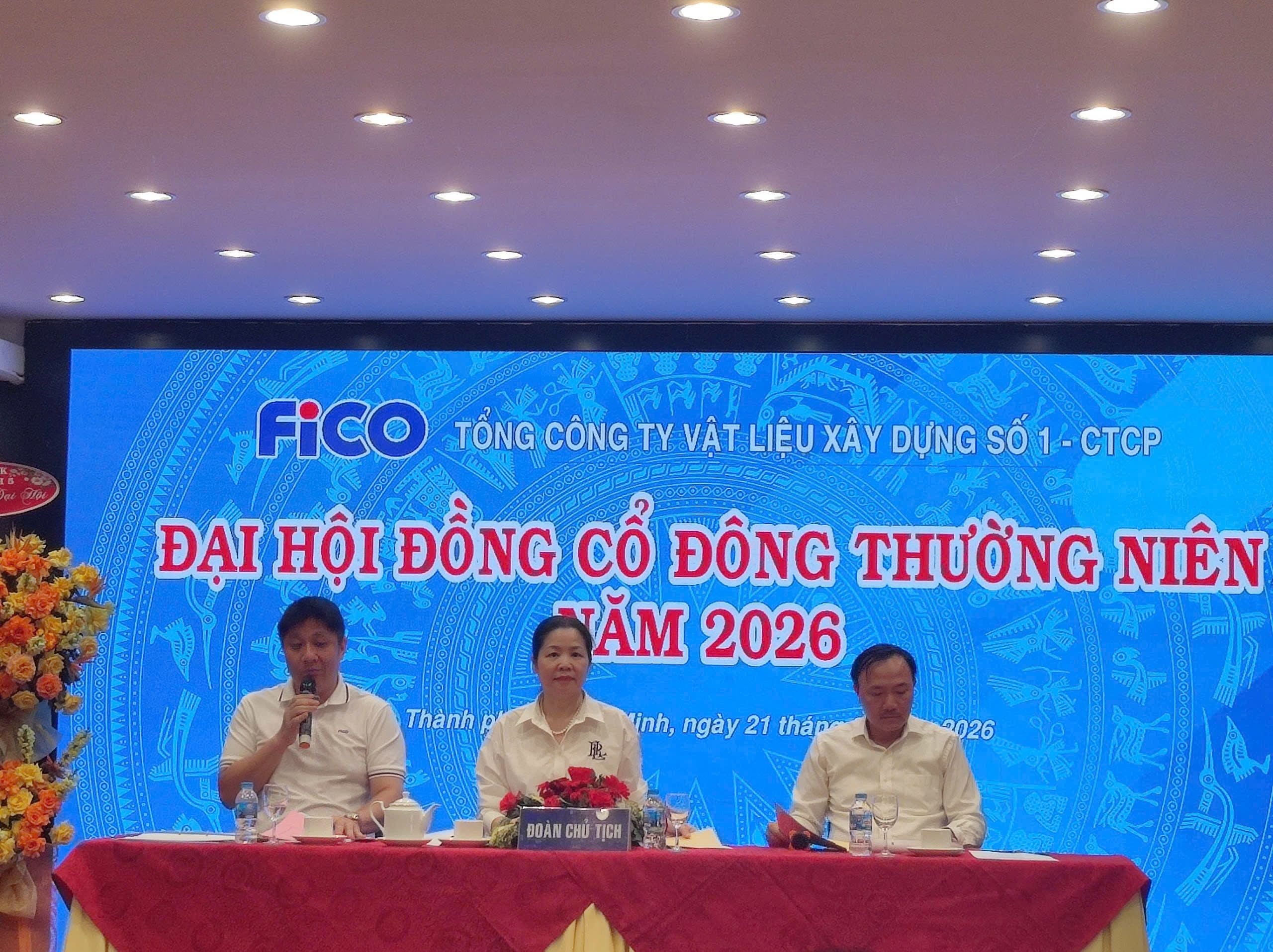
FiCO’s 2026 annual general meeting (AGM) approved a cautious business plan, citing continued market pressures and higher cost of capital. The company also elected a new leadership team for the 2026–2031 period and said it will focus resources on the Tay Ninh Cement Plant project.
Management expects 2026 to be more challenging than 2025, driven by global volatility and weaker market conditions. The interest rate environment is forecast to remain higher, potentially rising from about 5% to 8% per year. Fluctuating oil prices are also expected to increase production costs.
With debt around VND 550 billion, the rate gap is expected to lift production financing costs by VND 15–20 billion. Management noted that global dynamics can also affect capital costs, transport costs and production costs across member units.
FiCO aims to grow revenue by 1–2% year-on-year, depending on targets. Consolidated revenue is expected to be about VND 1,197 billion, while parent company net revenue is expected to be around VND 1,446 billion.
On earnings before tax, FiCO targets consolidated profit of VND 148 billion, while parent company pre-tax profit is expected to approach VND 100 billion.
The company plans to treat 2026 as a year to initiate major investment projects, prioritizing and expediting capital raising to support long-term development strategies.
FiCO officially kicked off a second phase of the Tay Ninh Cement Plant investment with estimated capex of around VND 2.8 trillion. The plant’s design capacity is 1.4 million tonnes of clinker per year, lifting total plant capacity to nearly 3 million tonnes of clinker annually.
Cement output is expected to rise from about 2.5 million tonnes to around 4 million tonnes per year. With the scale expansion, FiCO aims to increase its market share in the Southeast and Mekong regions from 10% to 18%.
For mining and logistics, FiCO plans to increase equity in Phuoc Hoa FiCO JSC to secure committed funds and ensure site clearance for the project.
FiCO also plans to launch the FiCO Inland Port cluster to enhance transport capacity and support trade in large-volume products such as stone and sand.
In real estate, FiCO said legal procedures related to land acquisition for the 2/34 Phan Huy Ich project in Ho Chi Minh City were still impeding progress. The company also plans renovations to bring office space on the 4th floor of the Ho Tung Mau building into operation quickly.
Another 2026 objective is to complete settlement and disbursement of capital and proceed with government-directed capital divestment. FiCO said it will coordinate with the Steering Committee on State Capital and related agencies to complete the transfer to a joint-stock company and implement divestment in line with policy, freeing capacity to attract new investment.
For 2025, FiCO paid cash dividends at 5.5%, totaling VND 69.9 billion, equivalent to 82.7% of distributable profit. For 2026, the board plans to present to the 2027 AGM a dividend of 5% for 2026.
Under its 2026–2031 strategy, FiCO said it will concentrate on key investment projects from 2026 to 2028. From 2028 to 2031, the group’s plants and mineral operations are expected to run steadily to support earnings growth.
In 2025, FiCO reported consolidated revenue above VND 1,186 billion and pre-tax profit near VND 145 billion, exceeding targets due to contributions from subsidiaries and associates. Net profit reached VND 131 billion.
Key drivers included cement, clinker, stone and mineral operations supported by public investment. FiCO highlighted Nui Ong Trinh quarry, which delivered pre-tax profit of nearly VND 48 billion—about four times the plan. The ceramic tile segment, however, saw roughly a 30% revenue decline due to restructuring and weak demand.
Financially, debt remained around VND 557 billion with interest costs around VND 21 billion. The company also intensified receivables collection and recorded provisions of nearly VND 146 billion.
Management said demand for finishing materials such as ceramic tiles remains very low, so 2026 is not expected to bring a sharp earnings surprise. In cement and minerals, conditions may stay favorable, but growth is expected to slow, and achieving 2025 levels is viewed as a success.






Premium gym chains are entering a “golden era” that is ending or already in decline, as rising operating costs collide with shifting consumer preferences toward more flexible, community-based ways to exercise. Long-term memberships are shrinking, margins are pressured by higher rents and facility expenses, and competition from smaller, more personalized…