•
•
•
•
•
•
•
•
•
•
•
•
•
•
•
•
•
•
•
•
•
•
•
•
•
•
•
•
•
•
•
•
•


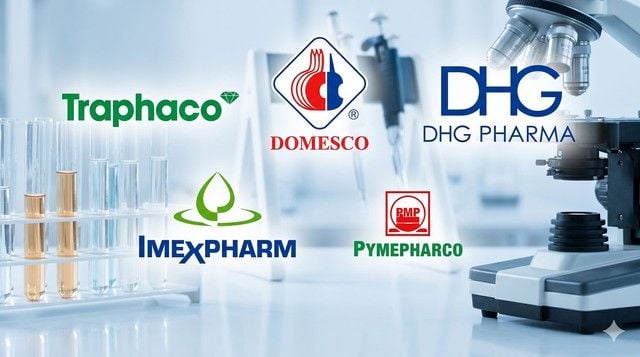
Vietnam's largest-capitalized pharmaceutical companies are now under foreign control or are involved in strategic foreign shareholder involvement. The Livzon takeover of Imexpharm recently underscores the trend of international capital shaping the domestic drug-manufacturing chain. Data from the stock market shows clear size stratification, with foreign capital being most evident among the leading players. At the three largest-capitalized companies in the sector today — Dược Hậu Giang (DHG - 12,709 billion VND), Imexpharm (IMP - 7,215 billion VND), and Dược Hà Tây (DHT - 6,340 billion VND) — foreign investors play a controlling role or are the largest shareholders. Specifically, Taisho Pharmaceutical (Japan) has maintained ownership above 51% in DHG since 2019. In early May 2026, through the entity Lian SGP, Livzon Pharmaceutical Group (China) completed the purchase of 67.87% of IMP shares, with a transaction value around 6,000 billion VND. In third place, DHT also recorded ASKA Pharmaceutical (Japan) continuously increasing its stake to about 40%. The trend of transferring control to international institutions has also been completed at many other pharmaceutical companies on the market. Abbott Laboratories (USA) currently holds 51.7% of Domesco's capital. Notably, the market previously saw STADA Arzneimittel (Germany) acquire 99.5% of Pymepharco (PME) in 2021 and subsequently delist the company. For the group of companies with foreign ownership nearing a controlling stake, TRA (Traphaco) currently records the participation of a Korean investment alliance (Daewoong and Mirae Asset) with a stake of 40.12%. Momentum from a $16 billion market The main objective of international groups in M&A deals is to access production systems that meet standards and an established domestic distribution network. In the Imexpharm deal, the core asset is a system of 12 production lines that meet EU-GMP standards, a necessary factor to compete in the hospital drug tendering segment (ETC). The ownership shift occurred amid a growing Vietnamese pharmaceutical market. The industry size rose from about $4-5 billion in 2015 to $8-9 billion in 2024-2025 and is projected to reach around $16 billion by 2032.
Premium gym chains are entering a “golden era” that is ending or already in decline, as rising operating costs collide with shifting consumer preferences toward more flexible, community-based ways to exercise. Long-term memberships are shrinking, margins are pressured by higher rents and facility expenses, and competition from smaller, more personalized…