•
•
•
•
•
•
•
•
•
•
•
•
•
•
•
•
•
•
•
•
•
•
•
•
•
•
•
•
•
•
•
•
•


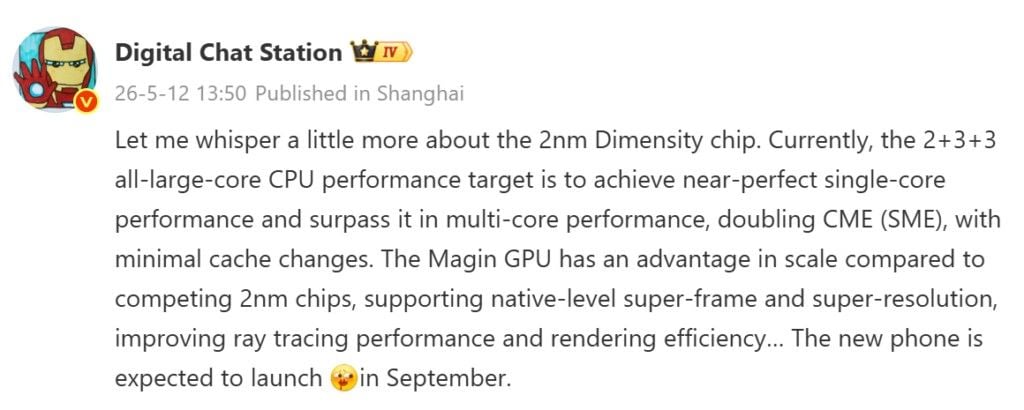
MediaTek is reportedly developing the Dimensity 9600, its first chip manufactured on the 2nm process. A leak attributed to Digital Chat Station suggests the new processor could bring major performance gains and, in some areas, outperform Apple’s chips.
The leak indicates the 2nm Dimensity 9600 may use a 2+3+3 CPU architecture, with all cores described as large cores. The source expects single-core performance to be close to Apple’s chips, while multi-core performance could be stronger. The leak does not specify whether the comparison is intended for the upcoming Apple A20 Pro or the current Apple A19 Pro.
MediaTek’s Dimensity 9600 is also expected to deliver a substantial improvement in CME/SME capabilities, with the leak suggesting performance could double compared with the previous generation. Cache changes are expected to be modest, according to the same source.
For graphics, the Dimensity 9600 is expected to include a next-generation Magin GPU. The leak says the GPU may use a larger die size than competing 2nm chips. It also points to support for native frame interpolation and super-resolution, alongside improvements in ray tracing and overall rendering efficiency.
The source states that devices using the Dimensity 9600 series are expected to launch in September. It is also likely that the Vivo X500 Pro line will be unveiled during the same month.
Separately, the OPPO Find X10 Pro and Find X10 Pro Max are rumored to be equipped with Dimensity 9600 series chips. However, it remains unclear whether those models will launch in September or follow the previous generation’s October schedule.
In September, Qualcomm is expected to announce the Snapdragon 8 Elite Gen 6 and Snapdragon 8 Elite Gen 6 Pro. The Xiaomi 18 line is believed to use these chips and is also expected to be unveiled around the same time.
Premium gym chains are entering a “golden era” that is ending or already in decline, as rising operating costs collide with shifting consumer preferences toward more flexible, community-based ways to exercise. Long-term memberships are shrinking, margins are pressured by higher rents and facility expenses, and competition from smaller, more personalized…