•
•
•
•
•
•
•
•
•
•
•
•
•
•
•
•
•
•
•
•
•
•
•
•
•
•
•
•
•
•
•
•
•


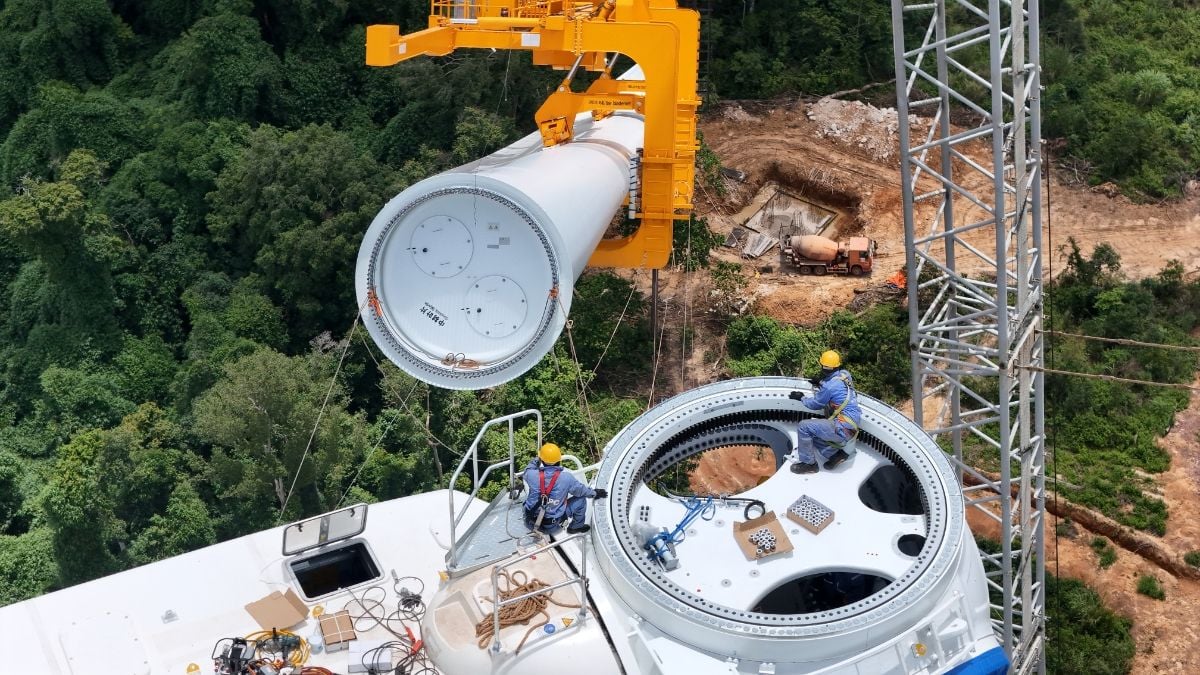
A wind-power project in Laos undertaken by T&T Group reached commercial operation (COD) and began injecting electricity into Vietnam after about 16 months, quickly achieving an output of approximately 0.9 billion kWh per year. The project is presented as part of a broader execution approach focused on thorough preparation from the outset to enable fast implementation, reducing delays between stages and maintaining overall momentum in large, complex projects. The strategy is linked to entrepreneur Do Quang Hien’s management maxim: “prepare thoroughly to implement quickly.”
Over more than two decades, Vietnam–Laos energy cooperation has evolved from traditional hydropower projects toward renewable energy. In earlier phases, scale and output were key measures, while more recent developments place increasing weight on the speed of progress.
In the early 2000s, projects such as Xekaman 1, Xekaman 3 and Xeset began. Hydropower plants on Lao soil started generating electricity and exporting some to Vietnam, with cross-border power exports reflecting both economic significance and a precedent for linking the two national grids. Cooperation during this period was assessed through electricity output, construction progress and stable cross-border operation.
By the 2010s, hydropower potential had diminished as Vietnam’s electricity demand continued to rise with urbanization and industrial expansion. Environmental concerns and emissions also became more prominent, pushing cooperation toward cleaner and more sustainable energy sources. Many Vietnamese firms began studying renewable-energy projects in Laos, with wind power viewed as a promising direction aligned with regional energy-transition trends.
However, wind power introduces different constraints than hydropower. Beyond building the plant, transmission infrastructure and grid integration become major bottlenecks. The article notes that even after construction, many projects waited for years to secure a clear electricity outlet, causing commercial-operation dates to slip from initial plans.
In this context, the ability to orchestrate the project end-to-end concurrently—rather than sequentially—has become a differentiator for investors. The article describes Savan 1 as a representative case mapped from the outset with the objective of achieving commercial operation in the shortest possible time.
The project began in early 2025 under T&T Group with a design capacity of about 495 MW. Phase 1 is 300 MW and includes 48 wind turbines. Rather than building the plant first and then seeking a transmission solution, T&T Group adopted a parallel approach: simultaneously constructing the wind farm’s main components while investing in a dedicated transmission line to bring power to Vietnam.
The article emphasizes that implementing multiple components concurrently depends not only on resources but also on the level of preparation beforehand. When technical options, infrastructure needs and execution plans are well considered, decisions can be made faster, reducing waiting times between stages and shortening the overall project timeline.
As a result, after roughly 16 months, Savan 1 achieved COD and connected wind power from Savannakhet to Vietnam’s grid. The project began operating stably with an annual output of about 0.9 billion kWh. The article describes this as evidence of the ability to manage progress, quality and exploitation efficiency within a short timeframe for a cross-border energy project.
It also states that the full project cycle—investment, construction, transmission-infrastructure completion and market participation—was closed within a period rarely seen for cross-border energy projects, arguing that the outcome reflects how the project is organized and controlled rather than chance.
Caption: 220kV transmission system – a crucial link helping deliver wind power from Savan 1 to Vietnam stably and efficiently. Photo: T&T Group.
Following Savan 1, T&T Group is proposing Savan 2, a wind-plant project. The article argues that this cluster logic is consistent with the broader strategy: sharing transmission infrastructure, transport equipment and deployment experience can reduce incremental capital costs and improve exploitation efficiency.
It also frames the rapid delivery capability as laying groundwork for future projects to be organized even faster. The Vietnam–Laos green-energy corridor, once described as a strategic direction, is presented as a structure that can be expanded and replicated.
Mr. Do Quang Hien, founder and executive chairman of T&T Group, is quoted as emphasizing that energy investment is sustainable when aligned with national interests, practical operating capability and long-term value for the economy. The article says the Savan 1 approach reflects this philosophy by balancing project scale with the ability to reach targets and deliver real electricity to the system.
While Savan 1 is not described as the starting point of Vietnam–Laos energy cooperation, it is presented as a milestone showing how deployment approaches are changing. Instead of progress depending heavily on external conditions, the article argues that progress control is becoming a repeatable capability—starting with thorough preparation that enables fast and continuous execution, consistent with the “prepare thoroughly—implement quickly” management philosophy.
Caption: Components are implemented around the clock, illustrating the determined spirit and organizational capability of T&T Group in large-scale projects. Photo: T&T Group.






Premium gym chains are entering a “golden era” that is ending or already in decline, as rising operating costs collide with shifting consumer preferences toward more flexible, community-based ways to exercise. Long-term memberships are shrinking, margins are pressured by higher rents and facility expenses, and competition from smaller, more personalized…




