•
•
•
•
•
•
•
•
•
•
•
•
•
•
•
•
•
•
•
•
•
•
•
•
•
•
•
•
•
•
•
•
•

FTSE Russell is scheduled to publish the interim review results for March 2026 for Vietnam on 07/04/2026, a key milestone in the country’s progress toward upgrading to the Secondary Emerging Market status (expected to take effect from September 2026), particularly in improving access for global brokers.
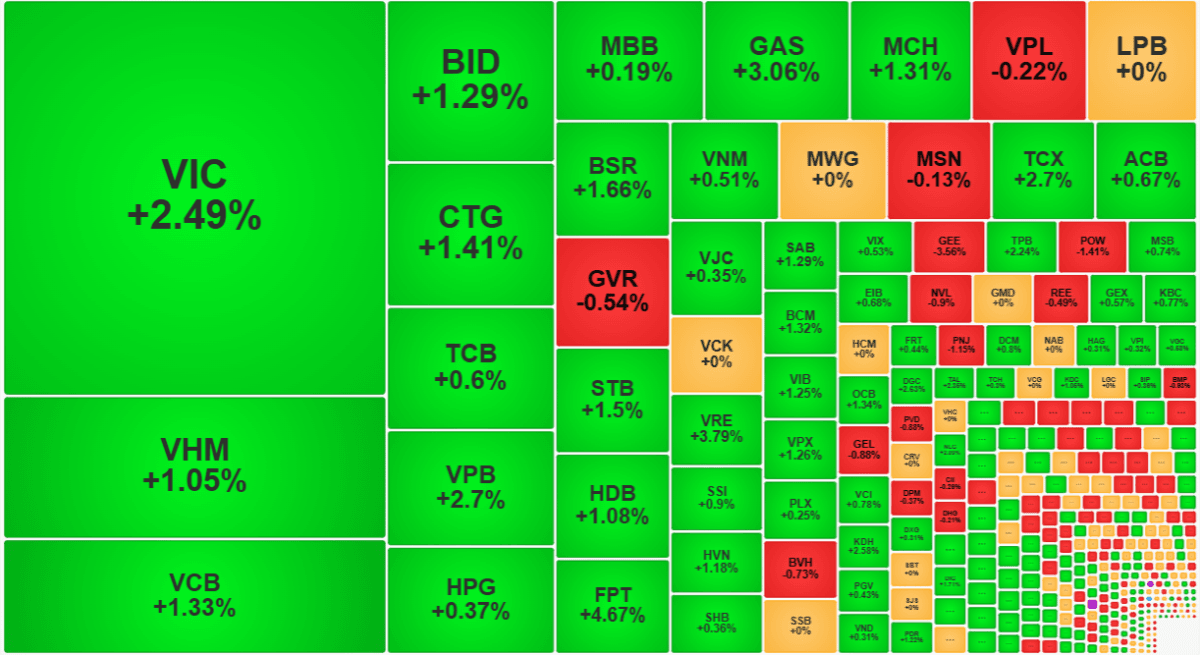
Vietnam’s stock market extended its recovery for a second week, supported by the return of the Vingroup group. At the close of the previous week, the VN-Index stood at 1,684.04 points, up 11.24 points (+0.67%). The advance was aided by large-cap stocks including VHM (+14 points), VIC (+13.8 points), GEE (+1.7 points), and VCK (+1.1 points). For the week, the VN30 index rose +0.87%, while Midcap and Smallcap declined by -2.2% and -0.9%, respectively.
MBS said longer-term support is linked to Conclusion 18-KL/TW from the 2nd Conference of the XIV Central Committee, which emphasizes the need to avoid economic crises in all situations. The conclusion highlights promoting growth tied to macro stability, controlling inflation, ensuring major balances, and prioritizing capital market development as a long-term funding channel to reduce reliance on bank credit.
It also points to measures to upgrade national credit ratings and upgrade the stock market, issue a policy mechanism to attract indirect capital and international funds, expand foreign room in sectors not affecting national security, and modernize the banking system by addressing weak credit institutions and increasing capital for state-owned banks.
Money flow data showed signs of profit-taking and a shift away from commodity and defensive groups, including Oil & Gas, Fertilizers, Power generation & distribution, and Insurance, suggesting that market risk is moderating and investors are gradually refocusing on company fundamentals.
Conversely, the stock sector attracted renewed flows after FTSE Russell announced the interim review, recording the highest capital concentration in four weeks. Some names continued to trend higher, including HCM, MBS, BSI, and VCK. Money also began to turn back toward Steel and Vingroup.
MBS recommended maintaining a 40/60 stock/cash ratio, preferring buying or restructuring during pullbacks, and avoiding chasing prices during sharp upswings—particularly when the VN-Index moves above 1,720. In a sideways range-building phase aimed at forming a second bottom, it suggested focusing on Midcap groups that have formed a clear bottom, including Residential real estate, Banking, Steel, Vingroup, Retail, and Industrial real estate.
KBSV noted that the VN-Index is set to extend a second straight week of gains after last week’s pullback, though it formed a very neutral spinning candle. On the daily chart, the index slightly breached the near-term resistance zone but then formed three consecutive reversal candles with long upper wicks, indicating distribution pressure and negating the initial week’s upside gap.
KBSV said this pattern suggests volatility in early-week sessions, with a rebound opportunity still possible. It added that the medium-term trend remains temporarily neutral, keeping upside risk elevated around resistance levels.
Mirae Asset assessed that in the short term the market may sustain a rebound with a range-bound, positive stance. Demand is expected to absorb well around the 1,650 level (MA200), supported by attractive discounted P/E valuations and stable liquidity. This could help sentiment improve and set up a supply–demand test around 1,700, with room for growth if selling pressure is absorbed.
Overall, the market is expected to oscillate within a range defined by MA100 and MA200, roughly 1,660–1,750 points. In the base case, internal catalysts could help the market form a second bottom near the MA200 as the earnings season approaches.
Foreign investors, meanwhile, remain heavy sellers ahead of FTSE Russell’s upgrade results.
9:09, 06/04/2026
Bitcoin (BTC) investors who use steady dollar-cost averaging (DCA) may be underperforming versus strategies that adjust exposure to the market’s cycle, according to new research arguing that Bitcoin’s behavior differs from traditional long-duration assets.
In a report cited by Markus Thielen of 10x Research, Bitcoin’s market…