•
•
•
•
•
•
•
•
•
•
•
•
•
•
•
•
•
•
•
•
•
•
•
•
•
•
•
•
•
•
•
•
•


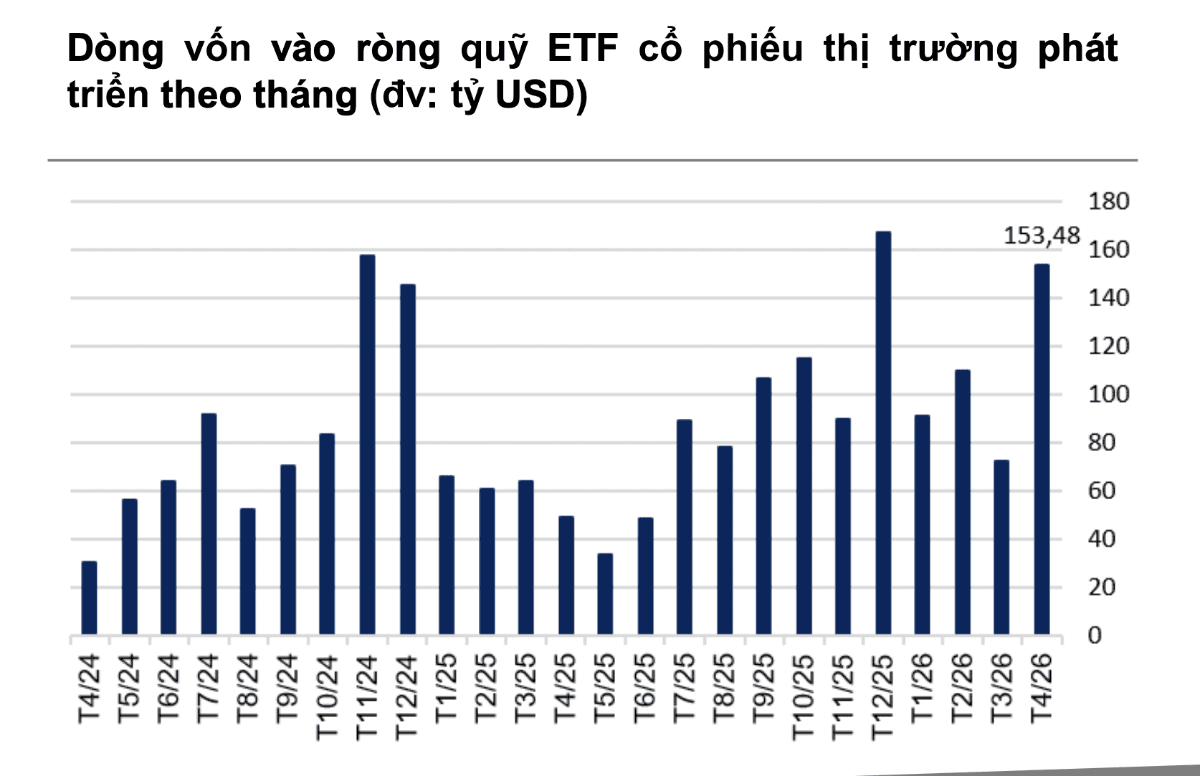
US stock ETFs attracted net inflows of about $133.1 billion in April 2026, up sharply from $33.6 billion in the prior month. According to VNDirect, the improvement reflected a better risk environment as the Middle East conflict did not escalate further and signs of cooling emerged, prompting investors to rotate back into risk assets.
Equity ETFs remained the main driver, recording net inflows of $165.5 billion, up 62.3% from the previous month. In the more defensive segment, bond ETFs drew net inflows of $45.6 billion, up 3% month-on-month, indicating continued demand for fixed-income exposure to help balance portfolios.
Currency ETFs attracted net inflows of $1.6 billion, down 80.4% from the prior month as investors shifted toward higher-yielding assets. Commodity ETFs drew net inflows of $2.8 billion, reversing a $9.4 billion net outflow in the previous month, supported by renewed buying after profit-taking and stabilization in commodity price volatility.
Global equity ETF flows were mixed in April 2026 as the Middle East conflict persisted. Equity ETFs in developed markets continued to attract inflows of about $153.4 billion, up 112.8% from the prior month, pointing to a notable improvement in risk-on sentiment.
By contrast, equity ETFs in emerging markets saw outflows totaling $25.6 billion, up from $1.2 billion in the previous month. The shift reflected more cautious sentiment toward higher-beta markets amid external volatility.
The US market led overall inflows, with US equity ETFs attracting net inflows of about $133.1 billion, up from $33.6 billion the previous month. The article attributes the rebound to improved investor risk appetite, supported by expectations that the Federal Reserve may ease monetary policy in the near term and by a positive earnings outlook.
In Asia, flows were mixed across major markets. Japan continued to attract net inflows of more than $4.4 billion, supported by positive growth expectations and progress in corporate governance reforms. China, however, recorded outflows of about $37.1 billion, reflecting cautious sentiment amid concerns about the durability of the recovery, deflationary pressure, and uncertainty over policy support.
In the last week of April, inflows into US-listed ETFs surged, according to Yuanta. Weekly net inflows into US-listed ETFs rebounded to $45.7 billion, up 113% from the prior week.
US equity ETFs accounted for much of the increase, adding $34.7 billion in net inflows, up 83.4% week-on-week, driven by hopes for positive Q1 results. US bond ETFs also rose for the second straight week, totaling more than $12.7 billion in net inflows, up 100% versus the prior week as 10-year US Treasury yields recovered toward 4.45%.
Flows into non-US equity ETFs declined for a second week, with net inflows of only $1.6 billion, down about 72% from the prior week. Non-US bond ETFs improved, attracting nearly $1.6 billion in inflows, up 178% week-on-week. Commodity ETFs continued to experience net outflows of $876 million, though the outflow was smaller than the prior week’s $2.6 billion.
Overall, the last week’s pattern suggested risk-on sentiment persisted through US equity inflows, while demand for defensive assets through bonds became more evident as yields remained high. The article also noted that demand for gold weakened as central banks signaled an imminent end to monetary easing.
In Asia, foreign capital continued to trend toward outflows. Taiwan saw net outflows of $6.3 billion after a week of inflows. South Korea, India, Indonesia and Vietnam also recorded outflows of $1.5 billion, $864 million, $409 million and $71 million, respectively. Thailand was the exception, with nearly $15 million in inflows.
ETF flows into Southeast Asia reversed to net inflows after two weeks of outflows. Thailand continued to attract $23 million in the second week, while Vietnam saw inflows. Indonesia led outflows with more than $16.5 million, and Singapore faced outflows of $5.5 million.
In local market performance mentioned in the article, the VN-Index rose 10% in April, and ‘shark’ PYN Elite reported a 1% gain.

Premium gym chains are entering a “golden era” that is ending or already in decline, as rising operating costs collide with shifting consumer preferences toward more flexible, community-based ways to exercise. Long-term memberships are shrinking, margins are pressured by higher rents and facility expenses, and competition from smaller, more personalized…