•
•
•
•
•
•
•
•
•
•
•
•
•
•
•
•
•
•
•
•
•
•
•
•
•
•
•
•
•
•
•
•
•


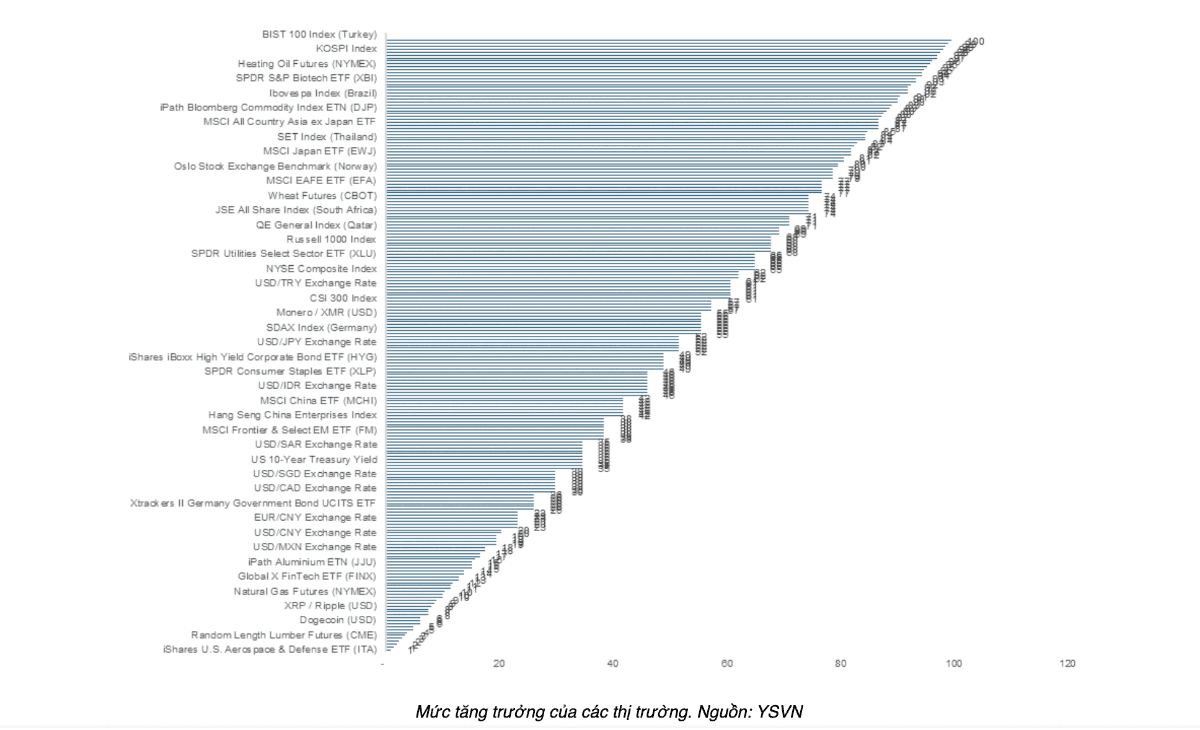
Global investment capital flows are rising as investors increase exposure to equities. LSEG Lipper data show investors placed a net $31.26 billion into global equity funds, the largest weekly net purchase since March 25, marking a fourth consecutive week of inflows through 15 April.
Cash is returning to the stock market, with equity indices standing out as the strongest asset class. The average RS across equities is reported at 1.15, with Korea’s KOSPI 200 leading the board.
Regional flows show a mixed but overall risk-on tilt:
Emerging markets recorded a second consecutive week of net inflows. Investors added $3.63 billion into stock funds and $2.11 billion into bond funds across 28,807 funds tracked.
Most global stock markets rose sharply over the past week, and the medium-term trend for equity indices remains upward. However, short-term conditions are described as potentially overbought, raising the possibility of shallow pullbacks in the coming week.
The U.S. market shows divergence across segments: Nasdaq-100 and the S&P 500 strengthened, while growth is described as lagging other markets. At the same time, the Russell 2000 rose, suggesting capital rotation into smaller-cap stocks.
In Europe, the rebound is described as stronger than expected after years of lag, with France’s SBF 120 accelerating alongside the DAX and CAC 40 maintaining high growth.
In Southeast Asia, the VN-Index is trading above the regional average with neutral growth, indicating Vietnam’s market has not yet entered an “explosive” phase.
The inflows are attributed to solid earnings and improving optimism that the Iran conflict could be resolved sooner than expected, supporting risk appetite.
Additionally, the share of retail trading in the U.S. has fallen to levels near pre-pandemic. The article notes this pattern often coincides with institutional accumulation when retail participation declines. The current 7–8% level—near the 2016 trough—is described as a favorable risk/reward zone for long-term positions.
While equities attract the bulk of attention, the article also notes that long-term bonds are accumulating, consistent with a posture often seen during a monetary policy transition.
By contrast, crypto and other high-risk assets remain weak and have not yet confirmed a durable recovery.
In Vietnam, the VNI-XAU index—measuring the VN-Index in gold terms—is trading near a bottom in the 2012–2013 range. With gold’s rally, the VNI-XAU has become less attractive recently, but momentum indicators suggest a potential long-term price bottom.
The article points to historical parallels in 2012–2013 and 2020, arguing that the probability of forming a long-term bottom is increasing.




Premium gym chains are entering a “golden era” that is ending or already in decline, as rising operating costs collide with shifting consumer preferences toward more flexible, community-based ways to exercise. Long-term memberships are shrinking, margins are pressured by higher rents and facility expenses, and competition from smaller, more personalized…