•
•
•
•
•
•
•
•
•
•
•
•
•
•
•
•
•
•
•
•
•
•
•
•
•
•
•
•
•
•
•
•
•


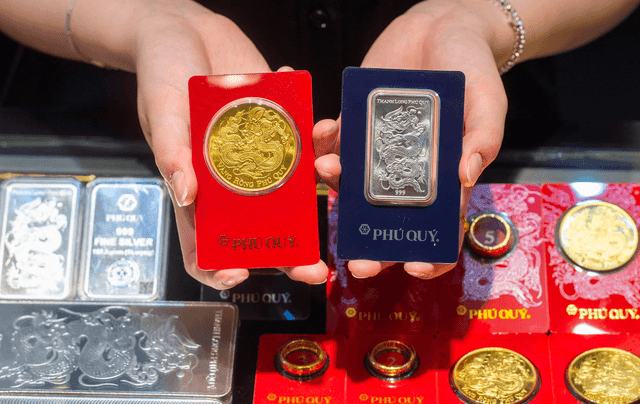
Capital inflows are expected to return to gold, one of the leading reserve assets, while the silver market outlook remains fundamentally positive, supported by strong demand tied to green economy initiatives and artificial intelligence.
Gold prices have risen about 15% from the end-March trough, while silver has rebounded more strongly, up more than 30%, roughly double gold’s gain. The rally has been supported by signals that the Middle East conflict could wind down, allowing trade through the Hormuz Strait to resume, alongside a slowing U.S. economy that has drawn funds into precious metals as safe-haven assets.
From the March trough of around 4,100 USD/ounce, gold has recovered more than 15%. Silver has risen about 30% from its bottom near 61 USD/ounce. Both markets have also moved higher on technical factors and bargain-hunting demand as investors weigh the macroeconomic backdrop.
Gold recently touched the 200-day moving average (MA 200) on March 23, described as long-term support, and then rebounded. However, gold remains below the 50- and 100-day moving averages, suggesting the mid-term outlook is not overly bullish. A weekly close for 2–9 May above the 20-day moving average (around 4,710) is cited as a short-term positive signal.
Silver’s technical indicators are described as slightly more constructive. Silver has not fallen back to MA 200 and remains above the MA 20–50 range, while the week closed at the MA 100.
Geopolitical tensions persist. The US–Iran talks are not yet formalized, and high oil prices remain a challenge for central banks. Central banks with major influence—such as the Fed, ECB, BOJ, and BOE—are unlikely to cut rates in the near term, and some hawkish officials have even hinted at possible rate hikes later. This is seen as limiting the near-term upside for both gold and silver.
After 2025’s near 70% rise in gold and over 130% in silver, a short- to medium-term correction is also considered understandable.
For gold, central banks’ net selling in March is described as not particularly supportive. However, it is framed as a lesson in diversifying reserve assets, with central banks needing to prepare for potential “black swan” scenarios. The article notes that if tensions ease and pressure on yields declines, capital could return to gold as a leading reserve asset capable of playing a major role in future risks.
The outlook for silver is described as fundamentally positive, with substantial demand linked to the green economy and artificial intelligence. The US–Iran conflict is also presented as highlighting the strategic importance of renewable energy; if the conflict ends, industrial demand for silver is expected to remain strong and support higher prices.
Ms. Chu Phuong, a gold and silver market expert, said investors should not “go all-in” at this stage despite the positive medium-term themes. With geopolitical instability in the Middle East and high oil prices, central banks are expected to be cautious in monetary policy decisions. She also pointed to ongoing volatility, including expectations of a leadership change at the Fed and a new policy stance.
Her recommendation is to deploy gradually and monitor global gold and silver prices to decide on investments. She also advises spreading exposure across multiple positions to reduce the risk of buying into a volatile market.
She added that the USD/VND exchange rate is relatively high, which is expected to push domestic gold–silver prices higher. High rates can also attract some funds into gold, reinforcing the need for portfolio diversification to safeguard assets and optimize returns.
Gold and silver have rebounded strongly but remain far from their 2026 highs. The article notes that some global financial institutions remain bullish, with a year-end outlook of around 5,000 USD/ounce for gold and about 95–100 USD/ounce for silver.
Premium gym chains are entering a “golden era” that is ending or already in decline, as rising operating costs collide with shifting consumer preferences toward more flexible, community-based ways to exercise. Long-term memberships are shrinking, margins are pressured by higher rents and facility expenses, and competition from smaller, more personalized…