•
•
•
•
•
•
•
•
•
•
•
•
•
•
•
•
•
•
•
•
•
•
•
•
•
•
•
•
•
•
•
•
•


Vietnam’s growth model is showing signs of obsolescence as geopolitical headwinds intensify globally and domestic momentum weakens, according to the annual Vietnam Economic Assessment 2025 released by the National Economics University (NEU). The report highlights a shift in the structure of investment capital in 2025, with public spending playing a larger role while domestic private capital—expected to be a long-term growth engine—faces barriers and appears to be losing ground. exchange rates today
In 2025, investment grew by 12%, lifting the social investment share of GDP to 32.31%. Government investment accounted for nearly 30% of total social investment. NEU notes that while state projects are a foundational driver of growth, they also require coordinated alignment to avoid pressuring private sector resources.
Prof. Dr. To Trung Thanh, representative of the NEU research group, said the strong presence of state projects supports growth but must be better coordinated to prevent crowding out private capital.
The report argues that public investment remains necessary for infrastructure, but calls for a gradual shift toward a “seed capital” mechanism to unlock private sector dynamism. It emphasizes that a transparent legal framework and reduced compliance costs are needed to help private investors move from a defensive stance to longer-term investment in production and technology.
This is also linked to Vietnam’s rising reliance on bank credit, which is growing at nearly 19%. The report states that credit channels provide 50% of funding, pointing to a deeper issue: the capital market has not fully developed. Enterprises lack long-term funding options, contributing to maturity mismatches, bad debts, and macro pressures on inflation and the exchange rate.
Nguyen Ba Hung, Chief Economist at the Asian Development Bank (ADB) in Vietnam, said the challenges are not only domestic. New tariff shocks and heightened uncertainty in global trade—linked to supply chain disruptions at the Hormuz Strait—also undermine private investor confidence.
NEU’s assessment indicates that the outcome is not only a decline in private investment scale but also in quality. Private capital inflows tend to shift toward safe assets or short-term speculation to hedge macro risks. If this pattern persists, it could weaken national competitiveness from within.
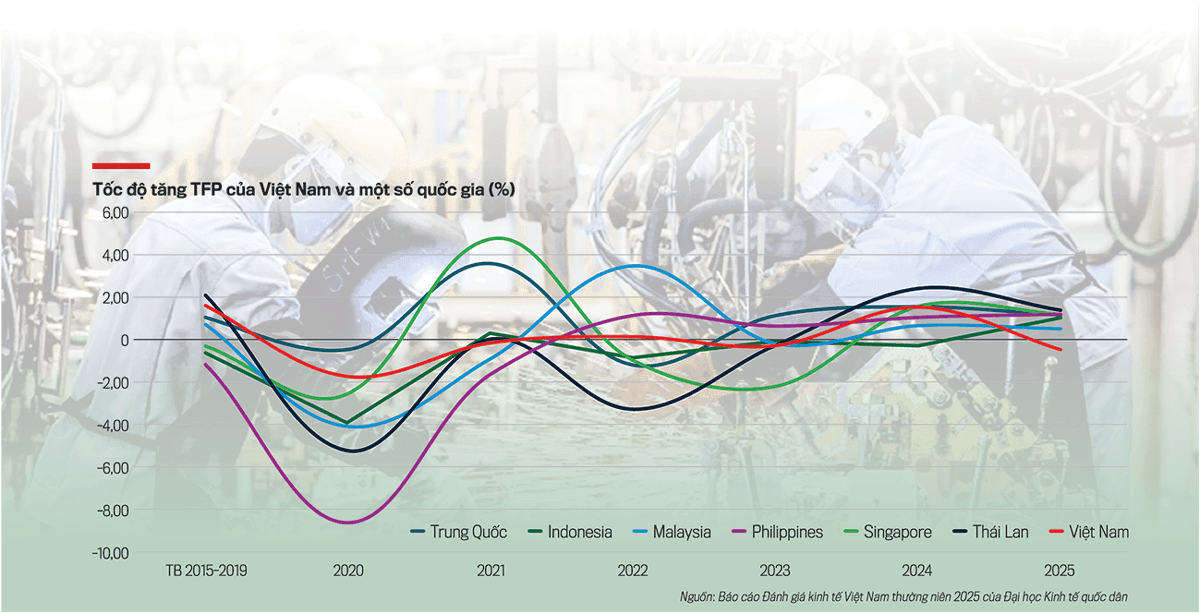
Despite maintaining high growth, NEU finds that growth quality—measured by Total Factor Productivity (TFP)—has not improved. In 2025, the report says the TFP contribution turned negative, indicating that gains from technology, management, and resource allocation have declined. The economy continues to grow mainly by increasing capital and cheap labor rather than raising real productivity.
The report notes that this remains the case even amid efforts in digital transformation, AI, and the 4.0 industrial revolution. Experts cited in the report say much of today’s digital transformation is still at the “surface digitization” stage and has not permeated deep operational processes within firms.
NEU also points to limited ICT capital contribution relative to the region. While Vietnam ranks 44th in the Global Innovation Index (GII), it faces institutional, infrastructure, and human resource constraints.
“Vietnam’s current growth lacks deep drivers. If this model isn’t changed, today’s achievements could become tomorrow’s risks,” warns Prof. Dr. To Trung Thanh.
The report says the digital economy should be understood not only as digitizing economic activities, but as reorganizing the entire economy in the digital era—from production and distribution to consumption.
It estimates that the digital economy currently accounts for about $70 billion, or 14.02% of GDP, with annual growth around 10%. However, it identifies several structural issues:
To Trung Thanh explained that Vietnam produces more products, but the value added retained domestically is not commensurate because the country operates mainly at lower rungs of global value chains such as assembly and outsourcing rather than owning core technologies or design. He also cited a lack of core digital-skill labor to operate the digital economy and shortages of core digital skills to run complex AI systems. The ADB expert added that reforming institutions and aligning data infrastructure alone may not automatically raise real value added or efficiency, and could increase costs.
With private investment shrinking and productivity stagnating, NEU frames reforming the growth model as urgent—especially given Vietnam’s goal of over 10% growth in 2026–2030. The report presents three recommendations:
Instead of broad, scattered investment, NEU recommends switching to a seed-capital mechanism to guide private investment. It says the state should focus on strategic infrastructure, core technologies, and sectors the private sector does not want or cannot do. It also calls for a transparent legal framework to protect business rights and reduce compliance costs to “unleash” private capital that is currently bottlenecked.
To improve the TFP index, the report recommends shifting from “digitization” to “data-driven restructuring.” This includes building a unified, transparent national data ecosystem capable of sharing. It argues that only when data is treated as a new production resource and flows freely among ministries, sectors, and firms can technologies like AI optimize the economy.
The full article is published in Tạp chí Kinh tế Việt Nam No. 17-2026, issued on 04/05/2026. Readers are invited to read at the link provided in the article.

Premium gym chains are entering a “golden era” that is ending or already in decline, as rising operating costs collide with shifting consumer preferences toward more flexible, community-based ways to exercise. Long-term memberships are shrinking, margins are pressured by higher rents and facility expenses, and competition from smaller, more personalized…