•
•
•
•
•
•
•
•
•
•
•
•
•
•
•
•
•
•
•
•
•
•
•
•
•
•
•
•
•
•
•
•
•


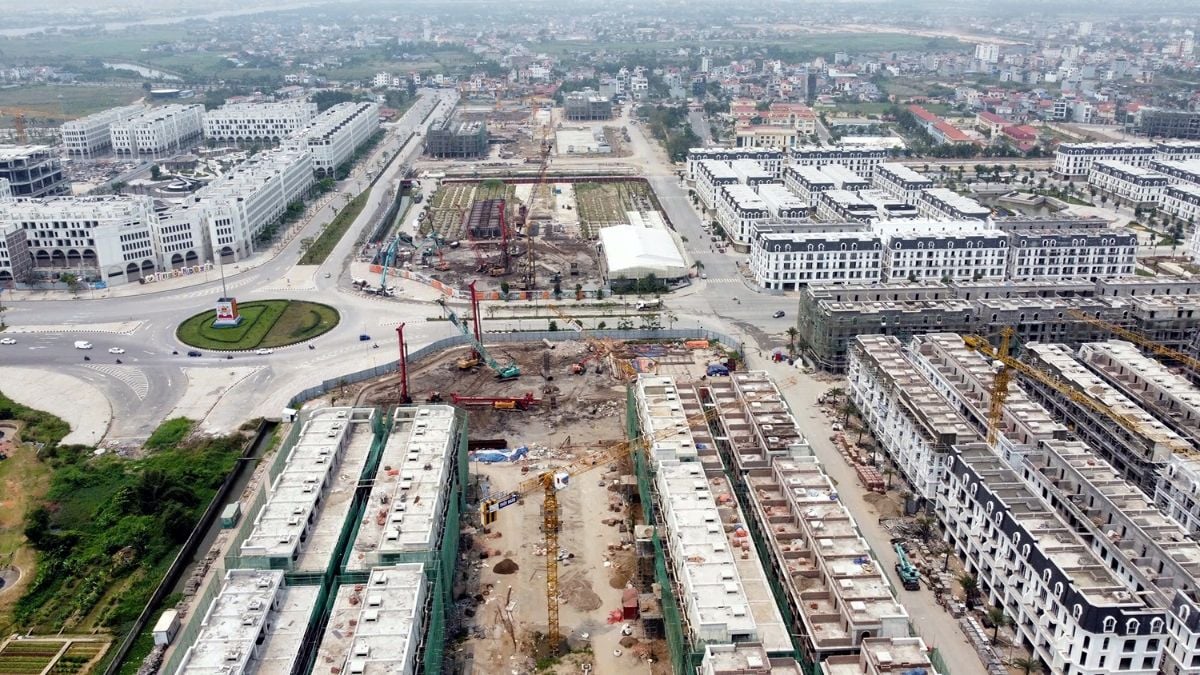
Hai Phong has approved adjustments to its new housing development program for 2021–2030, increasing floor area targets for commercial housing and social housing while reducing the floor area target for self-built housing. The changes were approved at the first session of the city’s XVII People’s Council.
According to information from the Hai Phong People’s Council, the resolution adjusts the city’s housing development program for 2021–2030 as follows: commercial housing floor area is increased by more than 7.2 million square meters, social housing by 486,000 square meters, and self-built housing by households is reduced by more than 3.9 million square meters.
City statistics indicate that housing development in Hai Phong achieved favorable results in the 2021–2025 period. Total housing floor area is estimated at 144.9 million square meters, equivalent to 103% of the plan, with added floor area in the period totaling 39.48 million square meters, or 14% above the plan.
Hai Phong (old) added about 21.8 million square meters of floor space, reaching 114% of the plan. This includes commercial housing of 6.53 million square meters (86% of the plan), social housing of more than 828,700 square meters (about 13,817 units), and self-built housing of 14.44 million square meters (138% of the plan).
Hai Duong (old) added about 17.68 million square meters of floor space, reaching 118% of the plan. This includes commercial housing of more than 993,000 square meters (90% of the plan), social housing of 171,700 square meters (about 2,862 units), and self-built housing of 16.52 million square meters (122% of the plan).
The rate of solid and semi-solid housing in both Hai Phong (old) and Hai Duong (old) reached 100%. The housing mix has shifted positively: while single detached housing remains dominant at 96.4%, apartments have increased to 3.62%, supporting land conservation and a more centralized urban space.
Under housing development programs approved for both eastern (old Hai Phong) and western (old Hai Duong) zones, total net land for new housing projects in 2021–2030 is 3,750 hectares. For 2021–2025, approvals were issued for projects covering about 1,319 hectares.
In Hai Phong (old), new development in 2021–2025 is about 967 hectares, of which 960 hectares were realized (99.3% of the plan). For 2026–2030, new development is about 1,200 hectares. In Hai Duong (old), planned new development in 2021–2025 is about 610 hectares, with more than 359 hectares realized (58.9% of the plan). For 2026–2030, planned new development is more than 912 hectares.
From July 1, 2025, Hai Phong and Hai Duong merged to form Hai Phong City. This merger brought significant changes to social housing and related land and property policies as laws were amended. As a result, Hai Phong considers it necessary to adjust housing development targets for Hai Phong (new) to ensure coherence between key growth areas and other parts of the city.
The city states that housing development must be aligned with the 2021–2030 plan adjustments with a view to 2050, aiming for Hai Phong to become a civilized, modern industrial port city attractive in Southeast Asia by 2030.
Hai Phong adjusted the average dwelling area from 36.02 m2 per person to 37.17 m2 per person. The total floor area target was adjusted from more than 199.9 million m2 to more than 203.6 million m2, while the total added floor area for the period was adjusted from more than 94.5 million m2 to more than 98.2 million m2.
Within the increased floor area, commercial housing was adjusted upward by more than 7.2 million m2 (from more than 35.7 million m2 to more than 42.9 million m2). Social housing was increased by more than 486,000 m2 (from more than 4.6 million m2, roughly 64,700 units, to more than 5 million m2, roughly 72,800 units). By contrast, the self-built housing target was reduced by more than 3.9 million m2 (from more than 54.1 million m2 to a little over 50.1 million m2).
In the 2021–2030 housing program for Hai Phong, the plan identifies 187.5 hectares of land for social housing, including 58 hectares for 2021–2025 and 129.5 hectares for 2026–2030.
The Hai Phong People’s Committee said the adjustment is intended to align with the current legal framework and harmonize with planning, strategies, and socioeconomic development plans. The adjustment is also expected to provide a basis to prepare a housing development plan for 2026–2030 and to serve as a legal basis for evaluating and approving investment plans and implementing housing projects in the period ahead.
Note: This content summarizes the main points of the article’s discussion on housing program adjustments and related projections.





Premium gym chains are entering a “golden era” that is ending or already in decline, as rising operating costs collide with shifting consumer preferences toward more flexible, community-based ways to exercise. Long-term memberships are shrinking, margins are pressured by higher rents and facility expenses, and competition from smaller, more personalized…