•
•
•
•
•
•
•
•
•
•
•
•
•
•
•
•
•
•
•
•
•
•
•
•
•
•
•
•
•
•
•
•
•


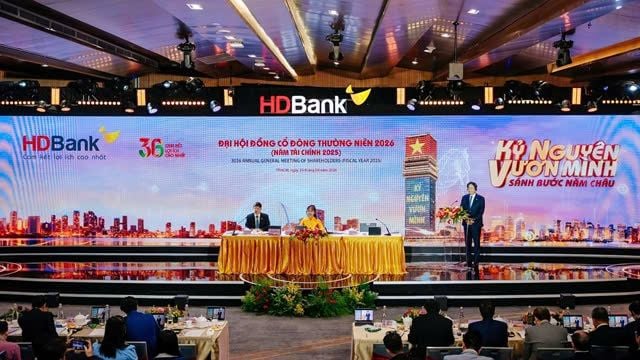
On the morning of April 24, 2026, Ho Chi Minh City Development Joint Stock Commercial Bank (HDBank) held its 2026 Annual General Meeting of Shareholders. Shareholders approved a set of resolutions covering the business plan, profit distribution, increasing ownership in HD Securities (HDS), and expanding HDBank’s charter capital.
In the discussion session, shareholders raised questions about HDBank’s ability to meet the high credit-growth cap of 35% approved by the State Bank of Vietnam (SBV), including whether sufficient capital would be available and whether additional capital support would be required.
CEO Nguyễn Hữu Đặng said HDBank will continue to receive a 35% credit-growth cap in 2026 in line with SBV’s direction, and that the policy could be maintained in subsequent years. He stated that, given the bank’s nationwide network and expanding customer base, HDBank is capable of achieving the target at a high level. He also noted that in 2025, HDBank achieved approximately 35% credit growth—among the highest in the sector—providing a basis to maintain momentum in 2026.
On funding, the CEO said safety and liquidity indicators are currently strong, with competitive funding costs and stable mobilization. He added that the bank maintains sufficient capital to meet credit-growth needs and to participate in market stabilization when necessary. Management emphasized that HDBank is proactive and does not rely on external funding.
With the high credit limit, HDBank plans to support customers and shareholders in accessing capital for production, business, and consumption. The bank will expand credit products, particularly digital lending, with competitive interest rates across the system.
Permanent Vice Chairwoman GS.TS Nguyễn Thị Phương Thảo responded to shareholders’ questions on growth capacity, citing HDBank’s strong equity position. She said the bank’s CAR is 16.7%, well above the regulatory minimum of 8% and among the highest in the sector. The loan-to-deposit ratio (LDR) remains below 80%, indicating room for further growth. She also said a stable funding structure underpins the bank’s ability to meet credit demand and fund development plans.
She further noted that if needed, there is a liquidity-support mechanism for credit institutions, and related items were presented to the AGM to ensure the bank remains proactive under different scenarios.
On the bank’s M&A strategy, management described it as a foundational pillar of HDBank’s development since its early years. From a smaller bank in 2011, HDBank expanded through mergers and acquisitions, including situations where target entities were previously under stress but later recovered and grew under HDBank’s stewardship.
Examples cited include the DaiABank merger, the acquisition of a consumer finance company, and more recently Đông Á Bank. After joining the HDBank ecosystem, these units stabilized and made progress, supporting job preservation and improving business efficiency.
After the integration of Đông Á Bank, HDBank accelerated digital banking, which management said became a core development focus. It pointed to improvements in 2025, including a better balance between revenues and costs and notable gains for employees. Overall, management said the M&A strategy supports both scale and sustainable value creation while strengthening competitiveness.
Management said current stock valuations have not fully captured intrinsic value. Over the past decade, HDBank has maintained a relatively stable dividend policy, typically around 20–30% annually. During certain restructuring periods under state-directed reforms, cash dividends were temporarily adjusted to prioritize capital, before being restored and maintained.
For dividend form, the AGM will consider proposals including cash dividends for shareholders such as Saigon Mechanical Construction Corporation (SCCM). Management said the board will consolidate and present proposals for AGM discussion and voting if conditions permit. However, given the current growth phase, HDBank prioritizes retaining earnings to strengthen capital and support mid- to long-term development. Management also noted that historical returns from holding HDBank shares have included value beyond dividends, including capital appreciation.
Opening the meeting, CEO Nguyễn Hữu Đặng stated that in 2026 HDBank aims to become a leading financial group, with commercial banking at its core and among Vietnam’s industry-leading players. Building on 2025 results, the bank targets total assets near 1.2 quadrillion VND and pre-tax profit around 30,000 billion VND, representing a 41% increase.
Management said the bank will keep non-performing loan ratio under 2% and maintain high profitability indicators, including ROE around 25% and ROA around 2%. To achieve the targets, HDBank plans to push innovation and digital transformation, strengthen governance and system safety, and remain customer-centered, while pursuing sustainable, value-driven growth and investing in human resources.
In 2025, HDBank recorded 21,346 billion VND in pre-tax profit. After taxes and funds allocation, distributable profit was 14,136 billion VND, including 747 billion VND of accumulated undistributed profits from prior years. Management said this amount could be used to pay dividends for 2025 and/or to increase charter capital via equity issuance, with a proposed total issuance up to 30%.
As of March 31, 2026, HDBank held 29.99% of charter capital in HD Securities Joint Stock Company (HDS). The AGM approved a plan to raise HDS ownership to at least 51% and up to 90%, making HDS a subsidiary. Management said the move is intended to complete the financial-ecosystem and reinforce competitive capacity while leveraging stock-market growth opportunities to broaden revenue streams.
Shareholders approved a plan to raise charter capital by up to more than 9,891 billion VND through bond conversion and private share issuance.
Implementation is expected in 2026–2027, subject to regulatory approval.
To increase flexibility in investment activities, the Board proposed and shareholders approved capital contributions and equity investments in other enterprises and financial institutions. Transactions valued at 20% of charter capital or more (based on the latest audited financial statements) will fall within the Board’s delegation scope to support M&A strategies and align with government and SBV reform directions.
In addition, HDBank said it envisions establishing a subsidiary company or bank at Vietnam’s International Financial Center (VIFC) when conditions allow. The AGM authorized the Board to implement related matters and ensure alignment with the group’s development strategy and applicable laws.




Premium gym chains are entering a “golden era” that is ending or already in decline, as rising operating costs collide with shifting consumer preferences toward more flexible, community-based ways to exercise. Long-term memberships are shrinking, margins are pressured by higher rents and facility expenses, and competition from smaller, more personalized…