•
•
•
•
•
•
•
•
•
•
•
•
•
•
•
•
•
•
•
•
•
•
•
•
•
•
•
•
•
•
•
•
•


HOSE has reminded PC1 of the delayed disclosure of the resolution and minutes of the company’s 2026 Annual General Meeting (AGM). HOSE said it received PC1’s AGM disclosure documents on March 31, 2026, covering an AGM held on April 22, 2026.
According to the disclosure, PC1 held the 2026 AGM successfully on April 22, 2026, with 81 shareholders attending in person or via valid proxies. The meeting represented 215,638,849 shares and 215,638,849 voting rights, equivalent to 52.43% of the total voting power of eligible shareholders (based on the attendee list as of March 16, 2026). The AGM was conducted in compliance with the company’s charter and applicable corporate law.
HOSE noted that, under point b of paragraph 3 of Article 10 and point c of paragraph 1 of Article 11 of Circular 96/2020/TT-BTC, public companies must disclose extraordinary information within 24 hours after an AGM decision is passed. The required disclosure documents include the minutes, AGM resolutions, and related attachments.
HOSE also referenced Circular 68/2024/TT-BTC, which requires large listed companies to publish periodic information in English from January 1, 2025. HOSE stated that the disclosure deadline has passed and that it has not yet received the AGM resolution and minutes for PC1’s 2026 AGM. HOSE therefore urged PC1 to strictly comply with its reporting obligations to protect shareholder interests.
In its 2026 AGM report, PC1 reiterated a multi-pillar growth strategy and a plan to issue rights to support double-digit profit growth of around 30%. The company’s four core growth pillars are: (1) electricity generation operations, (2) power EPC contracting (including expansion overseas beyond traditional electricity transmission), (3) green industrial parks and highly liquid residential real estate, and (4) minerals.
PC1 targets a five-year revenue compound annual growth rate (CAGR) of 15–18% and a net profit CAGR of around 30%, supporting an EPS CAGR of about 35% for 2026–2028, as cited by VCSC.
VCSC said PC1 has potential to slightly increase 2026 net profit attributable to non-controlling interests due to higher profits from Western Pacific and Nomura 2 industrial parks, and possible gains from exiting CT2. VCSC also pointed to long-term upside from new industrial parks in Vung Tau and Hai Phong and from the company’s offshore wind segment.
VCSC maintains a Buy rating with a target price of VND 30,500 per share. VCSC’s 2026 forecast is described as relatively conservative, with revenue of VND 15.6 trillion (+19% year-on-year) and net profit before minority interests of about VND 1.1 trillion (−23% year-on-year).
PC1 has reportedly achieved 149% of its net profit target over the two prior years and may exceed its 2026 target. In Q1 2026, PC1 recorded revenue of VND 2.3 trillion (+26% year-on-year) and net profit before minority interests of VND 264 billion (+82% year-on-year).
PC1 plans to issue up to 36% of the current issued shares in 2026, including:
VCSC noted that unsold rights will be reallocated and subject to a one-year transfer restriction.
Funds from the equity raise would be used for new hydropower projects (Bao Lac A and Thuong Ha) totaling about VND 125 billion, the floating solar project Trung Thu (VND 306 billion), the Gia Lam residential project (VND 120 billion), debt repayment, and working capital (VND 930 billion).
PC1’s leadership highlighted capital requirements for capital-intensive segments, including roughly VND 3 trillion for the Western Pacific industrial park, residential real estate, and capacity expansion of 400–500 MW over five years.
In the electrical construction segment, existing contracts are about VND 7 trillion (down from roughly VND 8 trillion at end-2025 after Q1 2026 revenue recognition). The company said its main growth drivers include floating solar, nearshore wind, and energy storage systems (BESS). Gross margin is expected to normalize below the 2025 peak (about 11.4%) due to higher input and logistics costs, while net margin may be affected by rising interest rates.
PC1’s order book is described as sufficient for 2026 revenue targets, with 50% from EVN and 50% outside EVN. Foreign EPC is expected to contribute around VND 1 trillion in 2026 revenue (including 58 MW of wind power in the Philippines), with a potential pipeline of about 300 MW.
Long-term, PC1 aims to become a regional EPC contractor (APAC), targeting 30–40% of revenue from backlog. The company also said it may participate in nuclear power as a subcontractor (not yet with VinEnergo).
For the generation segment, PC1 set a 2026 revenue target of VND 1.7 trillion (−3% year-on-year), citing El Niño impacts. Trung Thu floating solar is expected to achieve COD in 2027, earlier than VCSC’s 2028 forecast, which PC1 cited as evidence of execution capability and EPC-generation synergy.
In industrial parks, PC1 referenced progress at Western Pacific and Nomura 2, along with expansion into Vung Tau and Hai Phong. In residential real estate, the focus is mid-income and social housing with high liquidity and an emphasis on cash receipts. The company said gross margins at Golden Tower are below peers and that there are no near-term M&A plans.
For nickel, PC1 set a 2026 revenue target of VND 1.2 trillion (+5% year-on-year), implying modest downside risk. The company expects stable price trends through 2026–2028 due to steady demand.
Earlier, PC1’s Board approved contributing to the establishment of a solar company in Dien Bien. PC1 would contribute VND 27 billion to exercise an option to buy 2.7 million shares issued through a rights issue in 2026.
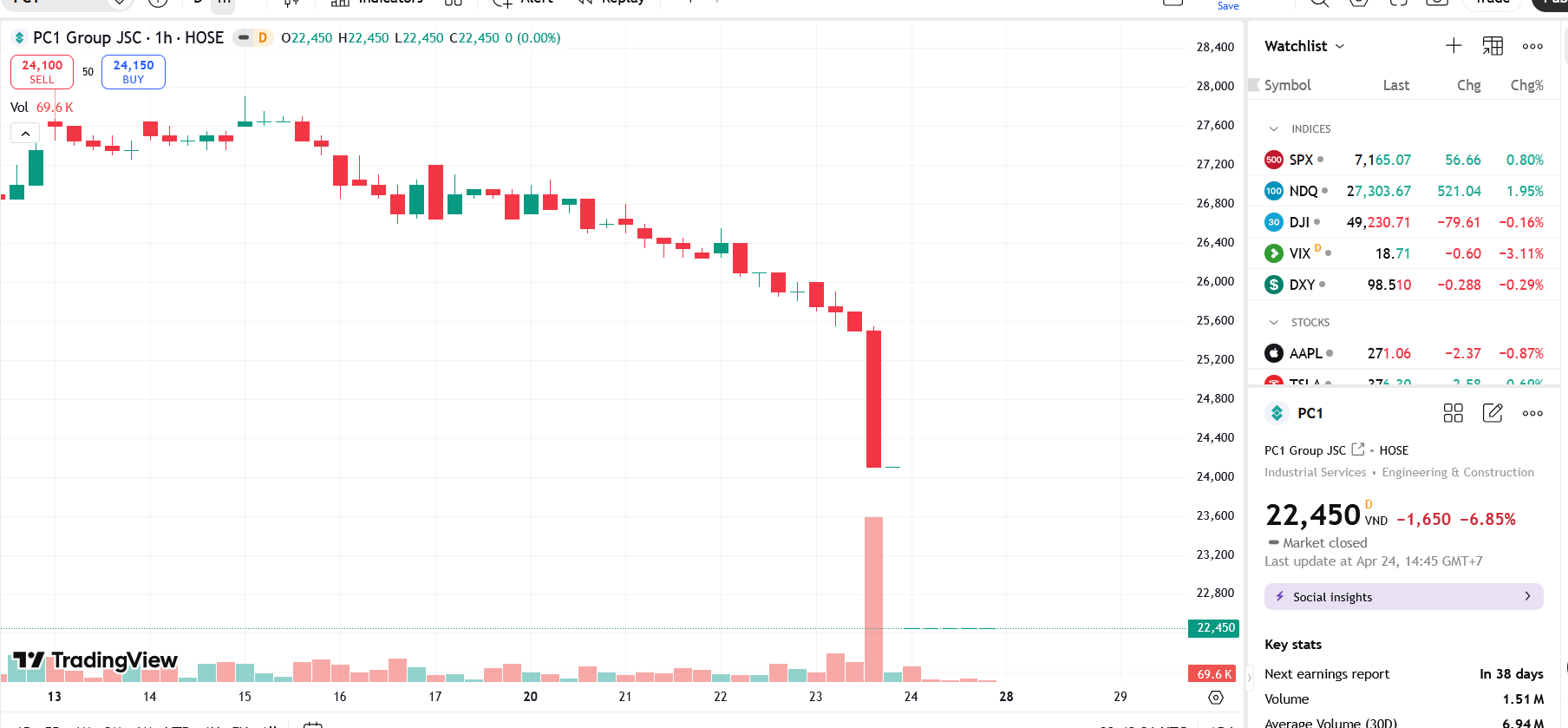
On April 23, PC1 experienced a trading halt and sharp price movement due to rumors. The stock briefly hit the floor at VND 22,450 per share, reducing market capitalization to about VND 9.9 trillion.

Premium gym chains are entering a “golden era” that is ending or already in decline, as rising operating costs collide with shifting consumer preferences toward more flexible, community-based ways to exercise. Long-term memberships are shrinking, margins are pressured by higher rents and facility expenses, and competition from smaller, more personalized…