•
•
•
•
•
•
•
•
•
•
•
•
•
•
•
•
•
•
•
•
•
•
•
•
•
•
•
•
•
•
•
•
•


Despite a volatile global economy, HSBC’s regional economists say Vietnam continues to maintain growth fundamentals supported by attracting foreign direct investment (FDI), expanding electronics exports, domestic consumption, and an increasingly strong position in global supply chains. They also point to domestic demand and a broad network of free trade agreements (FTAs) as key factors helping Vietnam withstand external swings.
HSBC Chief Asia Economist Dr. Frederic Neumann said energy shocks are adding pressure to growth prospects across many Asian economies. In Vietnam, he noted that the initial impact has shown up in inflation, with consumer prices in March and April both above the target.
“However, in a backdrop of many uncertainties, this is also a time for Vietnam to revisit its energy strategy and macro policy to bolster resilience against global shocks that are becoming more unpredictable,” Neumann said.
HSBC analysts said the market remains overly focused on short-term energy risks, while Vietnam’s underlying drivers are still positive. They expect 2025 to be a period of volatility as global tariff policies change, but Vietnam is still seen sustaining GDP growth around 8%, making it the second-fastest growing economy in Asia after Taiwan.
Against a backdrop of global trade pressures, Vietnam’s trade turnover reached a record high. Experts said the increase reflects not only order acceleration, but also Vietnam’s strengthening position in the global supply chain and e-commerce. They linked this performance to high-quality FDI inflows, improvements in the investment climate, and Vietnam’s rising role in global value chains.
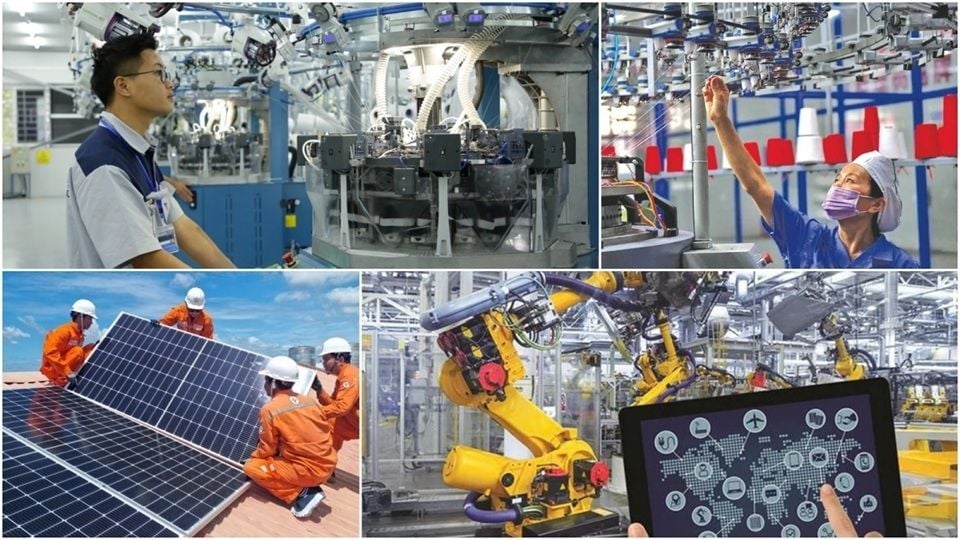
HSBC Senior ASEAN Economist Yun Liu said Vietnam’s export structure has shifted over time. While low-value-added sectors such as textiles and footwear previously dominated exports, electronics has become the new growth engine. Currently, more than one-third of Vietnam’s export value comes from electronics products.
Liu added that Vietnam is increasingly playing a vital role in the global electronics assembly chain, particularly in consumer electronics, supported by diversification of supply chains by major tech groups such as Samsung.
“In the face of volatile global trade, tariff policies can make investors cautious in the short term. However, in the long run, Vietnam remains competitive thanks to its ability to attract FDI, reflecting international investor confidence in the growth outlook of the economy.”
HSBC said that over the past 15 years, Vietnam’s share of consumer electronics exports—including smartphones, computers, and printers—has risen from near zero to around 8%–15%. The country is also expanding into higher value-added segments such as integrated circuits and semiconductors.
Notably, HSBC said Vietnam has continued to increase its market share in the US in several consumer electronics segments despite global tariff policy risks.
HSBC said Vietnam has expanded beyond traditional markets and leverages its wide network of FTAs, including the EU–Vietnam Free Trade Agreement (EVFTA). However, the economists said there is still room for improvement, particularly in reducing non-tariff barriers such as customs procedures or import licenses.
“In ASEAN, intra-regional trade remains relatively low even though most tariffs have been removed. Further reductions in non-tariff barriers are expected to open more room for intra-regional trade growth. Additionally, emerging markets like South America and the Middle East are seen as potential new outlets for Vietnamese goods,” Liu said.
HSBC said Vietnam continues to hold competitive advantages for attracting FDI, including openness, labor costs, infrastructure, and an existing production ecosystem. It added that FDI inflows continue to reflect international investor confidence in Vietnam’s medium- and long-term growth prospects.
Beyond exports and FDI, HSBC highlighted domestic consumption as another important growth driver. It pointed to improvements in the labor market, urbanization, rising middle class incomes, and strong e-commerce growth supported by Gen Z, all of which are expanding domestic growth opportunities.
“In a world of persistent uncertainty, Vietnam's growth opportunities are significant if effectively leveraging the advantages,” Neumann said.
Premium gym chains are entering a “golden era” that is ending or already in decline, as rising operating costs collide with shifting consumer preferences toward more flexible, community-based ways to exercise. Long-term memberships are shrinking, margins are pressured by higher rents and facility expenses, and competition from smaller, more personalized…