•
•
•
•
•
•
•
•
•
•
•
•
•
•
•
•
•
•
•
•
•
•
•
•
•
•
•
•
•
•
•
•
•


Hyosung Vina Chemicals has published its 2025 annual financial results, reporting a net loss after tax of more than VND 4,208 billion, close to the loss of over VND 4,261 billion recorded in the previous year.
The company’s accumulated losses total nearly VND 21,567 billion.
As of 31 December 2025, total assets reached VND 28,148 billion and total liabilities were about VND 18,153 billion. Bank borrowings fell sharply from over VND 22,652 billion to VND 11,857 billion.
On the equity side, owner-injected equity increased markedly from VND 18,728 billion to VND 30,882 billion. This supported an end-of-year equity position of around VND 9,995 billion, more than five times higher than the previous period.
As a result of the capital increase, the debt-to-equity ratio declined from 14.51x to 1.82x.
In its audit report conducted by PwC (Vietnam), auditors highlighted two key issues: accumulated losses of VND 21,567 billion and short-term liabilities exceeding current assets by VND 8,552 billion. The auditors said these factors indicate material uncertainty that could cast doubt on the company’s ability to continue as a going concern.
Separately, the parent company issued a financial support letter in February 2026, pledging to continue supporting Hyosung Vina Chemicals for at least 15 months from January 31, 2026.
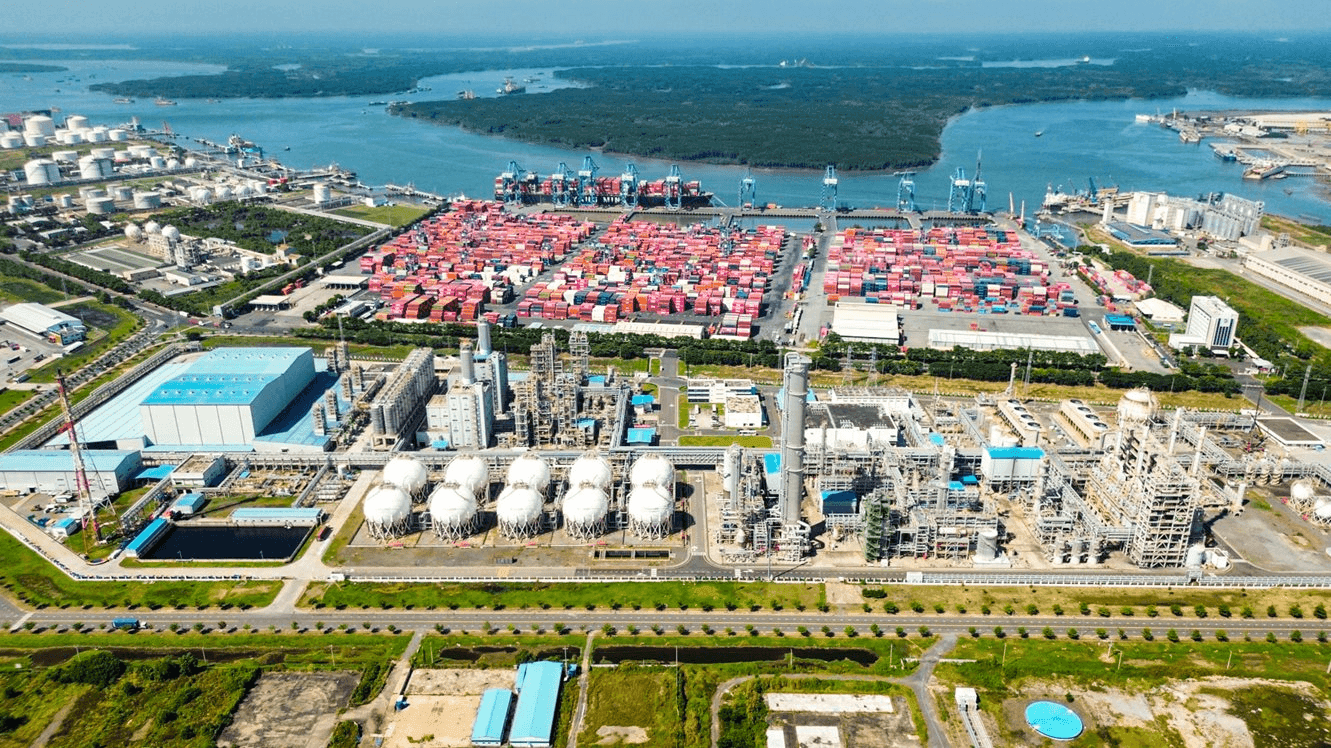
End of 2021, Hyosung Vina Chemicals inaugurated the polypropylene production plant and the underground LPG storage at Cai Mép Industrial Park (Tan Phuoc Ward, Phu My Town). The project has a total investment of USD 1.3 billion, including polypropylene production complexes 1 and 2 (each with capacity of 300,000 tons per year), a dedicated port for ships of 60,000 tons, and a Propylene and Ethylene plant with capacity of 600,000 tons per year.
The complex also includes underground LPG storage with a depth from 110m to nearly 200m below sea level, nearly 5 km long, and a capacity of 240,000 tons—described as the largest in Southeast Asia.
Wie Chol Ryang, the executive in charge of the underground storage, said the facility has a 50-year life and could be extended after 50 years if the pipeline and ancillary components are replaced.
He added that while the storage is built on marshy, tidal land, it is designed to be virtually fail-safe even in earthquakes, tsunamis, or volcanoes. The soil is mud and soft from the surface down to 60m, while below 60m it is granite—conditions described as critical for implementing the underground storage.
The underground storage is nearly fully automated using advanced technologies and is protected externally by a granite layer. It is designed and constructed in an egg shape to distribute pressure evenly rather than concentrating it at a single point.
On the surface, Hyosung built 10 gas tanks, each with a capacity of 4,000 tons, described as the world’s largest gas tanks, as existing similar tanks hold only about 1,000–2,000 tons.
To produce products from gas, the sponsor imported and installed a gas separation tower nearly 120m tall with a diameter of 10m, described as the tallest and largest gas separation tower in the world.
Hyosung is a major South Korean conglomerate operating mainly in chemical industries, heavy industries, information technology, commerce, construction, and textiles.
Hyosung has been present in Vietnam since early 2007 through its 100% owned subsidiary Hyosung Vietnam in Dong Nai.
According to Chairman Cho Hyun-joon, Hyosung is the third-largest Korean FDI partner in Vietnam, with total invested capital around USD 4 billion, creating about 10,000 jobs.
Hyosung plans to invest an additional USD 4 billion to create about 10,000 more jobs, contributing further to Vietnam’s economic development and fulfilling its corporate social responsibility.
Among these, the group is investing in a biotechnology plant and a carbon fiber plant with a total investment in two projects of USD 1.3 billion in Ba Ria–Vung Tau Province (old naming).
Hyosung intends to continue expanding investments in projects in the fields of data centers, high-performance industrial material products, sustainable aviation fuel, and carbon fiber production.


Premium gym chains are entering a “golden era” that is ending or already in decline, as rising operating costs collide with shifting consumer preferences toward more flexible, community-based ways to exercise. Long-term memberships are shrinking, margins are pressured by higher rents and facility expenses, and competition from smaller, more personalized…