•
•
•
•
•
•
•
•
•
•
•
•
•
•
•
•
•
•
•
•
•
•
•
•
•
•
•
•
•
•
•
•
•


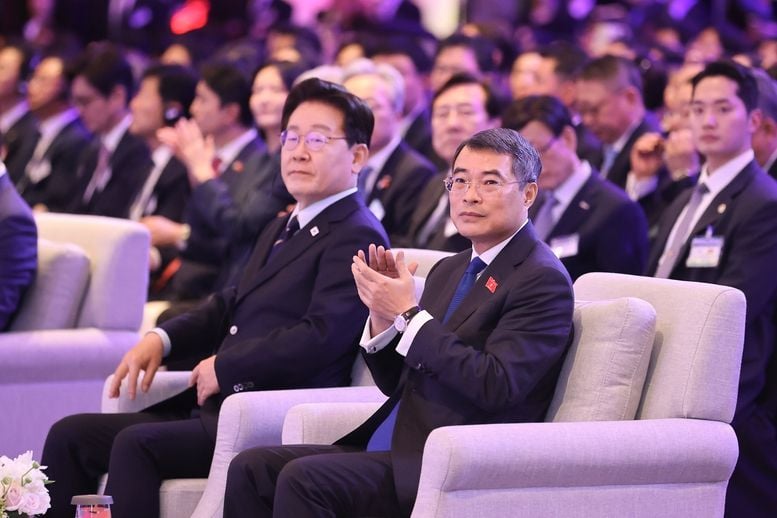
During a state visit to Vietnam by President Lee Jae Myung of the Republic of Korea and his spouse on April 23 in Hanoi, Prime Minister Le Minh Hung and President Lee attended the Vietnam–Korea Economic Forum themed “Enhancing industrial, investment and science-and-technology partnerships.” The forum brought together leaders from Vietnamese and Korean ministries and senior executives from multinational groups across energy, finance, technology, electronics, telecommunications, manufacturing, machinery, construction, infrastructure, trade, tourism and aviation.
President Lee Jae Myung said, “Vietnam's future is Korea's opportunity,” praising Vietnam as the heart of ASEAN’s economy and citing a dynamic growth trajectory of around 7% per year in recent years. He emphasized constructive cooperation between the two countries, highlighting trust and mutual respect, and referenced Nguyen Du’s line “Chữ tâm kia mấy bằng ba chữ tài.”
He also pointed to cultural and people-to-people ties, including Blackpink’s Hanoi performance and Vietnam’s pho becoming a shared national dish. He noted that roughly 5 million people from both sides traveled to each other in 2025.
President Lee called for deeper collaboration through three main avenues: (1) building next-generation industrial and technological ecosystems via integrated production, research and innovation clusters; (2) restructuring supply chains toward flexibility, resilience and higher value-added; and (3) strengthening knowledge linkage and innovation by moving beyond technology transfer to joint R&D and commercialization supported by state–industry–research collaboration.
Prime Minister Le Minh Hung welcomed the Korea–Vietnam partnership and said cooperation should advance in a new phase shaped by digital transformation and green, sustainable development. He noted that Korea has become Vietnam’s largest foreign investor and its third-largest trading partner, with more than 10,500 ongoing projects and registered capital approaching USD 100 billion. He said the investment supports nearly 1 million jobs and contributes over 30% of Vietnam’s total export value.
The prime minister highlighted technology, innovation and digital transformation as strategic pillars, including through research and development centers in Vietnam. He proposed three future-oriented directions: first, jointly create a next-generation industrial and technology ecosystem through production–research–innovation clusters; second, restructure supply chains toward flexibility, sustainability and higher value-added content; and third, strengthen knowledge linkage and innovation through joint research, development and commercialization, anchored by closer cooperation among the state, enterprises, research institutes and universities of both countries.
The Vietnamese government reiterated its commitment to reform and improve the investment environment to attract foreign investment, including from Korea. It emphasized ensuring a stable, cost-competitive production base and leveraging Vietnam’s large and rising middle class and strategic location as a gateway to regional markets through new-generation FTAs.
Both sides affirmed that the global shift toward the digital economy, green transition and sustainable development requires raising the quality—not only the scale—of cooperation, including stronger industrial ecosystems and technology-based growth.
In this context, 73 MoUs were signed across energy, finance, technology, electronics, telecommunications, manufacturing, machinery, construction, infrastructure, trade, tourism and aviation. Samsung Vietnam and Sun Group were highlighted for contributions to industry upgrading and talent development, alongside emphasis on supplier development and expansion of knowledge-based ecosystems.
Industry leaders and senior government officials pledged to continue improving policy frameworks, financial incentives and regulatory settings to create a predictable and competitive investment climate, support both nations’ interests and accelerate regional cooperation for peace, stability and growth.



Premium gym chains are entering a “golden era” that is ending or already in decline, as rising operating costs collide with shifting consumer preferences toward more flexible, community-based ways to exercise. Long-term memberships are shrinking, margins are pressured by higher rents and facility expenses, and competition from smaller, more personalized…