•
•
•
•
•
•
•
•
•
•
•
•
•
•
•
•
•
•
•
•
•
•
•
•
•
•
•
•
•
•
•
•
•


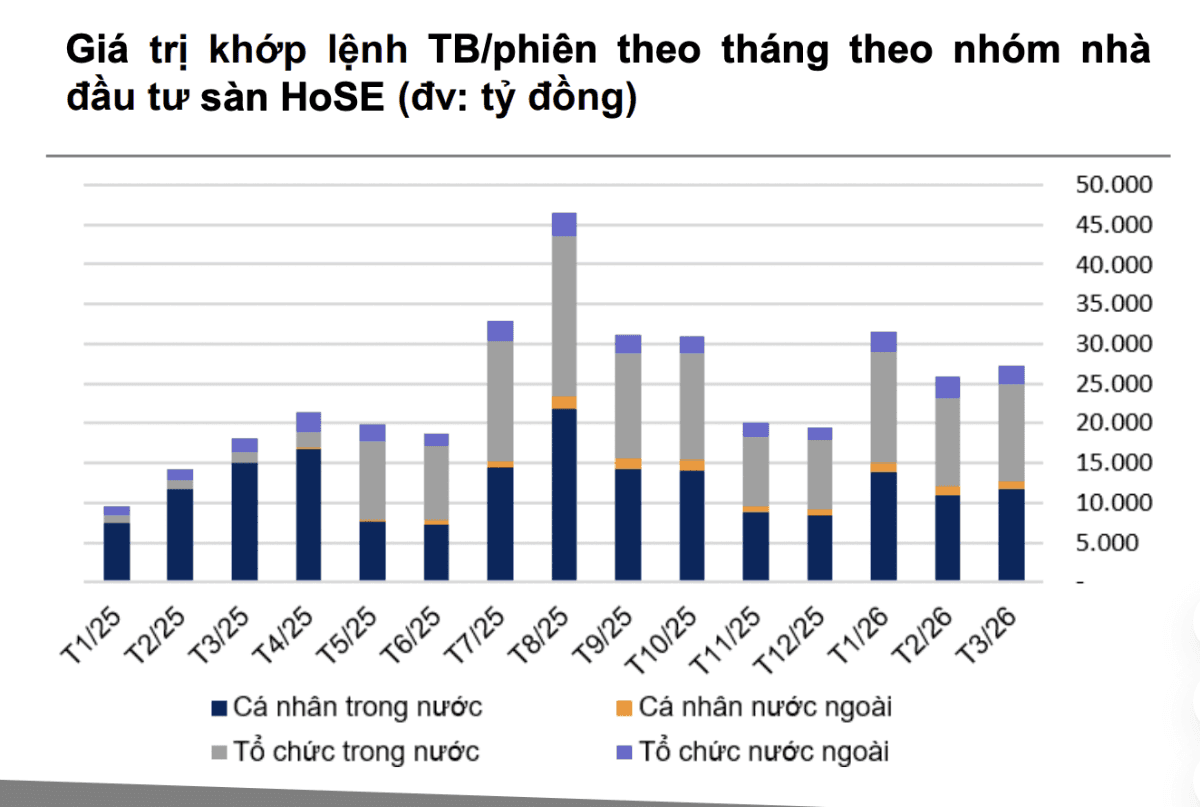
From a cash-flow perspective, domestic investor trading activity recovered after the Tet holiday, with the average value of matched orders per session by domestic individuals and domestic institutions rising 6.8% and 8.7% respectively compared with February 2026.
Globally, equity ETFs continued to lead net inflows, recording net inflows of USD 98.1 billion, but down 43.2% from the previous month as risk appetite cooled. Bond ETFs posted net inflows of USD 44.2 billion (down 28.7% month-on-month), indicating continued demand for fixed-income assets to balance portfolios amid rising uncertainty. Currency ETFs attracted USD 8.4 billion, down 56% month-on-month, reflecting a more cautious stance by short-term money. Commodity ETFs faced net outflows of USD 9.4 billion, reversing the prior month, mainly due to profit-taking after a period of strong commodity prices, notably gold and oil, under Middle East tensions.
In March 2026, global equity ETF flows became more selective by region, with the US still leading but at a slower pace. US equity ETFs recorded net inflows of about USD 33.6 billion, down from USD 59.6 billion in the prior month, reflecting a cooling risk appetite ahead of geopolitical and macro outlook concerns.
In Asia, Taiwan stood out with net inflows of over USD 7.6 billion, supported by a positive macro outlook and technology sector prospects. By contrast, China continued to see net outflows of about USD 8 billion, though pressure eased somewhat, indicating investor caution over growth and policy uncertainty.
Rising Middle East conflict heightened risk-off sentiment, restraining liquidity in Vietnam’s stock market in March 2026. Liquidity on HoSE remained subdued despite improvement from the Tet holiday, with average daily trading value of VND 27.3 trillion per session and 946 million shares per session, up 6% and 18.4% respectively versus February 2026.
Domestic money flow improved after Tet. The average matched value per session rose 6.8% for domestic individuals and 8.7% for domestic institutions versus February 2026.
Foreign money weakened as the activity of foreign individuals and foreign institutions fell by 8.5% and 3.1%, respectively, reflecting rising caution ahead of external risks.
Foreign selling pressure intensified, leading to net foreign outflows on HoSE in March 2026. Foreign investors sold a net of more than VND 17.5 trillion on HoSE, up 2.2 times from the previous month and the highest level since the start of the year.
By investor group, foreign institutions continued to post larger net sales than foreign individuals, at more than VND 11.7 trillion, up sharply from about VND 5.4 trillion in February 2026. Foreign individuals also remained net sellers, with more than VND 5.8 trillion, up markedly from VND 2.4 trillion in February 2026. Domestic funds from local institutions continued to act as a cushion, absorbing the net foreign selling in recent times.
Foreign selling pressure also affected Vietnam’s ETF capital, causing a reversal to net outflows in March 2026. Vietnamese ETFs recorded net withdrawals of more than VND 3.3 trillion, reversing net inflows in the prior two months. In the first three months of 2026, total net withdrawals from Vietnamese equity ETFs reached VND 2,874 billion, down 29.2% year-on-year.








Premium gym chains are entering a “golden era” that is ending or already in decline, as rising operating costs collide with shifting consumer preferences toward more flexible, community-based ways to exercise. Long-term memberships are shrinking, margins are pressured by higher rents and facility expenses, and competition from smaller, more personalized…


