•
•
•
•
•
•
•
•
•
•
•
•
•
•
•
•
•
•
•
•
•
•
•
•
•
•
•
•
•
•
•
•
•


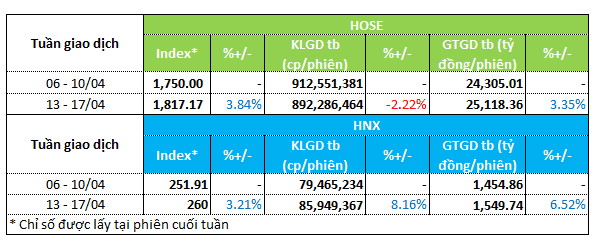
Liquidity improved modestly in the 13-17/04 trading week, but cash flow diverged across sectors. Real estate and steel were the two groups that attracted the most attention from investors, while financials and oil & gas saw weaker liquidity.
The market rose through the week. The VN-Index increased nearly 4% to 1,817 points, while the HNX-Index rose 3.2% to 260 points.
Liquidity improved on both listed exchanges. On HOSE, turnover rose more than 3% to 25.1 trillion dong per session, but trading volume fell 2% to 892 million shares per session. On HNX, both volume and turnover increased—by 8% and 6.5% respectively—to 86 million shares and 1.55 trillion dong per session.
Cash flow was concentrated in a few sectors, led by real estate. The Vingroup group was the standout magnet for funds during the week. VIC’s trading volume doubled versus the prior week to 5.7 million shares per session. VRE recorded a 90% increase in trading volume, while VHM rose 70%. Another Vingroup member, VPL, also attracted money with a 46% increase in trading volume.
Beyond Vingroup, liquidity also flowed into other real estate stocks including VPI, CRE, AAV, IDC, and CEO.
In addition to real estate, the steel stocks group recorded a week of money inflows. HSG, TLH, NKG, and VGS were among the tickers with top liquidity gains on both exchanges this week.
Conversely, the financial stocks group (banks and securities) did not attract favorable cash flow. Several securities names—TCX, TCI, FTS, VFS, MBS, and BVS—posted trading volume declines of 20-60% versus the prior week. Among banks, liquidity losers across both exchanges included KLB, LPB, TCB, and MBB.
Oil and gas stocks also saw notable outflows. ASP, PVS, PPT, PVC, and PLC were among the oil & gas representatives with the biggest liquidity losses this week.
Top 20 tickers with the biggest liquidity gains/losses on HOSE
Top 20 tickers with the biggest liquidity gains/losses on HNX
Note: The list of tickers with the biggest liquidity gains and losses is based on average daily trading volume above 100,000 shares per session.




Premium gym chains are entering a “golden era” that is ending or already in decline, as rising operating costs collide with shifting consumer preferences toward more flexible, community-based ways to exercise. Long-term memberships are shrinking, margins are pressured by higher rents and facility expenses, and competition from smaller, more personalized…