•
•
•
•
•
•
•
•
•
•
•
•
•
•
•
•
•
•
•
•
•
•
•
•
•
•
•
•
•
•
•
•
•


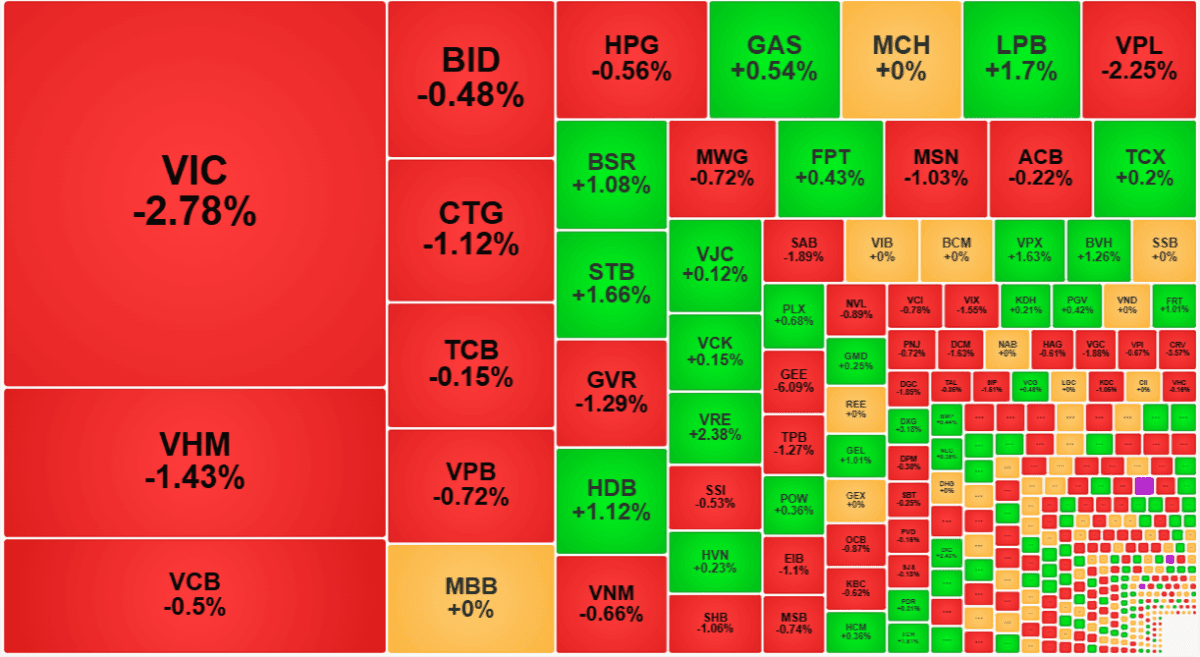
Although the breadth of the index wasn’t very weak this morning, the impact from blue-chip stocks weighed on the VN-Index, which fell sharply. The index dropped another 0.83% (−15.68 points), confirming that the attempt to break the previous high failed.
The market’s largest-cap group all closed in the red. At the morning close, the VN-Index eased to 1,879.82 points, as the number of blue-chip stocks falling was more than twice the number rising. Among the top 10 by market cap on HOSE, only GAS rose slightly (+0.54%) and MBB was flat; the rest declined.
The two biggest blue-chips, VIC and VHM, were key contributors: VIC fell 2.78% and VHM dropped 1.43%, together dragging the VN-Index by more than 12 points out of the total 15.68-point decline. In addition, five major banks—VCB, BID, CTG, TCB, and VPB—also declined, with CTG down 1.12%. Overall, the blue-chip group could not support the index, and leadership shifted toward mid-cap names.
Within the VN30 basket, there were only 8 gainers and 19 decliners. The few green names posted modest gains and were smaller in market cap. Standout gainers included VRE (+2.38%), LPB (+1.70%), STB (+1.66%), and HDB (+1.12%). However, even these advances were not enough to offset VIC’s decline.
The VN30-Index closed the morning session down 0.47% due to capitalization adjustments. Banking stocks in the basket helped paint a slightly better picture for the VN-Index.
Liquidity in the blue-chip group fell sharply by 19% versus yesterday morning, reaching the lowest level in 22 sessions. Even among the 10 most-active names, only 5 belonged to the VN30 basket. The weak money flow in blue chips suggests a pause in big-money activity.
For the broader market, lower liquidity appears to be a mild advantage. The VN-Index breadth was not too bad, with 123 advancers versus 162 decliners. Fifty-one green stocks rose more than 1%, though most trades remained relatively limited. The strongest group accounted for 22.2% of HOSE’s matched trades, concentrated mainly in the top 15 stocks—indicating that money clustered in a small number of names.
Blue-chips VRE, HDB, and STB were also among the higher-liquidity gainers. Some lower-liquidity stocks performed strongly as well, including DXS hitting the ceiling, CDC up 6.62%, HII up 6.18%, and HHP up 2.15%.
On the downside, the decline was still driven by weak demand. Sixty-five stocks fell more than 1% in the VN-Index, accounting for 28% of HOSE’s liquidity. Selling pressure did not widen: eight stocks traded above 100 billion, besides VIC and VHM, including VIX (−1.55%), MSN (−1.03%), SHB (−1.06%), CTG (−1.12%), GEE (−6.09%), and DGC (−1.85%).
The morning’s highlight was a notable 26% drop in liquidity across the two listed exchanges, with HOSE down 25%. The weak trading suggests that a downtrend in intensity is common. This also implies that a VN-Index rise may not be matched by commensurate investment activity, particularly when the index falls due to declines in large-cap stocks—conditions that do not encourage momentum trading.
Foreign investors also reduced activity in both directions. Net foreign flow on HOSE was around 583.8 billion dong, slightly lower than yesterday morning’s 720 billion. Notable net sellers included VHM (−117.3 billion), FPT (−83.5 billion), MSB (−60.4 billion), and VCB (−53.1 billion). On the buying side, net purchases included VRE (+87.3 billion), GEX (+31.9 billion), and VIC (+27.7 billion).
Premium gym chains are entering a “golden era” that is ending or already in decline, as rising operating costs collide with shifting consumer preferences toward more flexible, community-based ways to exercise. Long-term memberships are shrinking, margins are pressured by higher rents and facility expenses, and competition from smaller, more personalized…