•
•
•
•
•
•
•
•
•
•
•
•
•
•
•
•
•
•
•
•
•
•
•
•
•
•
•
•
•
•
•
•
•


Over-supply and export difficulties have pushed prices for watermelons and mandarins down to as low as 1,000–5,000 dong per kilogram, driving heavy losses for farmers.
In Gia Lai, watermelon prices are currently reported at 1,000–5,000 dong per kilogram. Wholesale buyers are selective, with higher prices only for batches that meet good quality standards.
Ms. Loan, a watermelon grower in Phú Túc commune, Gia Lai, said the investment cost for one sao is about 9 million dong. At harvest, she sold sheaves to traders for around 3 million dong per sao, implying a loss of about 7 million dong per sao. With an area of 8 sao, her family lost more than 50 million dong from this crop.
Nearby, the Phương family also reported severe losses. With nearly 8 hectares of watermelons, losses were approaching half a billion dong. They said that in previous years, watermelons after Tet fetched decent prices, but this year demand fell and exports to China were restricted, leading to sharp price declines.
According to the Gia Lai Department of Industry and Trade, the province has about 2,733 hectares of watermelons. So far, only about 10% has been harvested, producing around 12,000 tonnes. About 2,400 hectares remain to be harvested in March and April, accounting for nearly 90% of the crop.
Mandarins have similarly dropped in price. In Tra Con commune (Vĩnh Long), mandarins are sold in gardens for 1,000–3,000 dong per kilogram depending on variety. Farmers estimate annual losses of 100–200 million dong per hectare, given investment costs of 400–500 million dong per hectare.
Ms. Hai, who owns nearly one hectare of orange trees in Hiếu Thành, said high-quality mandarins sell at around 3,000 dong per kilogram, while poorer fruit fetches 1,500–2,000 dong. With production of about 9 tons per cong, her revenue is only about 27 million dong, still resulting in a loss. She said the decline has led her to consider switching crops.
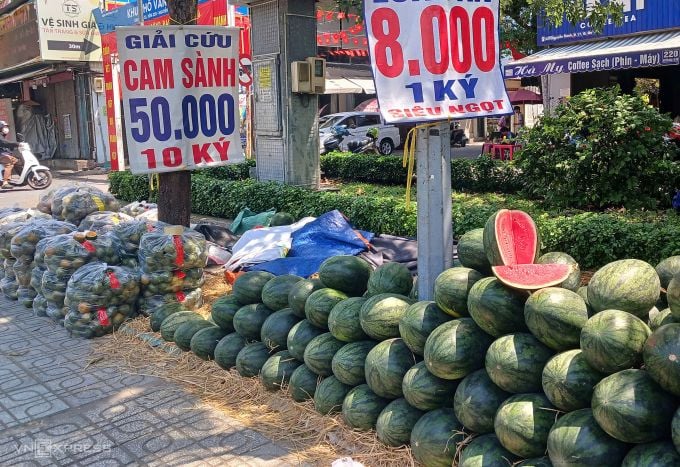
Price declines have pushed some traders to street stalls in Ho Chi Minh City, selling at lower prices. A survey of several streets showed mandarins around 5,000 dong per kilogram and watermelons around 8,000–10,000 dong per kilogram.
On Nguyen Oanh Street in Go Vap District, vendors posted banners for “rescue” sales, with boxes of mandarins and watermelons stacked high. Trader Hoa said post-Tet demand is weak and that, besides wholesale to intermediaries, retail is needed to clear stock quickly.
Vegetables also fell after Tet. In traditional markets in Ho Chi Minh City, tomatoes were 45,000–70,000 dong per kilogram before Tet, but are now 10,000–25,000 dong per kilogram depending on type. Green beans and okra fell by about half to 20,000–25,000 dong per kilogram, while many gourds and greens are commonly priced at 20,000–35,000 dong per kilogram.
Dang Phuc Nguyen, General Secretary of the Vietnam Vegetable and Fruit Association, said the declines reflect multiple factors.
According to the Bình Thuận Dragon Fruit Association, air freight costs rose from about 1.5 USD per kg to 4–5.5 USD, and have now reached 7–8 USD per kg. The high costs hinder shipments to Europe, leaving white-flesh dragon fruit exports at about 8,000–9,000 dong per kilogram and red-flesh at about 17,000–18,000 dong per kilogram.
Businesses said they are seeking new markets in Asia, such as Japan and Korea, but demand there cannot immediately offset declines in major markets.




Premium gym chains are entering a “golden era” that is ending or already in decline, as rising operating costs collide with shifting consumer preferences toward more flexible, community-based ways to exercise. Long-term memberships are shrinking, margins are pressured by higher rents and facility expenses, and competition from smaller, more personalized…