•
•
•
•
•
•
•
•
•
•
•
•
•
•
•
•
•
•
•
•
•
•
•
•
•
•
•
•
•
•
•
•
•


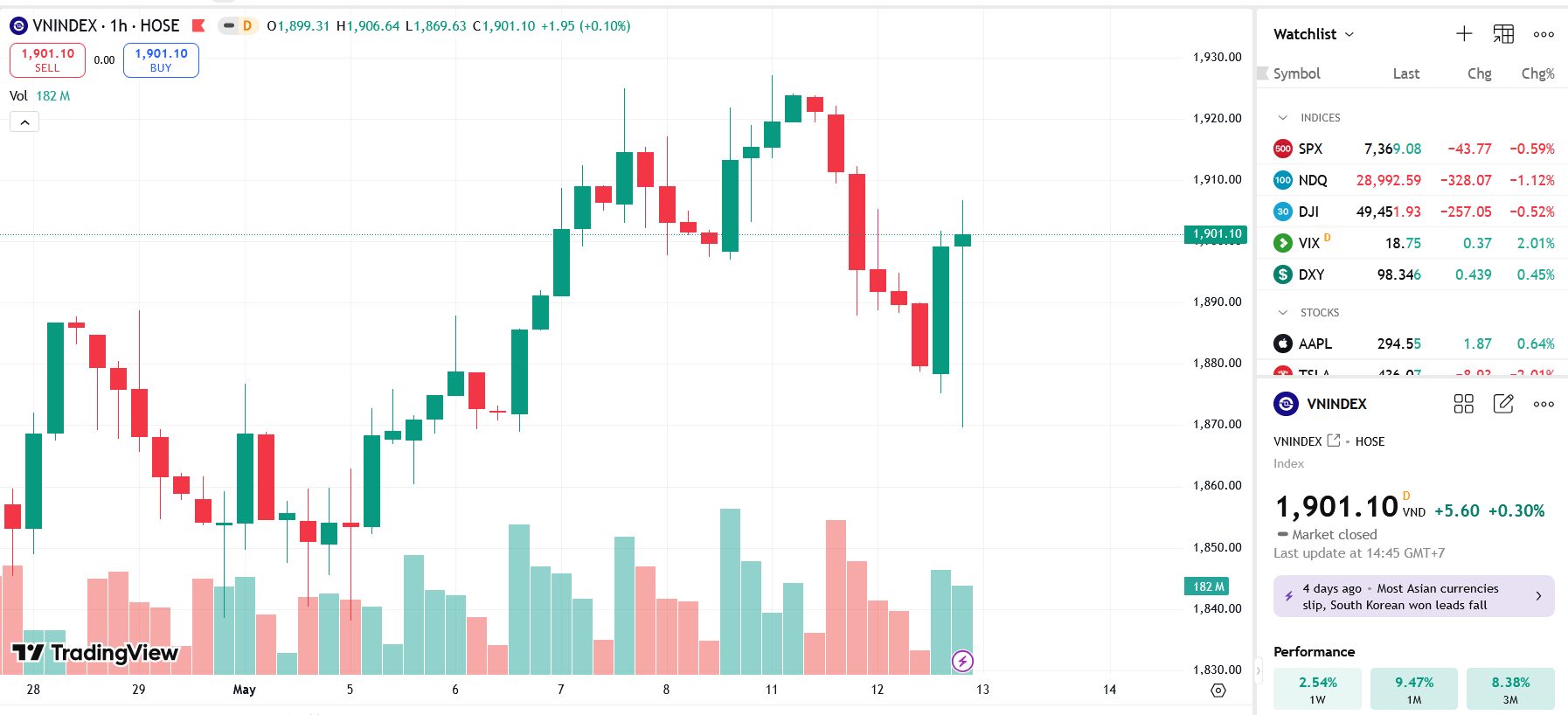
Market seeks a new balance Hà Anh May 12, 2026 According to BVSC, the market experienced a fairly volatile session with a clear differentiation across large-cap names and the rest of the market. At the close on May 12, the VN-Index rose 5.6 points, about 0.3% to 1,901.1. Similarly, the HNX-Index rose 5.22 points, about 2.1% to 253.28. VN-Index is entering a sideways phase to balance after the previous rally BVSC: VN-Index is entering a sideways phase to balance after the previous rally. The index may form a range around the old peak from 1,838-1,843 to 1,918-1,927. The performance of stock groups may not face broad selling pressure but will differentiate and rotate with gains in a market with a correction. Investors should maintain cash-to-stock ratios at a reasonable level. Rebalance short-term positions by partially taking profits. For trading purchases, investors still prefer T+ and can look to accumulate around support areas. Market is seeking a new balance BSC: VN-Index fell to around 1,875 before rebounding in the afternoon and closed at 1,901.10, up nearly 6 points from yesterday. Market breadth was fairly balanced with 12/18 sectors higher, led by Oil & Gas, followed by Insurance and Chemicals. On the foreign side, net selling occurred across HSX, HNX, and UPCOM. Money flow is mainly rotating across sectors to seek short-term profits; the trend is unclear. The market is seeking a new balance. VN-Index at risk of forming a short-term top at old January 2026 peak SHS: The VN-Index’s short-term trend remains up with support around 1,850, supported by rotation in the banking group. The strongest resistance around 1,920, corresponding to the January 2026 high and the high on May 11, 2026. For VN30, resistance near 2,080. Under the influence of VinGroup, the index’s rise/fall is affected. After a strong rally from around 1,600, the VN-Index is at risk of forming a short-term top at the old peak in January 2026. The market recovered under the influence of banks and energy stocks. This has led to many mid-cap blue chips resuming an uptrend. The total capitalization of 27 listed banks is about $111 billion, with fundamental valuations P/E 9.55, P/B 1.47. This is viewed as a reasonably justified valuation region for banks, lower than the market average. Other sectors also show attractive valuations with continuing earnings growth. Investors should maintain a balanced weight, evaluate, and consider accumulation opportunities in the best growth stocks across sectors. TVS maintains VN-Index target of 1940-1950 in the short term TVS: VN-Index rose 5.6 points (+0.3%), closing at 1,901.1. The index maintained a gain in the afternoon after a morning decline, driven mainly by the Banking group (STB, LPB, HDB) which pulled the index above the benchmark. Liquidity today declined with GTGD of 21,153 billion VND. With today’s favorable market conditions, they maintain the 1940-1950 near-term target. Positive factors may continue: (1) selling pressure in the VinGroup group has decreased and demand is returning, (2) the recovery of the Oil & Gas group after consolidation will support the index. Technically, VN-Index tested the MA10 and bounced, indicating the short-term uptrend remains. Investors are advised to maintain stock exposure at the current level and consider taking profits partially as the index moves toward the target region. Liquidity not improving, probability the index will not break above 1920-1926 resistance YSVN: The VN-Index rebounded after the prior session’s correction but liquidity did not improve. The price chart remains above the MA9 and the index could continue to rise in the coming sessions, but without liquidity improvement, it may not break above the upper resistance zone of 1920-1926. Short-term strategy: maintain current stock weights and buy lightly on corrections; consider portfolio restructuring as the index approaches 1926. Capital flow remains stable on the market VCBS: The VN-Index closed with a Hammer, helped by blue-chips in the afternoon. On the daily chart, RSI and MACD remain high and CMF turning up indicates money flow remains stable. The +DI and ADX remain around 25, suggesting the index will resume an uptrend after testing supply and demand. On the intraday chart, RSI trends up from a low area, +DI moves above 25 while -DI moves down, reinforcing a balanced move for the VN-Index in the 1880-1900 range. The market displays volatility and sector differentiation across large-cap and other stocks; investors are advised to seek stocks with signals attracting funds after testing support/resistance levels to consider increasing exposure or initiating new positions in the next sessions. Watch sectors including Banking, Logistics, and Oil & Gas/Phosphates. VN-Index recovers slightly at day’s end VCSC: Technically, VN-Index narrowed its loss after testing around 1870; this should serve as near-term support. Softer selling pressure allowed a late-day rise toward around 1930. VN-Index continues to hover around high levels SSI: The VN-Index continues to oscillate and trade around high prices, with a rebound from 1880-1890. The upper region is expected to provide support, enabling the index to sustain a positive trend with a chance to test the old peak at 1920. Market disclaimer: Market analysts’ assessments are for reference only. Banks may have conflicts of interest with investors. Mid-cap stocks up well, VN-Index shifts leadership? 15:25, 12/05/2026 Mid-cap stocks up, VN-Index shifts leadership? Efforts to recover late in the session were not enough to change the leadership of the largest-cap stocks. However, many mid-cap blue-chips and mid/small stocks rose, keeping the VN-Index in positive territory. Liquidity: 12:08, 12/05/2026 Liquidity remains thin; large-cap stocks continue to fall VN-Index loses the 1900 level, investors wary ahead of potential corrections 11/05/2026
Premium gym chains are entering a “golden era” that is ending or already in decline, as rising operating costs collide with shifting consumer preferences toward more flexible, community-based ways to exercise. Long-term memberships are shrinking, margins are pressured by higher rents and facility expenses, and competition from smaller, more personalized…